
Views: 0 Author: Site Editor Publish Time: 2026-08-05 Origin: Site
Selecting the right fastener dictates the structural integrity, project scale economics, and building code compliance of any industrial application. A single bad joint can compromise an entire build. We often view the standard common nail as the baseline for heavy-duty framing, crating, and structural joining. Its uniquely thick shank and high shear strength make it indispensable on tough jobs. Yet, specifying the wrong fastener invites catastrophic joint failure, severe material waste, and serious safety violations. You must evaluate load demands precisely to protect your project. This article provides a comprehensive technical evaluation framework. We will guide you through specifying the correct dimensions, identifying the appropriate protective coating, and understanding structural fastener varieties. You will learn how to optimize your builds and prevent costly rework. Choosing the correct fastener ensures your assemblies stand the test of time under heavy loads.
Defining success in an industrial fastening application requires three fundamental criteria. First, you need high withdrawal resistance to keep materials securely bound under tension. Second, you must achieve reliable shear capacity to withstand lateral forces. Finally, verifiable code compliance remains non-negotiable for structural safety. When building load-bearing walls or heavy industrial pallets, engineers rely on specific fastener profiles to meet these strict demands. A standard Common Nail routinely satisfies these critical success metrics.
The core characteristics of this fastener directly translate to reliable structural outcomes. We can break down its anatomy into three distinct functional features:
Industrial builders depend on these characteristics across several primary use cases. Structural wood framing represents the most frequent application. Contractors use them extensively to assemble 2x4 and 2x6 dimensional lumber for load-bearing walls. Heavy-duty crating and industrial packaging also demand high shear capacity. When shipping massive machinery, the crates must endure extreme lateral forces during transit. Temporary bracing and scaffolding represent another vital application. Workers need rigid, unyielding joints to guarantee human safety on active construction sites.
The construction industry relies on the "penny" system to classify fastener dimensions. Historically denoted by the letter "d", this standardized metric ranges from 2d up to 60d. Understanding this system is crucial for procurement. It dictates both the overall length and the corresponding gauge of the wire. As the penny size increases, the fastener grows longer and thicker proportionately. You must decode these sizes accurately to ensure structural joints perform as engineered.
Specifying the proper Length of common nail requires a simple mathematical rule of thumb. The fastener should penetrate the base material deeply enough to secure the joint. Generally, the length should be 2.5 to 3 times longer than the thickness of the top piece of material. If you attach a standard 1.5-inch thick 2x4 to another board, you need a 3.5-inch fastener. This specific dimension perfectly matches a 16d designation. Mapping Common nail sizes to their specific applications prevents structural weakness and minimizes dangerous blow-outs on the job site.
Gauge and diameter considerations matter just as much as length. The shank diameter scales predictably alongside the length. Specifying the exact wire gauge is necessary for calculating shear loads in engineering plans. A thicker shank displaces more wood fiber, creating a tighter frictional grip. It also physically resists the sliding forces across a structural joint better than a thinner wire. You must verify these exact gauge specifications against your local building codes.
| Penny Size (d) | Length (Inches) | Typical Gauge | Primary Industrial Application |
|---|---|---|---|
| 8d | 2.5" | 10.25 | Light framing, furring, and floor plates |
| 10d | 3.0" | 9 | Standard framing and heavy crating |
| 16d | 3.5" | 8 | Heavy-duty 2x4 and 2x6 structural framing |
| 20d | 4.0" | 6 | Timber joining and heavy scaffolding |
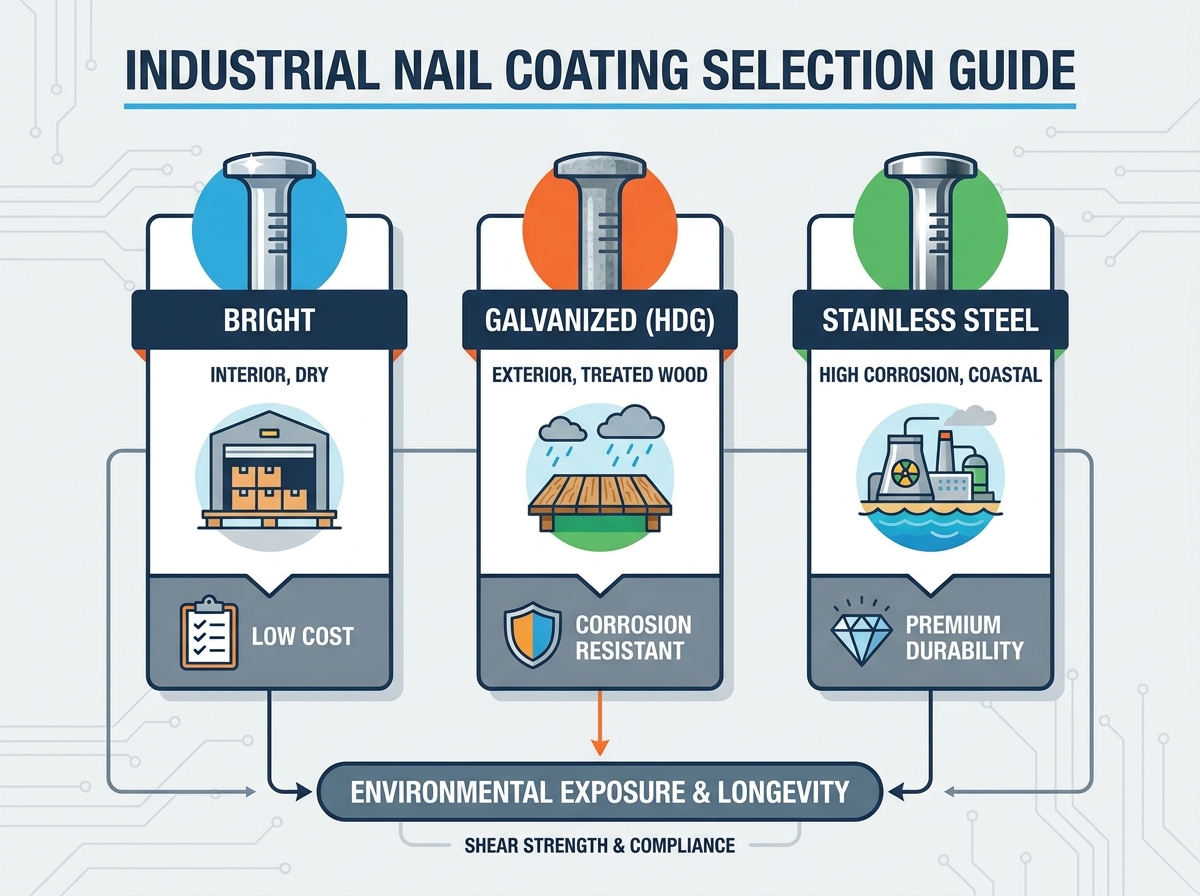
Choosing the correct physical dimensions only solves half the engineering puzzle. You must also select the right material and protective coating. Environmental moisture and chemical exposure dictate this choice entirely. If you ignore the environment, rapid corrosion will destroy the fastener long before the wood decays. We evaluate these coatings based on their resistance to rust, their cost-efficiency, and their compatibility with treated lumber.
Evaluating your specific job site climate is the only way to choose properly. Selecting a bright finish for an outdoor coastal deck guarantees joint failure within a few years. Conversely, specifying stainless steel for indoor dry pallets wastes valuable project capital. Match the coating to the specific environmental exposure to maximize structural lifespan.
Industrial builders frequently encounter situations where they must choose between different fastener profiles. Understanding the nuances of Common nails vs box nails heavily influences project success. The structural comparison ultimately comes down to shank thickness. A common nail utilizes a thick, heavy-gauge wire. It delivers exceptionally high shear strength. A box nail features a noticeably thinner shank. This thinner profile inherently offers lower shear strength, making it vulnerable to bending under heavy lateral loads.
The primary reason builders switch to a thinner profile involves the splitting trade-off. The thick shank of a heavy-duty fastener displaces significant wood volume. This intense displacement can easily split thin lumber or dense hardwoods, especially near the board edges. When assembling light crates or attaching fragile siding, industrial builders might downgrade to a box nail. A sinker nail offers a similar compromise. The thinner wire pierces the wood grain cleanly without acting like a splitting wedge.
Despite this convenience, you must respect strict building code realities. Box nails are undeniably easier to drive manually. They save energy and reduce arm fatigue during long shifts. However, building codes explicitly prohibit them in many load-bearing structural joints. The International Building Code (IBC) often mandates the thicker shank for critical framing connections. Engineers calculate sheer strength requirements based on the heavier gauge. Substituting a thinner fastener compromises the legal compliance and the physical safety of the entire structure.
Even perfectly specified fasteners can fail if crews install them incorrectly. Address the primary implementation risk immediately: wood splitting. Dense woods and edge joints are highly susceptible to cracking. You can deploy several mitigation tactics to protect your materials. Blunting the nail point is a traditional, highly effective trick. A sharp diamond point parts the wood fibers, acting as a wedge. A blunted point punches through the fibers, crushing them instead of wedging them apart. In extreme cases, pre-drilling pilot holes becomes necessary. You should also stagger your driving patterns. Placing multiple fasteners in the exact same grain line guarantees a split.
High-volume production environments demand careful evaluation of driving methods. You must choose between bulk loose hardware and collated strips. Manual driving from bulk boxes suits custom framing, repairs, and low-volume scaffolding. It keeps inventory costs low. However, pneumatic nailers dominate high-scale industrial manufacturing. Collated fasteners load into pneumatic guns, multiplying worker output exponentially. You must ensure your selected pneumatic tools are properly rated to drive thick, heavy-gauge structural shanks.
Compatibility with chemically treated wood presents another massive implementation risk. Modern pressure-treated lumber often utilizes Alkaline Copper Quaternary (ACQ) treatments. These heavy copper concentrations create a highly corrosive environment for standard steel. If you drive bright steel into ACQ lumber, galvanic corrosion begins immediately. The chemicals will dissolve the metal shank within months. You must enforce strict protocols to use only Hot-Dipped Galvanized or Stainless Steel in all treated wood applications.
Procuring the ideal fastener requires a systematic approach. You should define your application demands using a strict checklist before issuing a purchase order. First, calculate the structural load requirements. Determine if the joint faces extreme shear or withdrawal forces. Next, identify the specific wood type. Soft pine requires different holding characteristics than dense oak. Third, evaluate the environmental exposure accurately. Note any coastal salt spray, industrial chemicals, or simple weather exposure. Finally, estimate your project volume to determine if bulk manual or collated pneumatic options make sense.
Verification remains the most critical step before finalizing procurement. Ensure the selected fastener meets all local building codes. Consult the IBC or IRC standards for residential and commercial framing requirements. If you operate under custom engineering plans, verify the gauge and length against those specific documents. Never substitute a lighter gauge without explicit engineering approval. A simple procurement mistake can invalidate your insurance and violate building codes.
Strategic sourcing prevents production delays and quality control disasters. We recommend partnering directly with established industrial fastener suppliers. Look for vendors who can provide official mill certificates upon request. These documents prove the steel quality and coating thickness. Reliable suppliers also maintain deep bulk inventory to prevent stock-outs mid-project. Furthermore, they guarantee consistent collation quality. Cheaply collated strips frequently jam pneumatic guns, destroying your daily production quotas. Invest in quality suppliers to keep your operations running smoothly.
Specifying the exact right industrial fastener prevents catastrophic structural failure, avoids costly rework, and eliminates premature corrosion. A methodical approach to selection guarantees your assemblies meet rigorous safety standards. The common nail remains the undisputed baseline for heavy structural joints, provided you match its dimensions to your specific materials.
To summarize the evaluation funnel: always determine your required shear load first. Then, calculate the precise penny size and length necessary for adequate penetration. Next, select the proper environmental coating to defeat moisture and chemical corrosion. Finally, apply smart installation tactics to verify against wood splitting risks. By following these steps, you protect both your materials and your workforce.
Take action today to optimize your structural assemblies. Consult with a specialized sales engineer to review your blueprints. Request a comprehensive fastener sizing chart for your production floor. Browse trusted industrial hardware catalogs to secure the high-quality fasteners your projects demand.
A: The nail should penetrate the base material by at least 1.5 to 2 times the thickness of the top piece being fastened. For standard 1.5-inch thick framing lumber, a 3.5-inch (16d) fastener provides the ideal penetration depth for a secure, code-compliant hold.
A: Only if they are hot-dipped galvanized or stainless steel. Bright common nails will rapidly corrode in treated wood due to the high copper content in modern chemical treatments, leading to swift galvanic corrosion and total joint failure.
A: It is an historical industry standard that dictates not just the length, but the proportional gauge and thickness of the shank. Ordering by penny size ensures you receive a structurally balanced fastener engineered for specific load capacities, rather than just a random length of wire.
A: Yes, they are available in collated formats (paper, wire, or plastic) specifically manufactured for industrial pneumatic tools. However, you must verify your specific nail gun model is rated to drive the thicker shank diameter required by heavy structural applications.


