

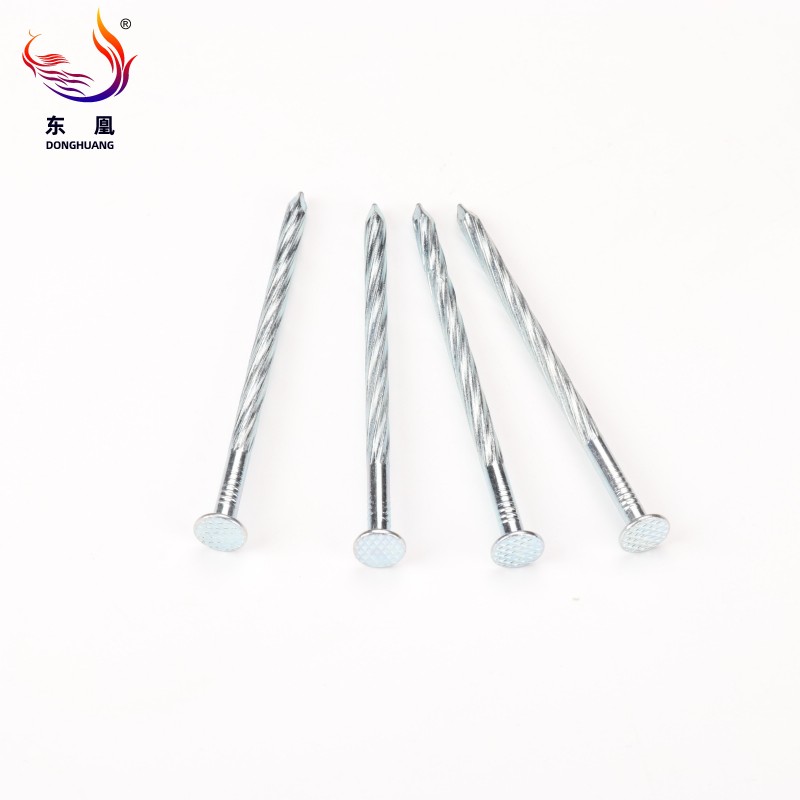


Spiral shank nails have a helical twist on the nail shaft, similar to a screw thread, that rotates as the nail is driven, creating a strong interlock with the wood and significantly increasing withdrawal resistance. These "screw shank" nails are excellent for dense or hardwood materials, as well as applications like decking, siding, and flooring, but can cause splitting in softwoods.


Carbon steel spiral shank nails represent a specialized category of construction fasteners, meticulously engineered with a continuous helical twist along the shaft. This distinct geometry mimics a screw thread, allowing the fastener to rotate naturally as it is driven into dense materials. The result is a powerful mechanical interlock with wood fibers that drastically increases withdrawal resistance compared to standard smooth alternatives. Manufactured from rigid carbon steel—with additional options in alloy or stainless steel—these fasteners deliver reliable performance when securing hardwood flooring, exterior decking, siding, and heavy-duty wooden pallets. Project managers and contractors rely on galvanized spiral nails and spiral shank concrete nails for environments facing constant moisture fluctuations, strong wind loads, or structural vibrations. The sharp, uniform twist not only provides exceptional grip but also creates a clean, flush finish on the material surface. By combining the rapid installation speed of a traditional nail with the superior holding power of a screw, these fasteners ensure long-term structural integrity for the most demanding construction and framing projects.
| Product name | Steel Smooth/Spiral Black/Galvanized Shank Concrete Nail/Masonry Nail/Steel Nail/Hardened Steel Flooring Nail |
| Standard | DIN & ANSI & JIS & IFI |
| Thread | unc,unf,metric thread |
| Material | carbon steel, alloy steel, stainless steel |
| Finish | Zinc Plated, HDG ,Black ,Bright,GOEMET |
| Packing | bulk in cartons (25kg Max.)+wood Pallet or according to customer special demand |
| Leading Time | 20-30 days or based on order required |
The defining visual and structural characteristic of these fasteners is their precision-forged helical spiral shank. Running continuously along the shaft, this sharp, uniform twist is engineered with an optimized shank diameter ratio. This specific geometry not only maximizes withdrawal resistance but also actively reduces the risk of material splitting when driven into high-density woods. The head is perfectly flat and textured to provide a secure strike zone for hammers or pneumatic tools, eliminating dangerous slippage during rapid installation. At the opposite end, the diamond-point tip is ground to a precise angle, allowing it to pierce tough fibers cleanly and initiate the twisting motion immediately upon impact.
Crafted primarily from hardened carbon steel, these fasteners offer the rigid tensile strength required for heavy structural loads. The surface finish plays a critical role in longevity, with options spanning bright, black oxide, GOEMET, and various zinc coatings. For exterior projects involving chemically treated lumber (such as ACQ-treated wood), the heavy-duty hot-dip galvanized (HDG) variant provides an essential barrier. This exceptionally thick zinc coating is specifically formulated to withstand the corrosive chemicals found in modern treated lumber, ensuring the fastener’s lifespan matches that of the wood itself. The tactile feel of the galvanized surface is slightly textured, a hallmark of the robust protective layer that shields the underlying steel from moisture, salt, and chemical degradation.
To accommodate diverse structural requirements, these fasteners are manufactured in a comprehensive array of dimensions, prominently featuring the widely utilized 4mm x 150mm specification. Compliance with global dimensional standards (DIN, ANSI, JIS, IFI) ensures seamless integration into international construction workflows. Beyond physical dimensions, we provide precise data on the nail count per pound or kilogram. This crucial metric empowers project estimators and regional distributors to accurately calculate material yields, control project budgets, and minimize on-site waste. Whether securing delicate hardwood flooring or assembling massive wooden pallets, the exact dimensional consistency across every batch guarantees predictable performance and cost efficiency.
The fundamental advantage of the spiral geometry is its ability to maximize surface area contact with surrounding wood fibers. As the fastener is driven, it rotates and carves a matching thread pattern into the material.
Natural wood is a dynamic material that constantly expands and contracts in response to ambient humidity and temperature shifts. Traditional fasteners frequently loosen under these conditions.
Driving fasteners into unyielding materials like oak, maple, or engineered lumber can be labor-intensive and often requires tedious pre-drilling. The twisting action generated by the spiral shank acts similarly to a drill bit.
Structural framing in regions prone to severe weather, high winds, or seismic activity demands fasteners that will not shear or bend under extreme lateral forces.
Achieving the secure, permanent hold of a threaded screw typically requires specialized driving tools and more time per fastening point. These helical nails perfectly bridge that gap.
Consistency and reliability are paramount in structural materials. Every batch of spiral shank nails is manufactured to meet or strictly exceed established global standards, including DIN, ANSI, JIS, and IFI specifications. This rigorous adherence ensures that our fasteners integrate flawlessly into diverse construction practices worldwide. During the manufacturing process, advanced optical and mechanical testing equipment is utilized to verify dimensional accuracy, thread pitch consistency, and core mechanical strength, guaranteeing that every single piece performs exactly as engineered.
The foundation of a superior fastener lies in its raw materials. We exclusively source high-grade carbon steel, alloy steel, and stainless steel from certified metallurgical suppliers. Before entering the production line, all raw wire rod undergoes stringent metallurgical analysis to detect any internal flaws or inconsistencies. This unwavering commitment to material excellence ensures that the finished product possesses the optimal balance of hardness and ductility, preventing brittle snapping during installation and guaranteeing long-lasting performance in the most demanding structural applications.
Our comprehensive quality control framework monitors every phase of production, from initial wire drawing and cold forging to spiral thread rolling and final surface coating. We conduct exhaustive laboratory tests for tensile strength, salt-spray corrosion resistance, and real-world withdrawal force. To completely eliminate quality concerns for volume buyers, we offer free physical samples for on-site driving and extraction testing. Furthermore, a robust quality traceability system is in place; every shipment is tracked, and we provide rapid-response technical support (including video and image feedback analysis) to ensure complete peace of mind for international procurement teams.
Recognizing the logistical complexities of global distribution, we provide highly flexible and secure packaging solutions. Options range from heavy-duty bulk cartons (up to 25kg) stacked on reinforced wooden pallets to fully customized, brand-specific retail boxes designed for OEM/ODM clients. Leveraging mature export capabilities and a massive manufacturing infrastructure, we maintain the capacity to fulfill large-scale and urgent orders with a dependable lead time of just 20 to 30 days. This streamlined production and logistics pipeline guarantees that critical construction materials arrive exactly when needed, keeping your project schedules firmly on track.
Absolutely. Carbon steel spiral shank nails deliver vastly superior holding power compared to traditional smooth-shank alternatives. The continuous helical thread carved into the nail shaft forces the fastener to rotate as it penetrates the wood. This twisting action creates a tight, friction-based mechanical interlock with the internal wood fibers. When subjected to pull-out forces, the trapped fibers resist the spiral grooves, making extraction exceptionally difficult. This enhanced withdrawal resistance is critical for structural applications like subflooring, decking, and pallet assembly, where preventing the fasteners from backing out under heavy loads or vibrations is essential for long-term safety.
Galvanized spiral nails are specifically engineered for exterior construction and any application exposed to high moisture levels or corrosive elements. The zinc coating—particularly the hot-dip galvanized (HDG) variant—creates a robust sacrificial barrier that protects the underlying carbon steel from rust and degradation. This makes them the premier choice for outdoor decking, exterior wood siding, fencing, roof framing, and the assembly of pallets used in maritime shipping. Additionally, the thick galvanized layer is highly recommended when working with chemically treated lumber, as it effectively resists the corrosive copper compounds often found in modern wood preservatives.
While the sharp point and optimized shank diameter of our spiral shank concrete nails are designed to minimize wood displacement, their aggressive twisting action can occasionally cause splitting in particularly dry or thin softwoods near the board edges. The rotational force exerts lateral pressure on the wood grain. To completely mitigate this risk when working with delicate softwood trim or near the ends of timber boards, we strongly advise pre-drilling a small pilot hole. This simple preparatory step relieves the internal stress on the wood fibers, allowing the spiral nail to secure the joint tightly without compromising the aesthetic or structural integrity of the lumber.
Because spiral shank flooring nails are specifically designed to resist withdrawal, removing them requires deliberate technique and substantial mechanical leverage. Standard claw hammers are often insufficient and may simply snap the nail head off. We recommend utilizing heavy-duty extraction tools such as a dedicated tack lifter, a slide hammer nail puller, or a long-handled pry bar. To avoid severe damage to the surrounding wood surface, it is crucial to place a protective shim or block beneath the fulcrum of your pry bar. Apply steady, gradual pressure to force the nail to un-twist as it backs out, rather than attempting to forcefully yank it straight up.


