
Views: 0 Author: Site Editor Publish Time: 2026-08-03 Origin: Site
For industrial procurement teams and commercial contractors, fastener selection directly impacts structural integrity, project compliance, and long-term liability. Fastener choice is never a minor detail. When crews use substandard products, buildings face severe risks. Structural frameworks can fail under load. Building inspectors will flag non-compliant joints. Project managers then face costly rework and delayed timelines.
To prevent these issues, you must understand the core materials driving commercial construction. We define the common nail as the absolute industry standard for heavy-duty framing. Crews rely on it for critical structural construction. It handles massive shear forces daily.
This guide provides a transparent, data-driven framework. We help you evaluate fastener specifications clearly. You will learn modern sizing conventions and material options. We outline strict compliance standards for commercial builds. Our insights guarantee accurate bulk procurement. You can confidently secure your next major project using these exact parameters.
Anatomy directly dictates physical performance. You must understand these defining characteristics. Fastener design determines how structures survive extreme stress. A Common Nail features three critical components. Each part serves a specific structural purpose.
The shank is the main body. Common fasteners feature an exceptionally thick shank. This thickness provides maximum holding power. Structural joints demand high shear resistance. Shear force tries to slice the fastener in half. A thick steel shank resists this lateral pressure easily. It keeps wall studs and floor joists securely locked together.
The head design matters immensely. This fastener uses a wide, flat head. It prevents pull-through under heavy loads. High winds create uplift forces. These forces try to pull wood pieces apart. The wide head anchors the top piece of lumber firmly. It also provides a reliable striking surface. Carpenters can drive it efficiently using manual hammers or pneumatic nailers.
The tip cuts through dense materials. Manufacturers use a standard diamond point. This sharp tip drives straight into dense lumber. It parts wood fibers quickly. However, it requires careful placement. You must evaluate grain patterns carefully. Careless driving often leads to wood splitting. We recommend analyzing wood density before finalizing your selection.
Using the correct anatomical profile prevents structural failure. It eliminates code violations in framing applications. Building codes demand specific fastener profiles. Procurement teams mitigate liability by matching these profiles correctly. Incorrect substitutions compromise entire framing assemblies. You protect your company by strictly enforcing these anatomical requirements on site.
The construction industry relies on a historical sizing system. We call this the penny system. You will see it denoted by the letter "d".
The "d" designation originated in England centuries ago. It originally represented the price for 100 nails. Today, its modern application standardizes procurement. Engineers write fastener schedules using this specific system. Procurement teams must translate these "d" numbers into physical dimensions accurately.
The system scales logically. The Length of common nail increases predictably alongside the penny size. A 2d fastener measures exactly 1 inch long. A 16d fastener measures exactly 3 ½ inches long. You must memorize these standard intervals. Precise length guarantees proper depth penetration. Building codes require fasteners to penetrate the receiving member sufficiently.
Standard Penny Size Conversion Chart
| Penny Size (d) | Length (Inches) | Standard Wire Gauge |
|---|---|---|
| 2d | 1" | 15 |
| 4d | 1 ½" | 12 ½ |
| 6d | 2" | 11 ½ |
| 8d | 2 ½" | 10 ¼ |
| 10d | 3" | 9 |
| 16d | 3 ½" | 8 |
| 20d | 4" | 6 |
Review standard Common nail sizes regularly. Teams use this data to calculate bulk orders.
Shank diameter must increase alongside length. We measure this thickness using wire gauge. A lower gauge number means a thicker steel wire. You need thicker wire for longer spans. This reinforces structural capacity for larger assemblies. A 16d fastener uses a thick 8-gauge wire. It easily penetrates two massive pieces of lumber without bending. Thin wires would buckle under the hammer force. They would also fail under building loads.
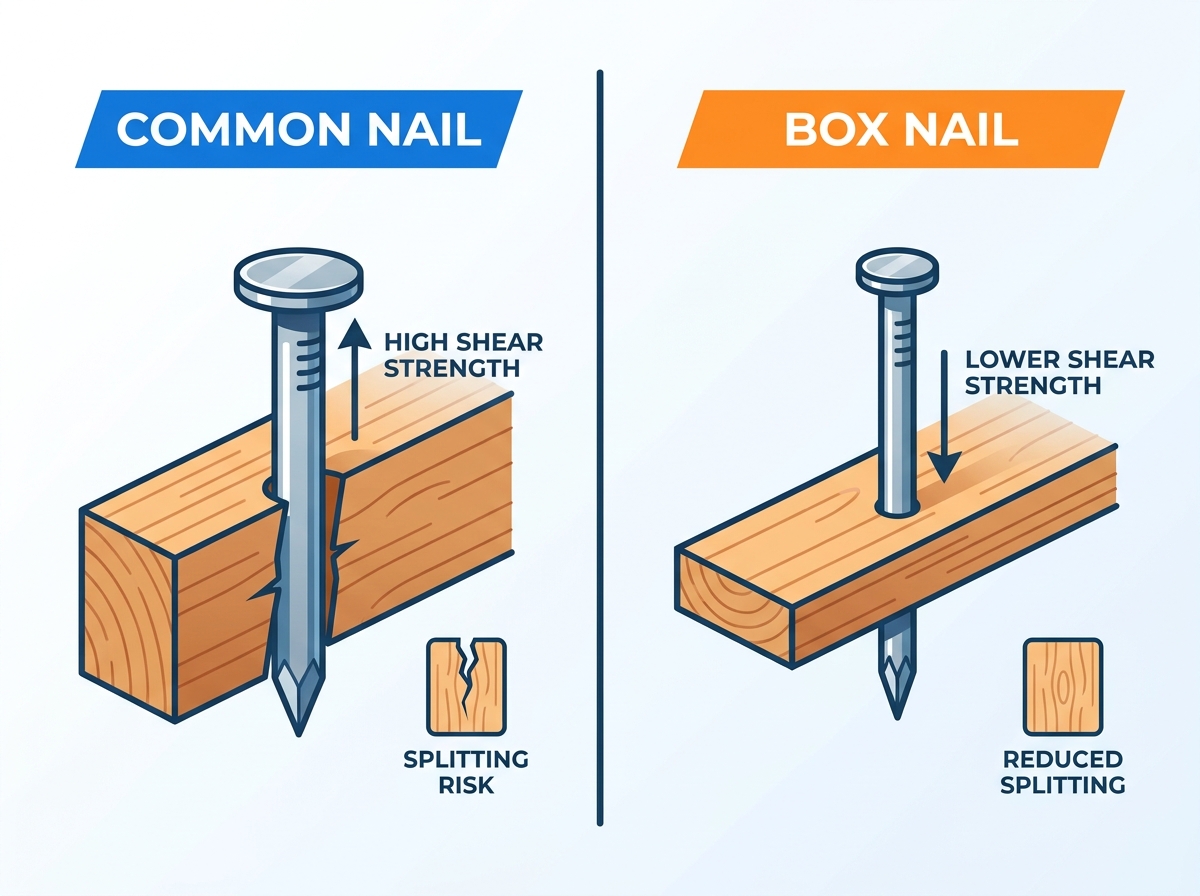
Contractors frequently debate fastener selection. You must understand the specific differences between similar products. Choosing incorrectly leads to wasted material.
You evaluate shank thickness first. Common fasteners use a heavy wire gauge. Box nails of the exact same penny size use a thinner gauge. For example, an 8d common uses a 10 ¼ gauge. An 8d box uses a thinner 11 ½ gauge. This fundamental difference dictates their respective applications.
Comparing Common nails vs box nails reveals distinct engineering trade-offs.
Use heavy-duty fasteners when structural integrity is paramount. They guarantee code-compliant load-bearing capacity. Inspectors look for them in wall framing. Use box variations when material preservation supersedes heavy load requirements. They prevent splitting in cedar siding. They save delicate trim from cracking. Match the fastener strength strictly to the structural demand.
Environmental exposure destroys unprotected steel. You must match the material finish to the project environment. Procurement teams evaluate three primary finish options.
Bright finish means uncoated steel. Manufacturers apply no protective layer. These are highly cost-effective options.
Use Case: They work perfectly for interior framing. Use them where moisture exposure is absolutely zero. They secure interior partition walls effectively.
Risk: They suffer rapid corrosion outdoors. Weather exposure rusts them immediately. Treated lumber contains chemicals. These chemicals dissolve bright steel very quickly. Never use bright finishes for exterior decks.
Manufacturers dip these in molten zinc. This creates a thick, bonded protective layer. It prevents rust formation entirely.
Use Case: You need HDG for all exterior projects. Modern ACQ-treated lumber requires them. The zinc coating resists the copper azole chemicals inside treated wood.
Evaluation: They are essential for compliance in outdoor structural builds. They represent a higher upfront unit cost. However, they prevent catastrophic deck collapses. Building codes mandate HDG fasteners for all exposed exterior framing.
Stainless steel offers the ultimate protection. Manufacturers use chromium alloys to prevent oxidation. Grades 304 and 316 are standard.
Use Case: High-salinity coastal environments demand them. Severe chemical environments also require stainless options. Coastal builders rely on them exclusively.
Evaluation: You get maximum corrosion resistance. They carry a very high unit cost. They are best for specialized industrial applications. Fastener failure in these zones carries extreme liability. Procurement teams justify the cost through risk mitigation.
Bulk procurement requires rigorous supplier evaluation. You cannot buy industrial fasteners based solely on price. Quality control failures lead to massive legal liabilities.
Always verify supplier inventory standards. Your products must strictly meet ASTM F1667. This is the Standard Specification for Driven Fasteners. It regulates carbon content, bend yield strength, and precise dimensions. Non-compliant products will snap under pressure. Request proof of ASTM compliance before issuing any purchase orders. We strongly advise auditing supplier certifications annually.
Assess bulk availability immediately. Commercial projects consume thousands of fasteners daily. Evaluate the supplier's packaging logistics.
Evaluate pricing based on "count per pound." Do not just look at the carton price. Yield determines your actual material efficiency. For example, 16d items yield roughly 47 units per pound. You calculate the total weight needed based on fastener schedules. If a roof requires 10,000 units, you need approximately 212 pounds. Compare yield rates across different suppliers. Thinner, non-compliant shanks might increase yield artificially. You must verify dimensions match the yield claim.
Take decisive action before signing contracts. Request Technical Data Sheets (TDS) immediately. Ask for recent mill test reports. These documents prove steel quality. They verify zinc coating thickness. You guarantee absolute transparency before finalizing high-volume POs. This rigorous process protects your project budget and structural integrity.
Accurate selection of fasteners requires careful evaluation. You must balance structural load requirements against material properties. Environmental exposure dictates your finish choices. Wood density determines your acceptable shank thickness. Making the wrong choice jeopardizes safety and compliance.
We recommend a systematic approach to procurement. Audit your project’s fastener schedule meticulously. Compare every requirement against standardized sizes and protective finishes. Verify ASTM compliance through rigorous supplier checks. Do this before issuing an RFQ to suppliers. By following this data-driven framework, you ensure resilient structures. You protect your teams, pass inspections easily, and deliver exceptional commercial builds.
A: Construction crews primarily use 16d (16-penny) fasteners. These measure exactly 3 ½ inches long. They serve as the undisputed industry standard for joining 2x4 lumber. This specific length provides optimal depth penetration. It secures wall studs to top plates efficiently. Building codes widely recognize this size for structural wall framing assemblies.
A: Only if they feature specific protective coatings. You must strictly use Hot-Dipped Galvanized (HDG) or Stainless Steel options. Bright uncoated fasteners will corrode rapidly. Modern pressure-treated lumber contains highly corrosive copper chemicals. These chemicals dissolve bare steel quickly. Using unprotected fasteners leads to structural failure and code violations.
A: You can blunt the tip slightly with a hammer before driving. A blunt tip crushes wood fibers instead of wedging them apart. Alternatively, pre-drill a pilot hole. Make it slightly smaller than the shank diameter. You can also evaluate box variations. They feature thinner shanks. See if they meet the load requirements for that specific joint.


