
Views: 0 Author: Site Editor Publish Time: 2026-08-12 Origin: Site
Building a sturdy structure requires more than just high-quality lumber. The actual strength of any timber frame relies heavily on the fasteners holding it together. Selecting the wrong framing fasteners risks catastrophic structural failure, failed municipal building inspections, and costly rework. Builders often get overwhelmed by marketing jargon and choose options based on availability alone. You simply cannot afford to guess when structural integrity and daily safety are on the line.
We will move past marketing claims to evaluate these essential fasteners based on strict structural requirements, tool compatibility, and environmental demands. This comprehensive guide breaks down the five critical specifications determining compliance, holding power, and on-site efficiency. You will learn exactly what parameters to verify before making your next bulk purchase. Our insights will help you avoid code violations and build stronger, longer-lasting structures.
The primary job of any fastener is penetrating the surface material and anchoring deeply into the substrate. Structural engineers call this concept embedment. Professional building codes generally mandate a minimum 1-½ inch embedment for secure structural framing. You must select your Framing nails size carefully to meet this strict requirement.
Industry standards rely heavily on the archaic "penny" system, denoted by the letter "d". The 16d (3-½ inch) fastener remains the gold standard for assembling 2x dimensional lumber. Driving a 16d through a standard 1.5-inch thick 2x4 leaves exactly 2 inches of embedment. This depth easily satisfies international building codes. Conversely, builders often utilize 10d to 12d (3 to 3-¼ inch) fasteners for specific shear wall paneling or toe-nailing applications. Using a full 16d in these scenarios risks blowing out the wood fibers.
Relying solely on the "penny" designation creates significant implementation risk. The market offers both "sinker" and "common" variations under the same penny size. A 16d sinker is noticeably shorter and thinner than a 16d common fastener. Building inspectors frequently fail structural connections framed entirely using sinkers instead of common dimensions. Always verify the exact inch measurement on the packaging.
Length ensures the fastener reaches the secondary board, but diameter dictates shear capacity. Shear capacity represents lateral strength. This is the primary force acting on wall frames, header joints, and joist hangers. High shear capacity prevents your walls from sliding or snapping under immense lateral pressure.
You must rigorously check the Framing nails specifications before loading your pneumatic tools. Fastener diameters fall into distinct categorizations based on their intended application.
Thick or "Common" fasteners feature .131" and .148" diameters. Most building codes explicitly require these thicker profiles for structural load-bearing walls. Thin or "Box" fasteners measure .113" and .120" in diameter. These thinner profiles slide effortlessly into nail guns and drive much faster. However, municipal inspectors routinely reject them for primary structural connections because they lack adequate shear strength.
Your primary decision rule must be cross-referencing local building code requirements before purchasing pallet quantities. Do not mistakenly assume "framing nailer compatible" means "code compliant." Manufacturers design tools to accept a wide range of gauges. The tool firing the fastener does not guarantee the resulting joint meets code.
| Nail Type | Wire Gauge (Inch) | Shear Strength Level | Code Compliance Context |
|---|---|---|---|
| Common (16d) | .162" | Maximum | Heavy structural, fully compliant |
| Standard Thick | .131" - .148" | High | Standard load-bearing walls |
| Box / Thin | .113" - .120" | Low to Medium | Non-structural, frequently rejected |
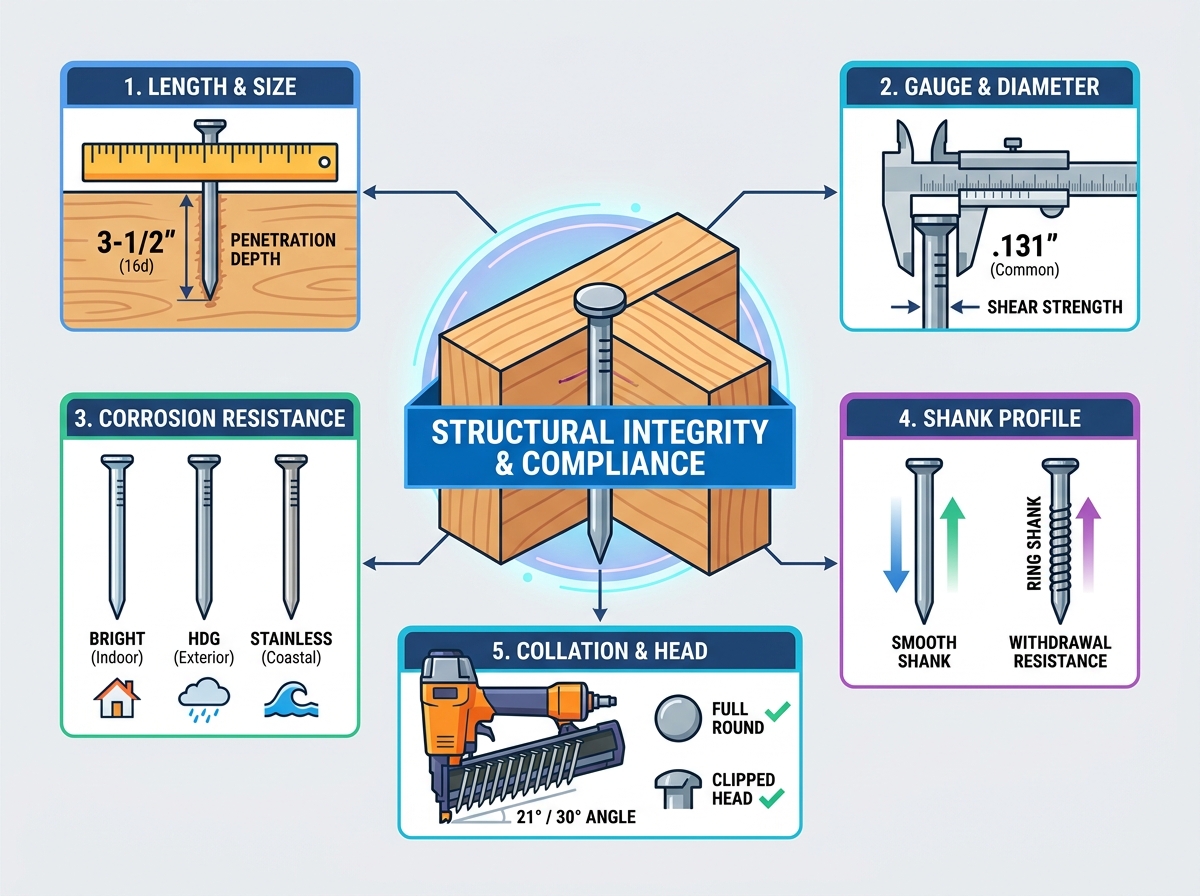
Selecting the correct physical dimensions only solves half the structural puzzle. You must also match the fastener alloy and chemical coating to the specific moisture exposure. Modern construction utilizes highly corrosive treatments in outdoor lumber. Using the wrong metal alloy guarantees structural failure within a few short years.
Manufacturers provide four primary solution approaches for varying environmental exposures. Bright (uncoated) fasteners represent the lowest upfront cost. These are strictly for interior, climate-controlled environments. They must never touch concrete or exterior weather. Electro-Galvanized (EG) options offer a very thin zinc layer. This provides minimal protection. You should consider them entirely unsuitable for exterior structural use.
Hot-Dipped Galvanized (HDG) fasteners feature a thick, rugged zinc coating. This represents the absolute baseline requirement for exterior construction. You must use HDG when securing ACQ pressure-treated lumber. The high copper content in modern pressure treatments rapidly eats away unprotected steel. Stainless Steel (304/316) provides maximum protection at the highest price point. Stainless is strictly mandatory for coastal environments. We also require it for cedar or redwood installations to prevent dark tannin staining.
Attempting to cut corners by buying bright framing nails for exterior jobs creates massive liability. The steel will rust out rapidly. This oversight heavily compromises structural integrity within three to five years, leading to dangerous collapses.
While shear capacity handles side-to-side forces, withdrawal resistance dictates how well a fastener stays embedded. Withdrawal resistance measures the ability to resist being pulled straight out of the lumber. You evaluate shank profiles by balancing this holding power against driving speed.
We classify shank profiles into two distinct solution categories. Smooth shank fasteners provide maximum shear strength because they retain their full wire diameter. They also offer the fastest driving speeds. A smooth profile remains entirely sufficient for standard interior walls under normal vertical loads.
Ring shank or annular thread fasteners feature aggressive ridges along the metal body. As you drive them into the lumber, wood fibers forcibly lock into these structural rings. This mechanical bonding offers up to 40% higher withdrawal resistance compared to smooth alternatives. They act much like screws once embedded.
You must carefully consider the implementation risks. Ring shanks are notoriously difficult to remove if your crew makes a mistake. Extracting them usually destroys the surrounding wood. Therefore, reserve ring profiles for specific applications. They perform perfectly for subfloors, roof decking, and high-wind or hurricane zone construction where severe uplift forces threaten the structure.
Your choice of fastener heavily dictates your daily workflow and tool compatibility. High-volume construction demands collated strips for pneumatic or cordless tools. Low-volume or specialized tasks might rely entirely on traditional hand-driving techniques.
Pneumatic and cordless guns require perfectly matched collation angles. Manufacturers utilize plastic, wire, or paper tape to bind strips together. The magazine angle of your specific tool dictates your purchase. You must precisely match the 21° plastic, 28° wire, or 30-34° paper tape format. Forcing incorrect angles causes dangerous tool jams and internal damage.
Manual application requires a completely different approach. When buying Framing nails for hammer use, always purchase bulk, loose packages. Collated strips feature structurally identical fasteners, but they are frustrating to hand-drive. Striking collated strips shatters the plastic or wire binding. This debris flies unpredictably, creating severe eye hazards and slowing down your crew.
Head type compliance also impacts your purchasing logic. Full round heads remain universally accepted by all building codes. Inspectors strictly require them in hurricane and seismic zones to prevent pull-through under extreme stress. Clipped or offset heads allow tighter collation, meaning more fasteners fit per strip. This increases tool capacity. However, historically, many jurisdictions banned clipped heads. Many modern codes now accept them if the shank diameter meets minimum standards.
You should follow a strict shortlisting logic. Check your local building code for head type restrictions first. Only after confirming compliance should you invest heavily in a specific angle of nail gun platform.
Sourcing these critical fasteners is a vital structural engineering decision, not just a routine procurement checklist. The stability of your walls, floors, and roofs depends entirely on the precise specifications of your hardware. Making uneducated substitutions compromises safety and invites regulatory fines.
Take immediate action on your upcoming project by auditing your environmental exposure. Determine if your materials require hot-dipped galvanized or stainless steel protection. Next, consult your local municipal building code for mandatory minimum gauge and length requirements. Finally, select the specific shank profile and collation angle matching your crew's existing pneumatic platforms. Following these steps guarantees a secure, compliant, and highly efficient build.
A: Standard framing for 2x4s typically requires 16d (3-½ inch) or 10d (3 inch) common nails, depending on whether you are face-nailing or toe-nailing.
A: While possible in a pinch, it is highly discouraged. The plastic, wire, or paper collation material splinters when struck by a hammer, posing a safety hazard and slowing down workflow. Buy loose bulk nails for hand driving.
A: The "penny" (d) system is an archaic measurement of nail size, while inches and gauge (e.g., .131") provide the exact dimensional specifications required by modern structural engineers and building inspectors.
A: No. Bright (uncoated) steel nails are standard and structurally sound for dry, interior framing. Galvanized nails are only required when the wood is pressure-treated or exposed to weather.


