
Views: 0 Author: Site Editor Publish Time: 2026-07-24 Origin: Site
Fastener failure in masonry carries severe business risks. A blown-out connection can trigger massive structural liabilities. You face costly project rework and potential safety compliance violations on the job site. Traditional fasteners thread perfectly into yielding materials like wood or metal. They rely on the substrate compressing around the thread. However, non-yielding, brittle materials like concrete and brick behave differently. They require specialized holding mechanisms to prevent immediate pull-out or substrate shattering.
This guide provides a comprehensive technical evaluation framework. We help you select the exact right fastener based on specific load demands, base material conditions, and harsh environmental factors. You will learn to mitigate risk and ensure total project compliance from start to finish. By understanding the physics behind these connections, you eliminate guesswork. Your installations will remain permanently secure under maximum stress.
Wood and sheet metal possess natural elasticity. When you drive a screw into wood, the material fibers part. They then compress tightly against the screw threads. Concrete completely lacks this elasticity. It is incredibly strong under compression but surprisingly weak under tension. When a standard screw attempts to cut into masonry, it shreds the brittle material. The concrete instantly turns to dust. This destroys any potential holding friction.
You cannot force standard fasteners into masonry. They require a yielding environment to function. Concrete simply does not yield. If you try to force a wood screw into a pre-drilled concrete hole, it strips the cavity immediately. The threads have nothing solid to grab. To achieve true holding power in masonry, you need specialized mechanisms. You must rely on friction, keying, or bonding. These mechanical principles form the foundation of every successful masonry fastening application.
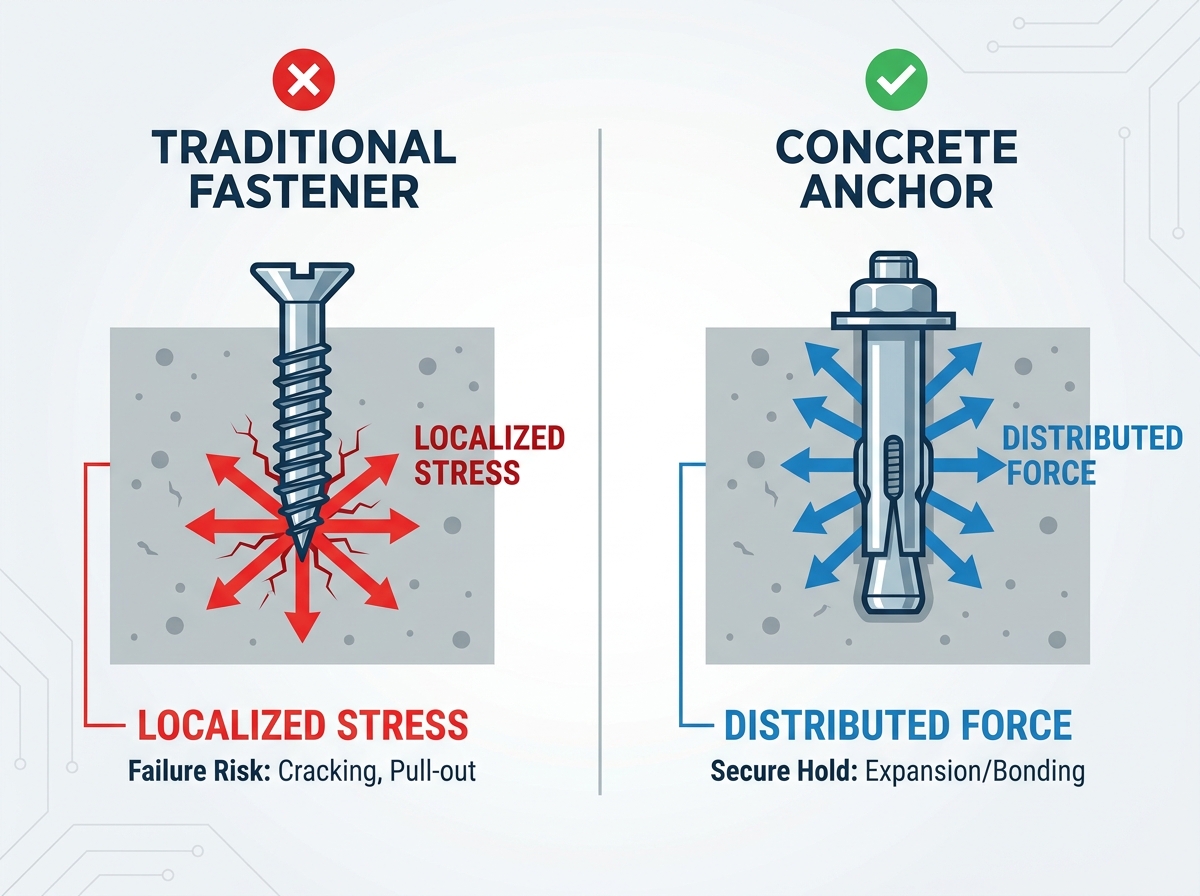
Standard fasteners create highly localized stress points. All the pressure focuses on the tiny edges of the threads. Concrete crumbles under this microscopic, intense pressure. A proper Concrete Anchor works entirely differently. It distributes force evenly across a much larger surface area. Mechanical anchors push outward against the walls of the hole. This expansion friction disperses the load safely. Chemical anchors bond the entire embedded length of the rod to the substrate. This eliminates point-stress entirely.
Using the wrong fastener leads to catastrophic failures. Dynamic loads easily shear the heads off improper screws. Concrete spalling occurs when expansive forces crack the surrounding substrate. We frequently see real-world failures resulting from misapplication. Heavy HVAC units detach from ceilings. Industrial shelving collapses under normal weight. Structural steel pulls away from foundations. These failures ruin expensive equipment. They also severely endanger lives and invite massive legal liabilities. You must prioritize proper specification to avoid these outcomes.
Navigating the market requires understanding the core taxonomy of available solutions. We categorize these fasteners by their underlying holding mechanics. Understanding the different Types of concrete anchors ensures you match the hardware directly to your project needs.
Mechanism: These rely on specialized thread-tapping. They feature a hardened high-low thread design. You drive them directly into precisely pre-drilled holes. The threads cut shallow grooves into the concrete walls.
Best for: You should use Concrete anchor screws for light-to-medium loads. They work perfectly for temporary installations. Because they do not exert outward expansion pressure, they excel in edge-close applications. You can place them near the edge of a slab without cracking it. They securely fasten electrical boxes, furring strips, and window frames.
Mechanism: These utilize mechanical friction expansion. You insert the anchor into a drilled hole. As you tighten the nut, it pulls a tapered cone upward. This cone forces a metal clip or sleeve to expand outward. The clip bites aggressively into the concrete walls.
Best for: These meet stringent Heavy duty concrete anchors requirements. They handle permanent static loads exceptionally well. We recommend them for structural steel connections and heavy machinery mounting. Wedge anchors provide the highest holding values in solid concrete. Sleeve anchors perform slightly better in softer or hollow base materials.
Mechanism: These feature an internally threaded, female body. You drop the anchor into a pre-drilled hole. You then insert a specialized setting tool. Striking the tool with a hammer drives an internal plug downward. This action forces the bottom of the anchor to expand.
Best for: We strongly advise using Drop-in concrete anchors for overhead installations. They sit flush with the concrete surface. This makes them ideal for flush-mount requirements. Plumbers and electricians rely on them constantly. They easily accept threaded rods for suspending HVAC ductwork, cable trays, and water pipes.
Mechanism: This system uses a two-part epoxy or hybrid resin. You inject the chemical into the hole. You then insert a threaded rod. The chemical cures and bonds the rod directly to the concrete. It essentially turns the fastener and substrate into one solid piece.
Best for: Chemical anchors dominate cracked concrete applications. They handle dynamic and vibratory loads without loosening. Since they create zero mechanical expansion stress, you can install them very close to concrete edges. They offer unparalleled strength but require strict adherence to curing times and temperature limits.
Choosing the right fastener is an engineering decision. You must utilize an evidence-oriented approach. Guesswork leads to structural failure. We use a proven framework to help you shortlist the perfect solution for your specific application.
You must understand the forces acting on your connection. Loads break down into two primary directions. Tension forces pull the anchor straight out of the hole. Gravity constantly applies tension to overhead fixtures. Shear forces push downward or laterally against the side of the fastener. A ledger board attached to a wall experiences intense shear force. You must calculate both vectors. Ensure your chosen hardware exceeds the maximum expected load in both directions.
The substrate dictates your options. Solid concrete handles maximum mechanical expansion. Hollow concrete block (CMU) breaks easily under wedge anchor expansion. You should use sleeve anchors or toggle bolts for hollow block. Brick crumbles under aggressive pressure. Furthermore, you must evaluate the concrete itself. Is it cracked or uncracked? Always verify ICC-ES approvals. These building codes dictate which fasteners perform safely in tension zones where concrete cracking commonly occurs.
Every job has unique requirements. You must tailor your choice accordingly.
Buyers constantly face a dilemma. Should they use a masonry screw or a wedge anchor? Both serve distinct purposes. Understanding their specific strengths helps you optimize both installation speed and structural integrity.
Screws install much faster. You drill the hole and drive the screw. The process takes seconds. Wedge anchors require more effort. You drill the hole, clear it, hammer the anchor in, and apply precise torque. If labor speed is your primary concern, screws win easily.
Screws provide reliable medium-duty performance. They handle shear loads surprisingly well. However, wedge anchors offer vastly superior heavy-duty tension resistance. Mechanical expansion provides a grip that thread-tapping simply cannot match. If life safety or heavy static loads are involved, you must choose the wedge style.
You can easily back screws out of a hole. This makes them perfect for temporary racking or formwork. Wedge anchors are permanent fixtures. Once expanded, they do not come out. If you abandon a wedge connection, you must cut the exposed threads off with an angle grinder. Alternatively, you can drive it completely flush into the hole.
| Application Requirement | Recommended Solution | Primary Reason |
|---|---|---|
| Temporary Installation | Concrete Anchor Screws | Easily removable without cutting. |
| Heavy Structural Steel | Wedge Anchors | Maximum tension and shear resistance. |
| Edge-Close Placement | Concrete Anchor Screws | Zero expansion stress prevents spalling. |
| Maximum Installation Speed | Concrete Anchor Screws | Fewer installation steps required. |
| Overhead Suspension | Drop-in / Wedge Anchors | Reliable long-term tension hold. |
Even the strongest fastener fails if installed incorrectly. Installation precision is as critical as the hardware itself. We regularly inspect failed connections. Almost all failures stem from poor installation practices rather than defective hardware.
Concrete dust is your biggest enemy. When you drill a hole, the bit leaves pulverized dust behind. Failing to blow out this concrete dust destroys holding capacity. It can reduce strength by up to 50%. The dust occupies critical space inside the hole. It prevents mechanical expansion clips from biting into solid walls. It completely ruins the chemical bond for adhesive applications. You must use a wire brush and compressed air. Follow the "blow, brush, blow" method for every single hole.
Torque determines mechanical success. Many installers use impact wrenches blindly. This causes severe over-torquing. Spinning an anchor in the hole destroys all friction. The concrete walls strip out completely. The hardware becomes useless. Conversely, under-torquing fails to expand the clip fully. The load will eventually pull it loose. You must use a calibrated torque wrench. Always follow the manufacturer's specific torque requirements.
Concrete cracks under pressure. We call this spalling. When you tighten a mechanical fastener, it exerts outward pressure. It creates a "cone of influence" inside the concrete. If you place it too close to an edge, that pressure blows the concrete out. If you place multiple anchors too close together, their stress cones overlap. This overlapping stress cracks the substrate. As a general rule, maintain a spacing of at least ten anchor diameters between holes. Maintain an edge distance of at least five diameters. Always consult specific technical data sheets for precise minimums.
Traditional fasteners have absolutely no place in masonry or concrete applications. Attempting to use them risks catastrophic failure, severe liability, and compromised safety. The correct choice depends entirely on evaluating your specific load vectors, understanding your base material, and planning for permanence.
Your next steps require precise calculation. First, calculate the exact tension and shear loads your project demands. Second, inspect your concrete for hollow zones or cracking. Finally, always check local building codes and verify ICC-ES approvals before you start drilling.
Do not leave your next structural installation to chance. Browse our specific product categories to find the exact hardware for your application. View our comprehensive technical data sheets for precise load capacities. If you have unique requirements, contact our technical sales team for custom project specifications today.
A: Wedge anchors typically work best for framing. They provide immense holding power for sill plates. They handle the sheer forces of a structure effectively. Always check local building codes for specific ICC-ES requirements regarding embedment depth and diameter.
A: You can use them for very light-duty tasks like hanging small pictures. However, they lack structural integrity. Never use plastic plugs for heavy or overhead loads due to severe shear and tension failure risks.
A: Load capacity ratings define heavy-duty status. They utilize aggressive mechanical expansion or strong chemical adhesives. These mechanisms resist high tension and shear forces found in structural steel or heavy machinery installations.
A: Technically yes, but experts strongly advise against it. The threads wear down during the initial concrete tapping process. Reusing them severely compromises holding power. If you must reinstall, always drill a fresh hole.


