
Views: 0 Author: Site Editor Publish Time: 2026-08-02 Origin: Site
Framing a new structure or attaching exterior siding demands absolute precision. You need reliable fasteners engineered to endure extreme stress over decades. Fasteners must never fail under heavy structural loads. They must also never destroy your expensive lumber during installation. Common nails and box nails look nearly identical to an untrained eye. However, choosing the wrong option carries significant daily risk on job sites.
A simple mistake often leads to severe structural code violations via weak joints. Conversely, it can cause frustrating material waste from severely split wood. This guide breaks down the core engineering differences, sizing standards, and project-specific use cases. You will learn how to evaluate each fastener effectively. We provide the exact technical details you need. You can then confidently select the perfect fastener meeting your project's strict structural and aesthetic requirements.
The construction industry universally recognizes this fastener as the ultimate standard for heavy-duty work. You will find a Common Nail on nearly every framing site worldwide. Builders rely on them heavily for load-bearing applications. They provide the necessary brute strength for erecting skeletal wall frameworks.
Manufacturers engineer these fasteners specifically for structural integrity. They prioritize strength over delicate aesthetics. You can easily identify them by checking three distinct physical characteristics.
The hardware industry measures fastener length using the historic "penny" system. We denote this system using the lowercase letter "d". The standard Length of common nail variations span a wide and versatile range. A small 2d fastener measures exactly one inch. A massive 60d fastener stretches to exactly six inches.
Contractors need a reliable reference for inventory. The chart below outlines standard Common nail sizes mapped to their exact physical length and wire gauge.
Standard Fastener Sizing Reference Chart
| Penny Size (d) | Length (Inches) | Standard Wire Gauge |
|---|---|---|
| 2d | 1.0" | 15 |
| 4d | 1.5" | 12.5 |
| 6d | 2.0" | 11.5 |
| 8d | 2.5" | 10.25 |
| 10d | 3.0" | 9 |
| 16d | 3.5" | 8 |
These fasteners deliver exceptional shear strength. They easily resist immense lateral forces pushing across building frames. They also provide incredible resistance to pull-out forces. Engineers call this withdrawal capacity. The thick shank creates a massive surface area. Surrounding wood fibers grip this wide area tightly. This friction locks the joint firmly in place over decades.
Their greatest strength also creates their biggest weakness. The thick shank acts exactly like a steel wedge. You drive it into lumber. It displaces a massive volume of wood fiber. Driving it near the end of a board creates severe tension. Thin or brittle wood often cracks under this intense pressure. You must avoid using them on delicate trim pieces.
This fastener serves as a specialized, lighter-duty alternative. Historically, factory workers designed them for assembling wooden boxes. They needed to build shipping crates efficiently. The thin crate slats split far too easily under standard framing fasteners. Today, we use them primarily for exterior residential cladding. They perform beautifully on light trim installations.
They share a similar visual profile to standard framing fasteners. However, their internal engineering differs significantly to protect fragile materials.
The remarkably thinner shank displaces much less wood fiber. It easily slides between dense wood grains. This drastically reduces your risk of splitting delicate materials. You can safely fasten 1/2-inch or 3/4-inch boards. Cedar siding shingles respond perfectly to this gentle penetration. You save substantial time and lumber costs. Your finished project looks clean and professional.
You sacrifice raw power for finesse. They suffer from significantly lower shear capacity. They bend much easier under a heavy hammer strike. You cannot use them to support heavy structural loads. They will fail catastrophically in framing joints. Building inspectors will issue severe citations if they find them in load-bearing walls. They completely lack the structural rigidity required for safe framing.
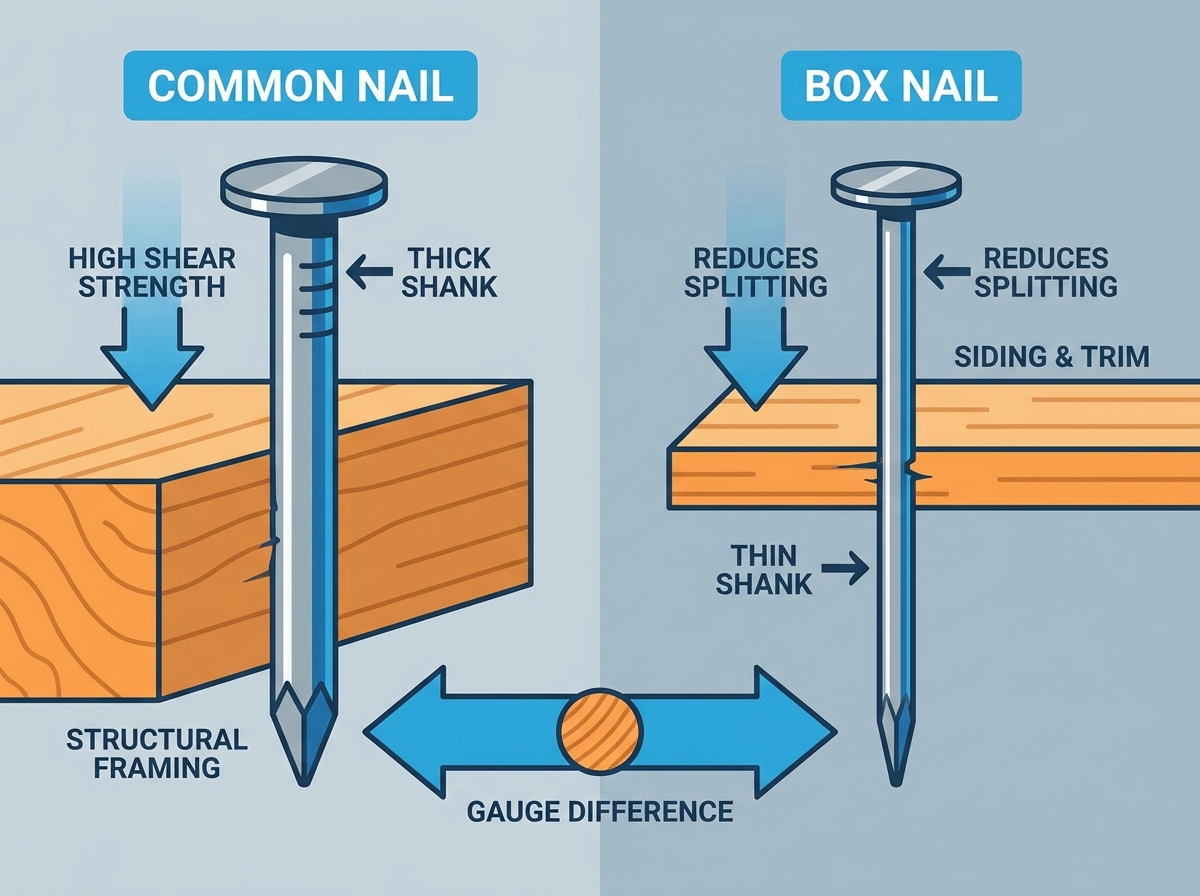
How do you choose between these two distinct options? A direct Common nails vs box nails comparison reveals their true engineering purposes. We evaluate their performance across four critical construction dimensions. This rigorous evaluation ensures you apply the correct tool for your specific application.
Shear strength measures how fasteners react to perpendicular forces. Gravity constantly pulls down on floor joists. Wind aggressively pushes sideways against exterior walls. This creates immense lateral shear stress on every joint. Structural framing requires maximum shear resistance. Building inspectors rigorously check load-bearing studs and rafters. They strictly require thick-shank framing fasteners. Lighter alternatives simply snap under these heavy lateral loads. They cannot guarantee building safety.
Pull-out resistance dictates a joint's holding power over time. Lumber naturally expands and contracts through seasonal moisture changes. This constant movement slowly pushes weak fasteners out of the wood. The thick shank provides significantly more surface area. Crushed wood fibers grip this massive surface tightly. This superior friction resists seasonal lumber movement. It holds structural joints together perfectly.
Wood splitting ruins projects instantly. Thin siding boards require a very delicate touch. You often need to fasten material dangerously close to the board edge. The lighter fastener proves its absolute superiority here. Its slender profile pushes through the grain gently. It avoids acting like a destructive wedge. It completely prevents catastrophic splitting in fragile materials.
Both fastener styles offer galvanized variants for rust protection. However, contractors use the lighter fasteners much more frequently outdoors. Siding and exterior trim demand extreme, long-term rust resistance. Manufacturers dip them in hot zinc for maximum protection. Conversely, framing fasteners primarily live permanently indoors. Wall framing stays dry forever behind protective drywall. Therefore, cheap uncoated bright versions remain incredibly popular for structural framing.
Fastener Performance Comparison Table
| Evaluation Dimension | Thick Shank Fastener | Thin Shank Fastener |
|---|---|---|
| Shear Strength Capacity | Exceptionally High | Significantly Lower |
| Pull-Out Resistance | Maximum Hold | Moderate Hold |
| Wood Splitting Risk | High (Needs caution) | Extremely Low |
| Primary Environment | Dry Interior Framing | Wet Exterior Cladding |
Theoretical knowledge only matters if you apply it correctly. You need a practical framework for your daily job site decisions. Use this logic to shortcut your selection process. We break down the ideal projects for each fastener style.
These are your undisputed heavy lifters. You bring them out for foundational work.
These are your precision instruments. You rely on them for aesthetic finishing work.
Even the correct fastener fails if you install it poorly. Professional contractors utilize several core techniques. They maximize holding power while minimizing material damage. You should adopt these three proven methods for your next project.
Experienced carpenters use a remarkably clever trick. They lightly tap the sharp point of the fastener with their hammer. They do this exactly once before driving it. A razor-sharp tip wedges delicate wood fibers apart aggressively. A blunted tip acts differently. It actually crushes the fibers directly beneath it. It pushes the crushed mass downward rather than outward. This simple crushing action significantly reduces lateral splitting risks.
Sometimes you face a uniquely difficult scenario. A structural joint demands a thick-shank framing fastener. However, the specific lumber piece seems highly prone to splitting. The solution is straightforward. You must drill a precise pilot hole first. Make the drilled hole slightly smaller than the shank diameter. This strategic void guarantees maximum holding power. It also completely eliminates the splitting risk in dense hardwoods.
Your tool choice matters immensely. You need a heavier framing hammer for rough framing jobs. A 20-ounce or 22-ounce hammer provides the necessary driving force. It forces the thick steel shank into dense lumber efficiently. It reduces user fatigue over long shifts. Conversely, you need a lighter touch for delicate trim. Use a 16-ounce smooth-faced hammer. This lighter weight prevents accidental fastener bending. The smooth face also protects your delicate exterior siding from ugly surface damage.
The ultimate choice comes down to one core engineering trade-off. You must constantly balance structural integrity against material preservation. Heavy-duty structural framing demands absolute brute strength. It requires thick shanks to resist lateral shear forces. Lighter exterior cladding requires pure precision and finesse. It needs thin shanks to prevent catastrophic wood splitting. Always match the fastener's exact engineering profile to your specific material limitations.
You should evaluate your upcoming project requirements carefully. If you are building a load-bearing structure, check your local municipal building codes immediately. Consult their guidelines for specific shear strength minimums. Once confirmed, browse the exact gauge sizes required for your chosen fastener style. Secure the correct hardware before making your very first hammer swing. This guarantees a safe, durable, and highly professional build.
A: Yes, they are exactly the same length. Both measure 3.5 inches long. The penny ("d") system exclusively measures the physical length of the fastener. However, they differ significantly in wire gauge. The framing version features a much thicker, heavier shank.
A: No, you must never use them for structural framing. They lack the necessary shear strength to support load-bearing walls. They bend and fail under heavy lateral forces. Using them for framing explicitly violates modern building codes and creates severe safety hazards.
A: They earned this name during the early 20th century. Factory workers used them extensively for manufacturing wooden shipping crates and boxes. The lumber used for crates was incredibly thin. Workers needed a specialized thin-shank fastener to assemble the boxes without splitting the fragile wood.
A: Yes, you can. Pneumatic nail guns shoot collated fasteners engineered to match both profiles. You must purchase the correct collated strips. Select thick-gauge framing strips for structural work. Select thin-gauge siding strips for exterior trim. Always verify your nail gun accommodates the required gauge size.


