
Views: 0 Author: Site Editor Publish Time: 2026-08-14 Origin: Site
Structural framing relies entirely on fastener shear strength and withdrawal resistance. These small components carry the entire weight of your building. Choosing the wrong nail leads to rejected building inspections, split wood, or structural failure over time. We simply cannot afford these mistakes on any job site. Builders and DIYers alike need exact knowledge of their fasteners.
This guide equips you with a clear, code-compliant framework. You will learn to evaluate and select the exact fasteners required for any project. We cover interior builds, exterior structures, and pressure-treated lumber applications. You will discover how shank types, lengths, and coatings impact your structural integrity. Our goal is to ensure your next framing project stays strong and passes every inspection.
Understanding Framing nails specifications prevents costly errors during construction. Builders use a specific vocabulary to describe fastener length, diameter, and shape. You must master these terms to buy the right supplies.
The construction industry measures nail length using the "penny" system. It is denoted by the letter "d". This historical term originated in England. Today, it translates directly into specific inch measurements. You need accurate depth penetration for secure joints.
| Penny Size (d) | Actual Length (Inches) | Primary Application |
|---|---|---|
| 8d | 2.5 inches | Sheathing, subfloors, furring |
| 10d | 3.0 inches | Toe-nailing, double headers |
| 16d | 3.5 inches | Face-nailing 2x4 and 2x6 framing |
You will encounter three main profiles in the fastener aisle. Each profile serves a distinctly different structural purpose.
The shank is the main body of the fastener. Standard framing uses smooth shanks. Smooth shanks drive quickly and provide excellent shear strength. However, high-wind areas and hurricane zones demand more. In these regions, you need ring shanks. Ring shanks feature small ridges along the metal. Wood fibers lock into these ridges. This design provides superior pull-out resistance during extreme weather.
Choosing the correct Framing nails size guarantees a strong, code-compliant connection. Using the wrong length compromises the entire wall assembly.
You will join two pieces of 2x nominal lumber frequently. This process is called face-nailing. The 16d nail serves as the required baseline for this task. A standard 2x4 actually measures 1.5 inches thick. When you join two 2x4s, the combined thickness is 3 inches. A 3.5-inch 16d fastener penetrates completely through the first board. It bites deeply into the second board. This provides the maximum holding power required by building codes.
Sometimes you must drive a fastener at an angle. This technique is called toe-nailing. You use it to connect wall studs to base plates. For toe-nailing, you must size down. You should use 10d or 8d framing fasteners here. If you use a 16d size for toe-nailing, the massive shank will fracture the end-grain. Sizing down prevents end-grain splitting while maintaining enough penetration for a secure hold.
Sheathing involves attaching plywood or OSB sheets to your wall studs or floor joists. You do not need massive 16d hardware here. Instead, map 8d ring-shank options to this task. The 2.5-inch length perfectly secures the thin panels to the thick studs. The ring shank prevents the panels from lifting or squeaking over time. This approach ensures optimal floor stiffness.
Many beginners think larger hardware creates stronger joints. This is a dangerous misconception. If a thick fastener causes the wood grain to fracture, the joint loses all structural integrity. A split board cannot hold weight. Always match the fastener gauge to the lumber density to prevent catastrophic blowouts.
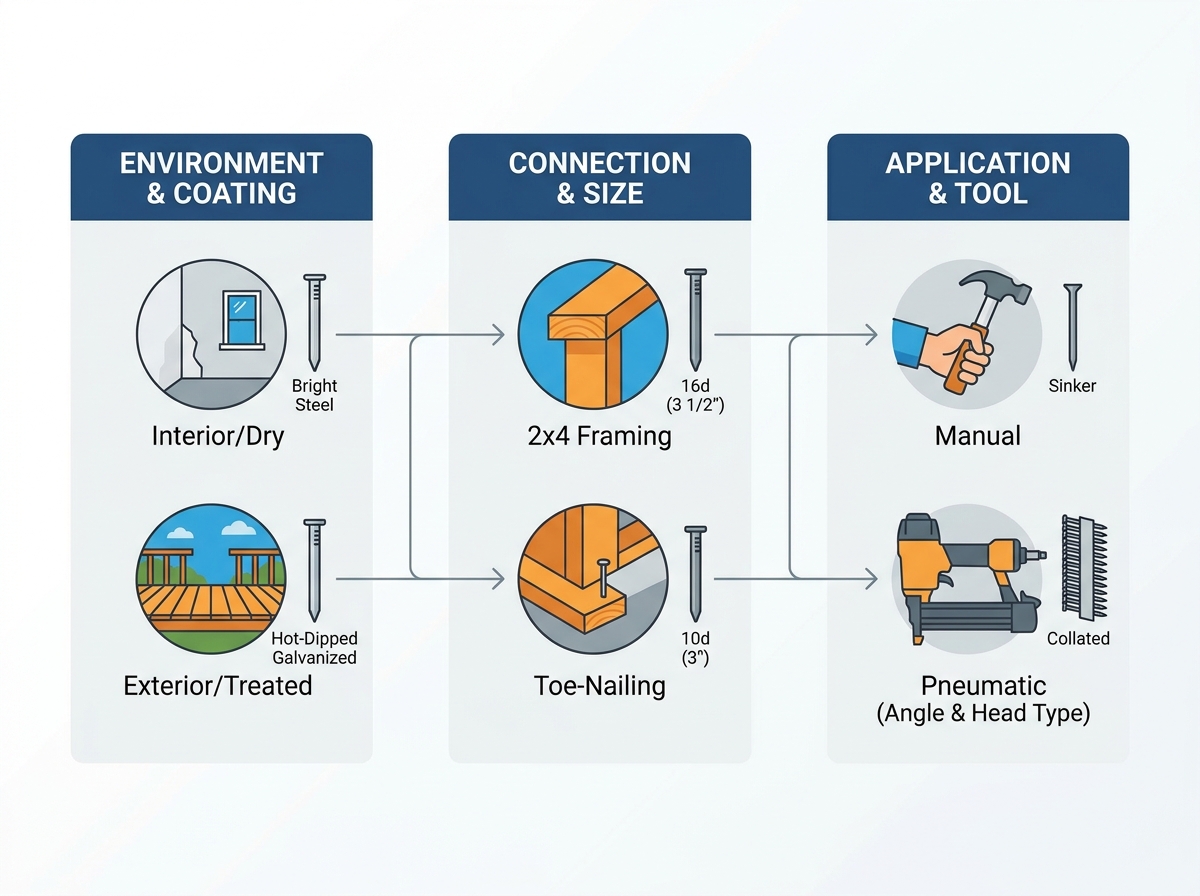
Your application method dictates your purchase. Manual hammering and pneumatic nail guns require completely different product formats. Selecting Framing nails for hammer applications involves different criteria than buying for a pneumatic magazine.
Hand-driving requires stamina. You want materials designed to make manual labor easier. We highly recommend vinyl-coated "sinkers" as the optimal choice for hand-driving. The heat-activated vinyl coating acts as a lubricant. You will bend fewer shanks and save energy. Additionally, look for a textured or waffled head design. This grid pattern grips the hammer face upon impact. It prevents the hammer from glancing off and damaging the wood.
Pneumatic nail guns require collated fasteners. Manufacturers bind these together in long strips or coils. You must carefully match the collation type to your specific tool.
You cannot buy just any strip. You must match the collation angle to your nail gun magazine. Common angles include 21-degree, 28-degree, and 30-degree formats. A 21-degree strip will jam immediately inside a 30-degree magazine. Always check your tool specifications before purchasing.
Pneumatic tools often utilize clipped-head fasteners. Manufacturers cut a notch out of the head so they can pack the strips tightly together. However, clipped heads offer lower shear values. They pull through sheathing easier during high winds. Consequently, many building inspectors outright reject clipped heads for structural framing. We advise you to default to full round head options. They guarantee compliance and provide peace of mind.
Moisture is the enemy of steel. If your connections rust, the building will eventually sag or collapse. You must match the metal coating to the framing environment.
| Finish Type | Best Environment | Moisture Resistance | Primary Use Case |
|---|---|---|---|
| Bright Steel | Dry, interior only | Very Low | Interior wall framing |
| Electro-galvanized | Lightly damp, indoor | Moderate | Bathrooms, kitchens |
| Hot-Dipped Galvanized (HDG) | Exterior, treated wood | High | Decks, barns, fencing |
| Stainless Steel | Coastal, marine | Maximum | Beach houses, docks |
Bright steel has no protective coating. It offers the highest raw holding power because the bare metal grips wood fibers aggressively. These are perfect for dry, interior wall framing. However, they have severe limitations. They rust rapidly if exposed to moisture. Never use bright steel outside or in wet environments.
Galvanization involves coating the steel in zinc. Zinc sacrifices itself to prevent rust. You must choose between two distinct galvanization methods.
Sometimes HDG is insufficient. Coastal and marine environments feature salt spray. Salt destroys zinc coatings rapidly. Stainless steel serves as the ultimate, premium choice here. It uses chromium alloys to prevent rust completely throughout the entire metal. Use stainless steel for beach houses, boat docks, and premium exterior trim. It guarantees your structure survives harsh coastal elements.
Using robust framing nails means nothing if you fail the local building inspection. Structural compliance requires strict adherence to documented standards. You must demonstrate authoritative knowledge on the job site.
The International Residential Code (IRC) and International Building Code (IBC) dictate exactly how you must build. You cannot guess how many fasteners a joint needs. You must reference the IRC Fastening Schedule tables. For example, the code typically mandates three 16d nails for a standard stud-to-top-plate connection. It specifies the exact spacing between fasteners for wall sheathing. Memorizing these tables ensures your framing passes inspection on the first try.
Geography alters building codes heavily. Local jurisdictions in hurricane paths or earthquake fault zones implement stricter rules. They frequently mandate ring-shank, full round head hardware. High winds create massive uplift forces. Earthquakes generate violent shear forces. A standard smooth shank can vibrate loose during a seismic event. Ring shanks stay locked permanently. Always verify special regional requirements with your local building department.
Decision fatigue happens easily in the hardware aisle. When in doubt on a load-bearing wall, follow a simple rule of thumb. Default to 16d common, full round head, smooth shank hardware. This exact configuration provides maximum shear strength. It satisfies almost every standard building inspector in non-coastal, non-seismic zones. It serves as your safest baseline choice.
Selecting the correct fasteners guarantees structural longevity and code compliance. Base your final purchase on a three-factor decision matrix. First, assess the Environment to choose your coating. Use HDG for outdoor treated lumber and bright steel for dry interiors. Second, evaluate the Connection Type to pick your size. Rely on 16d for joining 2x4s and 8d for sheathing. Third, check your Application Method to select the format. Match collated strips to your pneumatic gun angle.
Your next steps are straightforward. We recommend checking your local IRC building codes before buying bulk fasteners. Confirm whether your city bans clipped heads. Finally, test a small batch of hardware on scrap lumber. Check for aggressive wood splitting before committing to your final wall assembly. Careful preparation saves money and ensures a flawless build.
A: The letter "d" stands for penny size. It indicates a heavy-duty, thick structural fastener used for heavy lumber. A 16d nail is 3.5 inches long and very thick. "Gauge" refers to wire thickness. A 16-gauge fastener is a thin brad used for delicate finish carpentry and trim. You can never use gauge hardware for structural framing.
A: Generally, no. Framing relies on shear strength. When a house shifts, nails bend slightly without breaking. Standard wood screws have high tensile strength but low shear strength. They are brittle and will snap in half under heavy lateral framing loads. Only use specialized structural screws explicitly rated for framing.
A: A 3-inch fastener is classified as a 10d size. While some local codes allow 10d for specific non-load-bearing connections or toe-nailing, most inspectors require 16d (3.5-inch) hardware for primary face-nailing on 2x4 walls. You should always consult your local IRC tables to confirm exact inspector requirements.
A: They are coated in a specialized polymer resin blend, commonly referred to as vinyl. The friction of the hammer blows creates intense heat. This heat temporarily melts the resin, which acts as a liquid lubricant. Once it cools, the resin hardens and acts as a mild adhesive inside the wood.


