
Views: 0 Author: Site Editor Publish Time: 2025-11-26 Origin: Site
You use machine screws in many projects, and their size determines how well they fit and hold. Both imperial and metric standards exist, covering a wide range from #0 to #14, with diameters up to 0.75 inches. The table below shows common machine screw numbers and their thread diameters:
Machine Screw Number | Nominal Thread Diameter (mm) | Nearest Fractional (in) |
|---|---|---|
#0 | 0.060 | 1/16 |
#1 | 0.073 | 5/64 |
#2 | 0.086 | 3/32 |
#3 | 0.099 | 7/64 |
#4 | 0.112 | 7/64 |
#5 | 0.125 | 1/8 |
#6 | 0.138 | 9/64 |
#8 | 0.164 | 5/32 |
#10 | 0.190 | 3/16 |
#12 | 0.216 | 7/32 |

You need to understand the correct size because it affects load capacity and fit. Donghuang offers reliable machine screws and custom solutions for your needs.
Machine screws have many sizes. These sizes use imperial and metric systems. Picking the right size helps things fit well and stay strong.
To measure machine screws, look at diameter, length, and thread details. Use calipers to get exact measurements.
It is important to know thread count and pitch. Coarse threads are good for soft materials. Fine threads work better for metal.
Always check size charts before you buy screws. This stops mistakes and helps you get the right fit for your project.
Picking the correct screw size and type makes your project last longer. It also lowers the chance of things breaking.

Knowing how to measure machine screws helps you pick the right one. You need to check the diameter, length, and thread details. These measurements follow rules from groups like ASME and ISO. A size chart can help you compare machine screw sizes and choose the best one.
There are two main ways to measure machine screw diameter: major diameter and minor diameter. The major diameter is the biggest part of the thread. The minor diameter is the smallest part. The table below explains these diameters:
Diameter Type | Description |
|---|---|
Major Diameter | The largest diameter of an external or internal screw thread. |
Minor Diameter | The smallest diameter of an external screw thread, or the diameter measured at the crests of an internal screw thread. |
You can use a caliper to measure the major diameter. This helps you find the right hole or nut for the screw. Always check the machine screw diameter before you install it.
To measure machine screw length, start from the flat part under the head to the tip. You can use different tools to get the right length:
Use a lathe to trim the screw to the length you want.
A Dremel with a cutoff blade or a grinder can make a clean cut.
Put a nut on the screw before cutting. This helps fix the threads after you cut the screw.
Tip: Always measure the length after you cut to make sure the screw fits your project.
Thread sizes are important for how machine screws work. You need to know about thread count and pitch to pick the right screw for your material.
Term | Definition |
|---|---|
Thread Pitch | The distance between adjacent threads. |
Thread Count | The number of threads present in a given length (often expressed as threads per inch). |
Thread pitch changes how many threads are in a certain length. A smaller thread pitch means there are more threads. More threads give more surface area and better load resistance. Standard thread pitches make it easier to compare screws and pick the right one.
You can measure thread pitch in a lab by following these steps:
Use the three-wire method for the most exact pitch diameter.
Pick the right wire size based on threads per inch, using a Table of Thread Elements.
Use the right gaging pressure: 40 oz. for 20 or fewer TPI, 2 oz. for 140 TPI or more.
Measure at different spots along the thread.
Put the thread wires in a holder with little space for good alignment.
Check all measuring tools for dirt and damage before you start.
Makers use molds called dies to make machine screws with the same thread sizes and shapes. This makes sure every screw meets strict rules for fit and strength. By using these methods, you can trust that machine screws will fit and work as they should.
Note: Picking the right thread sizes and standard thread pitches helps you avoid problems when putting things together and makes your project last longer.
You can use these ways to measure and compare machine screw sizes and pick the best one from a size chart. Good measurements make sure your screws work well in different materials and uses.

When you choose a machine screw, you need to know the standards that define its size. These standards help you compare options and select the right fastener for your project. You see two main systems: imperial (SAE) and metric. Each system uses different ways to measure and label screws.
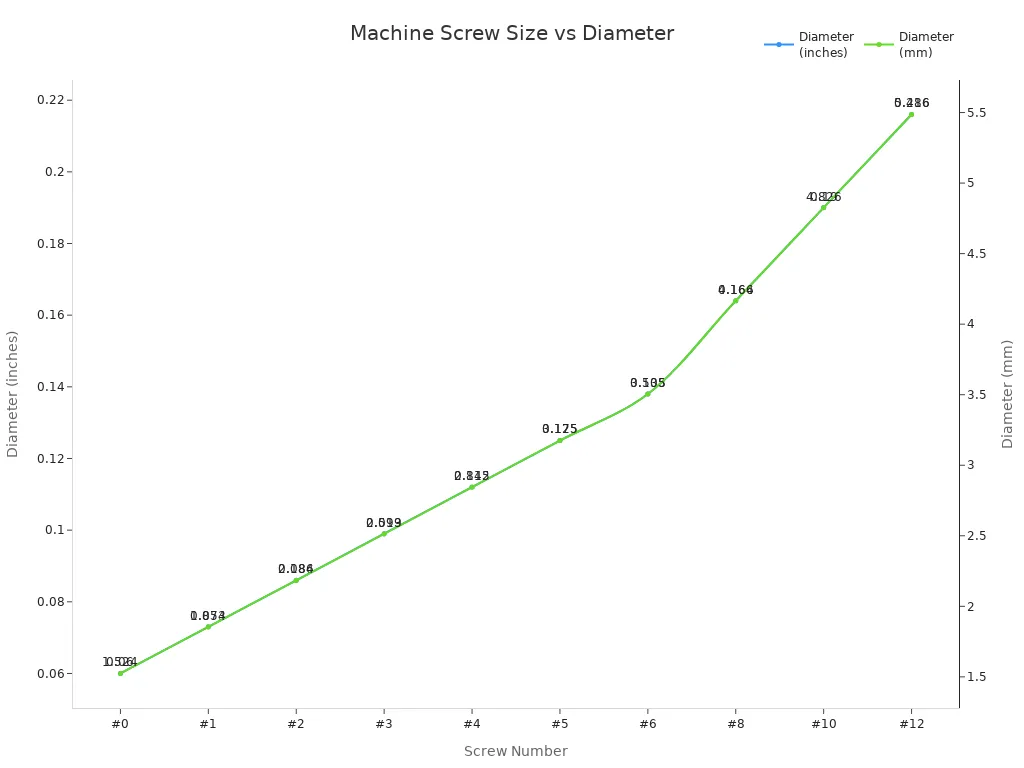
In the United States and some other regions, you use the imperial system for machine screw sizes. This system relies on size numbers and threads per inch (TPI). The American Society of Mechanical Engineers (ASME) sets the official definitions. The ASME B18.6.3 standard covers machine screw numbers from #0 to #14. You measure the nominal thread diameter on the outside of the threads. This measurement helps you match screws to holes and nuts.
Machine Screw Number | Nominal Thread Diameter (inches) | Nominal Thread Diameter (mm) |
|---|---|---|
#0 | 0.060 | 1.524 |
#1 | 0.073 | 1.854 |
#2 | 0.086 | 2.184 |
#3 | 0.099 | 2.513 |
#4 | 0.112 | 2.845 |
#5 | 0.125 | 3.175 |
#6 | 0.138 | 3.505 |
#8 | 0.164 | 4.166 |
#10 | 0.190 | 4.826 |
#12 | 0.216 | 5.486 |
ASME B1.1-2024 applies to the thread form, series, class, allowance, tolerance, and designation for unified screw threads.
You find that screws with a diameter less than 1/4 inch use a size number, starting with #000 for the smallest up to #12 for the largest. If you need a screw larger than 1/4 inch, you see sizes given in fractional inches. According to SAE standards, machine screws with diameters less than 1/4 inch are designated by size numbers, while those larger than 1/4 inch are specified in fractional inches.
Many countries use the metric system for machine screw sizes. You measure these screws in millimeters. The International Organization for Standardization (ISO) sets the rules. ISO 68-1 defines the basic principles of metric screw threads. ISO 261 and ISO 262 list preferred combinations of diameter and pitch.
Thread Size | Pitch (mm) | Major Dia (mm) | Minor Dia (mm) | Tap Drill Size (mm) |
|---|---|---|---|---|
M3 | 0.5 | 3.00 | 2.39 | 2.5 |
M4 | 0.7 | 4.00 | 3.30 | 3.3 |
M5 | 0.8 | 5.00 | 4.13 | 4.2 |
M6 | 1.0 | 6.00 | 4.92 | 5.0 |
M8 | 1.25 | 8.00 | 6.75 | 6.8 |
M10 | 1.5 | 10.00 | 8.35 | 8.5 |
M12 | 1.75 | 12.00 | 9.85 | 10.2 |
M16 | 2.0 | 16.00 | 13.55 | 14.0 |
M20 | 2.5 | 20.00 | 16.93 | 17.5 |

You often see metric screws labeled like "M6 x 1 x 20." This means the screw has a 6 mm diameter, a 1 mm thread pitch, and a 20 mm length. The most common metric sizes in manufacturing include M3, M6, M8, M10, and M12. You use these sizes for many types of machinery and equipment.
Aspect | Metric (SAE) | Imperial |
|---|---|---|
Measurement System | Millimeter (mm) | Inches or threads per inch (TPI) |
Regional Preferences | Standard in Europe, Asia, etc. | Common in the US and some UK industries |
Common Mistakes | Rounding errors, visual confusion, thread pitch misunderstanding | Rounding errors, visual confusion, thread pitch misunderstanding |
You find machine screw sizes that fit many needs. The smallest screws start at #000, with a nominal diameter of 0.060 inches. The largest standard size reaches #14, with a diameter of 0.250 inches. If you need bigger screws, you use fractional inch sizes or larger metric sizes.
Size | Nominal Thread Diameter |
|---|---|
#000 | 0.0600 inches |
#12 | 0.2160 inches |
1/4 | 0.2500 inches |
You measure the nominal length from below the head to the tip. For countersunk screws, you measure from the top of the head to the bottom. You use a size chart to compare machine screw thread sizes and select the right fastener for your project.
Tip: Always check the size chart before you buy screws. This helps you avoid mistakes and ensures a good fit.
At Ningbo Donghuang Hardware Co., Ltd., we offer a wide range of machine screw sizes. You can choose from standard options or request custom dimensions to fit your unique needs. Our expertise covers both imperial and metric standards. We help you find the right machine screw size for any application. If you need special materials or finishes, we provide custom solutions to match your requirements. You can explore our full product range at Donghuang Machine Screws.
When you look at machine screw packaging or the screw itself, you often see markings that tell you important details about size and thread. These markings help you choose the right screw for your project and avoid mistakes. In Europe, you see clear labeling conventions. For example, a screw might be marked as "M8-1.25×30," which means it has an 8 mm diameter, a 1.25 mm thread pitch, and a 30 mm length. You also find tolerance classes, like "M500–6g," that show how tight the fit is. External threads use "g" or "h," while internal threads use "G" or "H."
Here is a table showing common labeling conventions in different regions:
Region | Labeling Convention |
|---|---|
Europe | M8-1.25×30 (length in mm) |
Tolerance classes (e.g., M500–6g) | |
External threads: g or h | |
Internal threads: G or H | |
USA | Limited information available on conventions |
You may also see standards listed on packaging, such as BS 3643 for ISO metric screw threads or ANSI/ASME B1.13M for metric screw threads. These standards help you match screws to the right application.
Tip: Always check the marking and standard before you buy screws. This helps you avoid confusion and ensures a proper fit.
You can read machine screw markings by looking for numbers and letters that show the screw’s size and thread details. The first number tells you the major diameter of the screw shaft. The second number shows the threads per inch (TPI) or the thread pitch in millimeters. To find TPI, count the threads that fit within one inch using a ruler or caliper.
Here is a table to help you interpret common marking examples:
Measurement Type | Description |
|---|---|
Major Thread Diameter | Measure in inches or millimeters and match to the chart. |
Thread Pitch (TPI) | Verify using a gauge or compare to TPI table. |
You can use these steps to check screw markings:
Look for the diameter and thread pitch on the label or screw head.
Use a thread gauge to confirm the pitch matches the marking.
Measure the length from under the head to the tip.
Industry professionals use thread gauge inspection and size inspection to make sure the markings are correct. They measure pitch and diameter with special tools and check the length with measuring instruments. This process ensures every screw meets quality standards.
Note: Understanding markings helps you select the right screw for your project, whether you need a specific thread pitch or want to match machine screw head types for your application.
When you pick a machine screw size, you need to think about a few key things. Every project is different, so the screw must match the job. Here are some things you should look at:
The screw size must fit your project and be strong enough.
Thread count is important. Coarse threads are good for soft materials. Fine threads are better for metal.
The screw should be longer than the material so it holds tight.
The material of the machine screw changes how it works. Stainless steel does not rust in wet or outside places. Aluminum or titanium are good if you want something light. Brass is best if you need the screw to carry electricity.
Where you use the screw matters a lot. Water, heat, and chemicals can change what screw you need.
Some jobs need special screws for different materials.
You have to pick a screw that can hold the weight and strength your project needs. The right size helps you finish your work safely and well.
You can use these easy tips to choose the best machine screw size for your project:
Measure the screw from under the head to the tip. If it is a countersunk screw, measure from the top of the head to the bottom.
Pick a screw that lets 2 or 3 threads stick out past the material.
Choose a head style and drive type that works for your project.
Use a thread-locking compound if you need the screw to stay tight.
Put the screw in a hole that is already drilled. Tighten it with the right tool. Do not make it too tight.
If you need something special, Donghuang can help you. You can get advice about machine screw materials, sizes, and finishes for special jobs or places.
Feature | Description |
|---|---|
Personalized Customization Service | Changes how screws are made, what they are made of, and how they are finished for your needs. |
Material Application Consultation | Tells you the best materials and finishes for special places. |
Customization for Special Challenges | Makes screws with special materials, sizes, or uses for hard jobs. |
Professional Production Capability | Uses good machines and smart teams to make high-quality custom screws. |
Tip: You can ask Donghuang for expert help if you need a custom machine screw size.
You now know how to check machine screw size, understand standards, and pick the right fastener. Careful thread checks and good measuring help you make fewer mistakes and get better results.
Lead errors can make screws not fit or break.
Gaging systems let you test if screws are good for your project.
Evidence | Impact |
|---|---|
30% of product failures come from wrong screw choice | You save money by picking the right size. |
Correct materials make fasteners last up to 50% longer | Your project works better and lasts longer. |
Proper screw size lowers joint failure risk by 30% | Your builds stay strong and safe. |
Contact Donghuang if you want expert help or custom fasteners. You will get support for any project you have.
The number shows the screw’s diameter. For example, a #6 screw has a larger diameter than a #4 screw. You use this number to match the screw to the right hole or nut.
You measure from the flat part under the head to the tip. For countersunk screws, measure from the top of the head to the tip. Use a ruler or caliper for accuracy.
Coarse threads have fewer threads per inch. They work well in soft materials. Fine threads have more threads per inch. You use them for metal or when you need a tighter fit.
You should not mix metric and imperial screws. The threads and diameters do not match. Mixing them can damage your project or cause the screw to fail.
You can get custom machine screw sizes from Donghuang. The company offers special dimensions, materials, and finishes to fit your project needs.


