
Views: 0 Author: Site Editor Publish Time: 2026-07-22 Origin: Site
Concrete fastening acts as a critical structural liability on any commercial job site. The success of massive commercial framing, heavy machinery installation, and structural steel erection relies entirely on correct anchor specification. One failing connection easily jeopardizes an entire structural framework.
Industrial procurement goes far beyond matching basic dimensions from generic hardware catalogs. Buyers must precisely align anchor mechanics directly against unpredictable base material realities. You have to understand how extreme stress alters concrete, specifically the difference between cracked and uncracked zones. Furthermore, meeting strict environmental compliance and complex structural code requires meticulous hardware selection.
This guide provides a definitive evaluation framework for industrial buyers and engineering teams. We will help you specify the correct fastening systems, mitigate common installation risks, and ensure complete regulatory compliance. Read on to build a safer, more resilient infrastructure.
Every Concrete Anchor serves as a vital load-bearing bridge between the superstructure and its foundation. When you specify the wrong hardware, site liability risks skyrocket immediately. Catastrophic risks of pull-out or shear failure multiply rapidly in high-load or extreme environments. Mining operations and seismic zones punish weak connections without warning. When a connection fails, heavy machinery breaks loose. You face immediate safety hazards, work stoppages, and severe legal liabilities.
Choosing the wrong hardware also triggers massive hidden project costs. Field installers burn through expensive masonry drill bits trying to fit improper expansion sleeves into undersized holes. Poorly selected hardware demands constant site rework. Site managers face delayed structural inspections when inspectors spot unapproved fasteners. These disruptions ruin tight project schedules and drain budgets.
Finally, you must evaluate the security level of the installation environment. Some applications require tamper-resistant, secure fastening. Prisons, psychiatric facilities, and public transit hubs demand specialized secure hardware to prevent vandalism. Conversely, standard industrial hardware works perfectly fine for enclosed, restricted-access manufacturing plants.
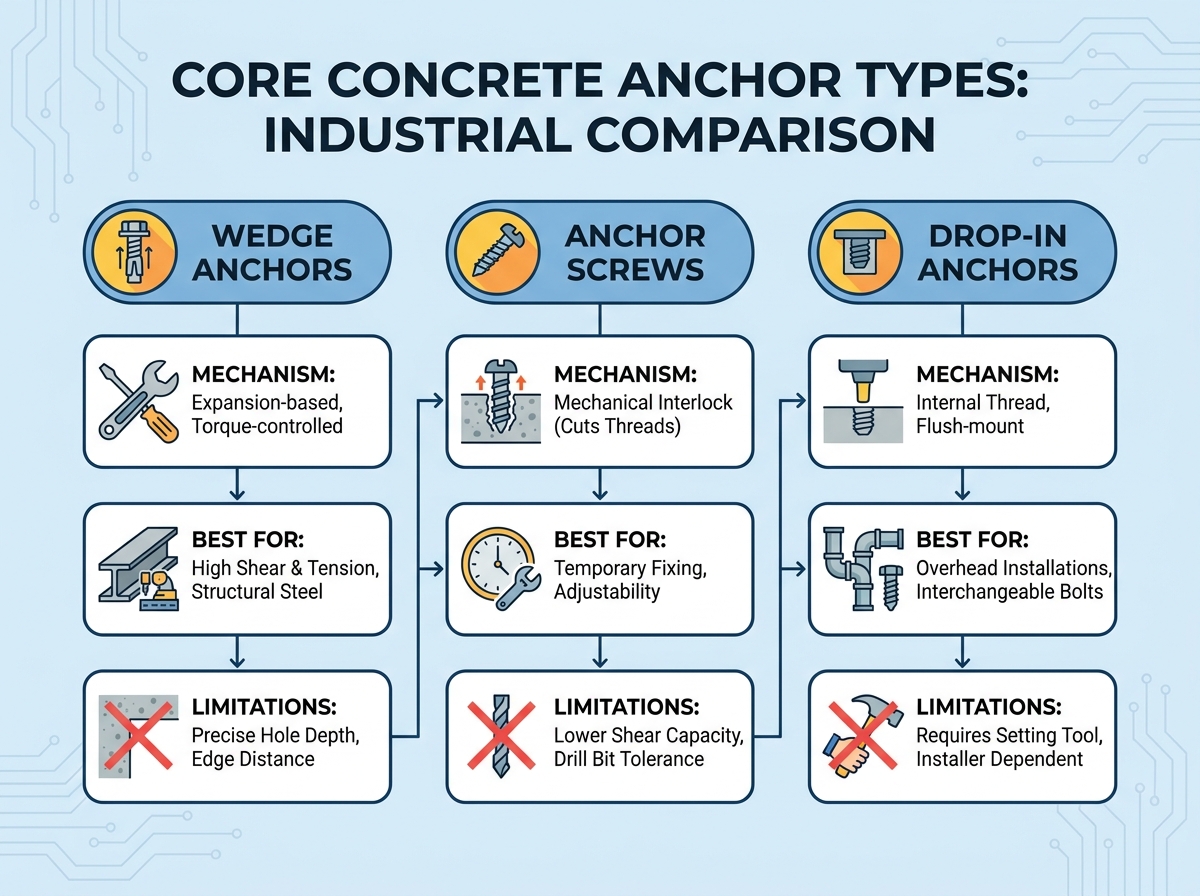
Engineers and buyers must navigate multiple Types of concrete anchors to match specific site demands. We organized the main categories into a scannable comparison below to streamline your selection process.
Concrete Fastening Mechanism and Application Matrix
| Anchor Category | Mechanical Action | Optimal Use Cases | Key Limitations |
|---|---|---|---|
| Wedge Anchors | Expansion-based; torque-controlled. | High shear/tension, structural steel. | Requires precise depth; poor near edges. |
| Anchor Screws | Mechanical interlock (cuts threads). | Temporary fixing, fast installation. | Lower shear capacity; strict drill tolerances. |
| Drop-in Anchors | Internally threaded, flush expansion. | Overhead HVAC, interchangeable bolts. | Relies on manual setting tool expansion. |
| Sleeve Anchors | Full-length sleeve expansion. | Porous block, brick, unknown substrates. | Lower load ratings than wedge types. |
When you need uncompromising structural hold, Heavy duty concrete anchors step up. They operate via an expansion-based, torque-controlled mechanism. Tightening the external nut pulls the working stud up into a sturdy expansion clip. The metal clip powerfully bites into the surrounding concrete walls.
These fasteners excel at handling high shear and tension loads. We heavily specify them for structural steel base plates and heavy machinery mounting. However, they carry distinct physical limitations. They require precise hole depth during drilling. Furthermore, you cannot use them close to concrete edges. The intense outward expansion forces will easily fracture the edge, causing a blowout.
Concrete anchor screws utilize a direct mechanical interlock. They literally cut their own rigid threads directly into the concrete substrate. You drive them in much like a traditional wood screw, though they require immense rotational force.
They shine in applications requiring temporary fixing. You can remove them quickly without leaving a protruding stud. Applications requiring adjustability benefit greatly from their fast, straightforward installation. However, they generally offer lower shear capacity than traditional wedge anchors. They also require incredibly specific drill bit tolerances. If the hole is slightly too wide, the threads simply will not engage the walls.
Contractors frequently rely on Drop-in concrete anchors for critical overhead work. They feature an internally threaded, flush-mount expansion body. You insert the hollow body into a pre-drilled hole. Next, you strike an internal metal plug down using a specialized setting tool. This forces the anchor shell outward permanently.
They are best for overhead installations like heavy HVAC ductwork and commercial pipe suspension. They provide a completely flush surface requirement when you remove the connecting bolt. The major limitation is their strict reliance on the setting tool. They rely entirely on the installer achieving full internal expansion during the strike. A weak hammer strike guarantees a weak hold.
Sleeve anchors provide versatile, full-length expansion. Tightening the bolt head pulls a cone-shaped stud upward into a tubular metal sleeve. The sleeve expands outward against the base material along its entire inserted length.
These are highly adaptable fasteners. They are perfect for porous base materials. Block, brick, and unknown concrete quality situations heavily call for sleeve anchors. The prolonged, distributed expansion handles weaker substrates better than localized wedge clips.
You need a clear decision-tree framework to specify fasteners safely. Consider the following crucial engineering dimensions.
You must understand the distinct difference between cracked and uncracked concrete. Industrial buyers must always assume concrete will crack in the tension zone. Concrete flexes dynamically under heavy load. Microscopic hairline cracks develop naturally around fasteners over time. Standard mechanical anchors placed in these zones can slip out if they lack specific cracked-concrete approvals. Always verify base material conditions before placing bulk orders.
Different physical forces attack the fastener constantly. Match your specification to the dominant load profile:
Every structural use case demands a unique fastening approach. For instance, Concrete anchor bolts for framing secure wooden sill plates directly to the foundation. They typically face moderate shear forces from wind and minor settling. Structural steel base plates, however, support massive vertical columns. They demand immense pull-out resistance and strict municipal seismic ratings.
Corrosion destroys structural integrity silently and rapidly. You must assess environmental conditions carefully before buying.
Even the finest hardware fails miserably if installed poorly. Practical field realities directly impact anchor performance. We often see top-tier products fail due to bad habits.
Site managers must emphasize the strict "Drill, Blow, Brush, Blow" rule. Installers often skip thoroughly cleaning the drilled hole to save time. Leftover silica dust acts as an efficient lubricant against the steel. It drastically reduces overall pull-out resistance. We routinely document catastrophic failures simply because contractors failed to use a wire brush and compressed air.
Anchor spacing matters immensely to structural integrity. Placing anchors too close together overlaps their invisible stress cones inside the slab. The concrete trapped between them fractures quickly under load. Placing them too close to an edge causes dangerous concrete spalling. The expansion force simply blows the side of the concrete away. Always follow the published manufacturer guidelines for minimum edge distances.
Common Mistake: Ignoring the minimum embedment line etched on the fastener. Driving it too shallow drastically lowers holding capacity.
Mechanical fasteners require precise, controlled tension. Installers love using pneumatic impact wrenches to speed up repetitive work. This common practice is incredibly dangerous. Impact wrenches over-torque mechanical fasteners almost instantly. Severe over-torquing crushes the surrounding concrete matrix. It can also stretch the steel bolt far past its safe yield point. A stretched bolt loses its holding power permanently. Crews must use calibrated torque wrenches.
Industrial supply chains require strict product vetting. Consolidating your hardware choices brings significant operational benefits to the job site.
Industrial buyers must strictly mandate ICC-ES (International Code Council Evaluation Service) approved hardware. Published ESR reports are absolutely essential for any structural applications. Independent labs generate these reports to verify testing for cracked concrete performance and seismic categories. Never accept substitute generic products without matching ESR documentation. Building inspectors will reject uncertified hardware, causing massive delays.
You can minimize chaos on the job site through smart procurement. The operational benefit of standardizing on a versatile anchor family across a job site is massive. You minimize the varying variety of drill bits needed by crews. You heavily reduce the number of proprietary setting tools moving around the site. Furthermore, installation training becomes much simpler for new workers. Standardization drastically reduces installer errors and speeds up overall construction.
A concrete anchor functions as a highly engineered structural component, not just a cheap commodity fastener. The safety of your facility rests entirely on proper specification, rigorous load matching, and flawless installation.
Before initiating bulk procurement, take decisive action. We strongly encourage buyers to consult directly with structural engineers on site. Review specific manufacturer load tables to match your exact dynamic forces. Contact technical sales representatives for a site-specific fastening audit. Making informed decisions upfront guarantees a secure, compliant, and durable project.
A: Mechanical anchors rely entirely on physical friction and steel expansion to grip the concrete walls. Chemical anchors use a two-part epoxy or resin system to chemically bond a threaded rod directly with the concrete substrate. Chemical systems are best for edge proximity and heavy dynamic loads.
A: Concrete anchor screws can typically be removed and occasionally reused in different holes. However, wedge anchors and drop-in concrete anchors are strictly permanent once expanded. If you remove the nut from a wedge anchor, the expanded stud remains permanently embedded in the concrete.
A: Anchor sizing is dictated by the fixture's hole diameter, the required embedment depth, and the total fixture thickness. Always consult the manufacturer's technical data sheet. It provides exact ultimate load values based on the specific anchor size and concrete compressive strength.


