
Views: 0 Author: Site Editor Publish Time: 2026-08-10 Origin: Site
Selecting the wrong fasteners for a 2x4 project isn’t just a minor inconvenience. In fact, incorrect sizing can easily lead to split lumber, failed municipal inspections, and compromised structural integrity over time. Standard 2x4 lumber actually measures 1.5 inches by 3.5 inches in practical thickness. These exact dimensions require precise fastener sizing to create secure, lasting joints. You need adequate penetration into the adjoining board without breaking through the opposite side. If you miss this crucial balance, framing joints become immediate weak points under stress.
This guide breaks down exact framing nails specifications to help you build safer structures. We will explore building code realities and structural demands in modern residential construction. Finally, you will learn the practical trade-offs between hand-driving and pneumatic fastening. This knowledge ensures you can confidently procure the best materials for your specific project.
Fastener choices drastically affect your entire building structure. Every joint in a wood-framed building experiences continuous physical stress. Let us examine how physical dimensions directly influence holding power and structural longevity.
The thickness, or gauge, handles the lateral weight of the building. We call this shear strength. It prevents structural boards from sliding past one another during high winds, seismic activity, or heavy snow loads. The thicker the steel shank, the higher the shear capacity. Conversely, the overall length dictates withdrawal resistance. This metric measures how well the fastener resists pulling out of the wood grain. If you use the wrong framing nails, both critical forces suffer. A building becomes highly susceptible to shifting, sagging, or outright collapse under extreme weather conditions.
Some builders try using shorter 8d or 10d fasteners for base plates or double studs to save money. This cuts dangerous corners and violates basic building codes. Short lengths reduce structural rigidity instantly. They simply do not penetrate deep enough into the second stud to create a monolithic joint. When wood shrinks and expands across changing seasons, undersized fasteners easily work themselves loose. You will eventually notice squeaky floors, cracked drywall, and warped door frames.
Going too large presents an entirely different set of dangers. Pushing oversized gauges into dry 2x4 ends increases your risk of splitting the wood. When wood splits, it loses its grip on the steel shank entirely. Splitting ruins the holding power immediately. This results in wasted material and compromised structural joints. You end up spending significantly more time cutting new lumber and replacing ruined studs. Dense wood species like Southern Yellow Pine are especially prone to blowout if you drive a massive gauge near the board edges.
Think about the massive financial cost of rework. Building inspectors routinely reject entire framed walls. They will immediately fail your project if you opt for faster, thinner 3-inch gun nails instead of code-required thicknesses. Pulling out thousands of rejected fasteners wastes days of expensive labor. It also damages the lumber, often forcing contractors to rebuild entire sections from scratch. Always verify your local engineering requirements before firing a single shot.
Understanding exact Framing nails size requires navigating two completely different measurement systems. Builders still use the old "penny" system alongside highly accurate modern decimal gauges. Let us clarify these confusing terms so you can shop with confidence.
The letter "d" stands for denarius, an ancient Roman coin. Centuries ago in England, this denoted the cost for one hundred hand-forged pieces. Today, it strictly denotes length.
Modern building codes rely heavily on exact decimal measurements rather than archaic penny sizes. You must translate penny sizes into direct decimal gauges for accurate purchasing. A micrometer measures the exact thickness of the steel shank. Thicker shanks require more driving force but offer exponentially better shear resistance.
Below is a highly useful conversion matrix. It links specific diameters to their typical structural limits, ensuring easy procurement for your next lumber order.
Standard Fastener Conversion and Application Matrix
| Penny Size (d) | Length (Inches) | Gauge (Decimal) | Primary 2x4 Application |
|---|---|---|---|
| 10d Common | 3" | .148 | Toe-nailing, non-load bearing walls |
| 12d Common | 3-1/4" | .148 | Light interior framing, blocking |
| 16d Sinker | 3-1/4" | .148 | General residential framing, top plates |
| 16d Common | 3-1/2" | .162 | Heavy load-bearing walls, structural shear panels |
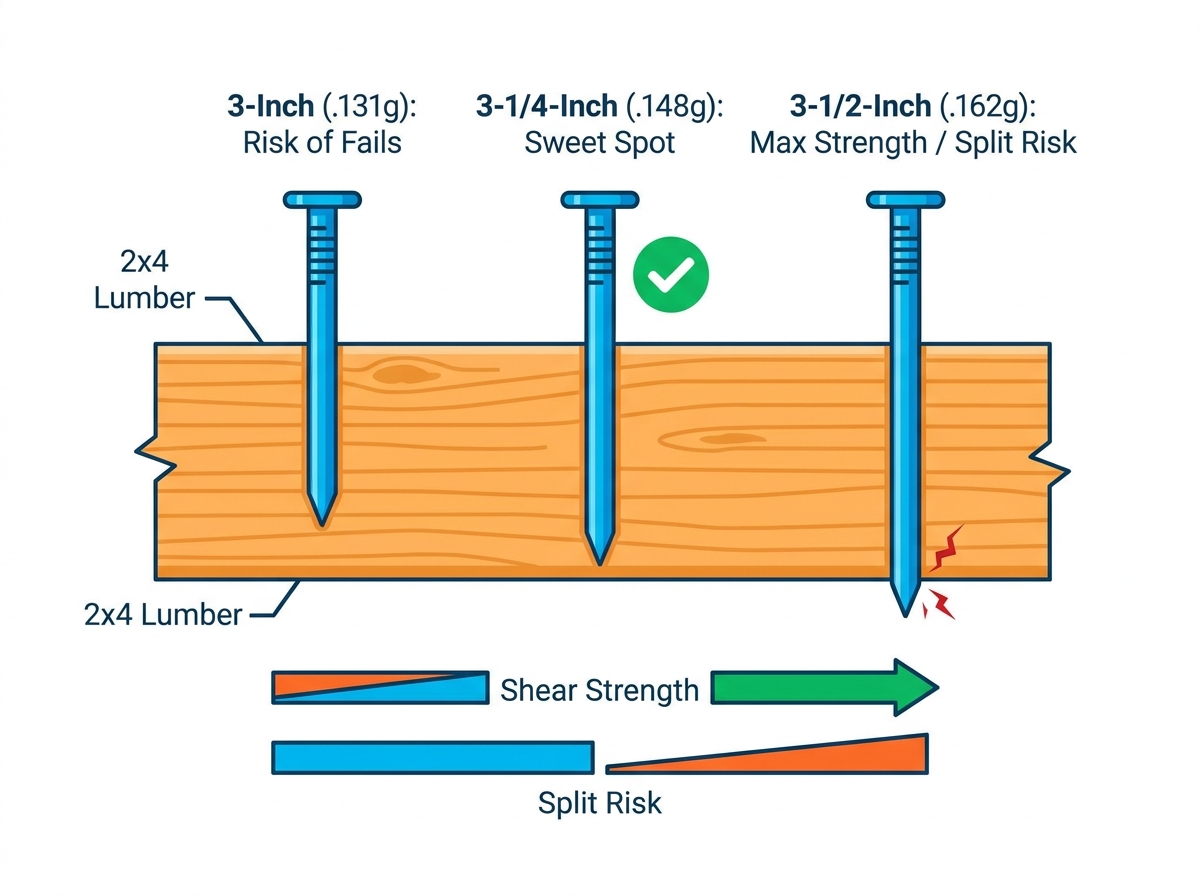
Choosing the exact decimal length severely impacts your daily speed and municipal compliance. Let us compare the three most popular options for modern 2x4 construction projects.
These thin profiles are incredibly popular for lightweight pneumatic nailers. They bring distinct benefits and notable drawbacks to the job site.
Many framing experts view this specific dimension as the perfect professional compromise.
This is the absolute heavyweight champion of standard lumber framing.
The method you choose to drive the fastener changes your procurement strategy entirely. Hand-driving requires very different physical considerations than shooting them forcefully from a high-pressure gun.
If you plan to swing a hammer manually, you need specific materials to save your joints. When buying Framing nails for hammer driving, loose, bulk 16d sinkers are universally preferred by seasoned carpenters. Manufacturers coat these specific sinkers in a thin vinyl or polymer resin. When you strike the head, friction generates intense heat along the shank. The vinyl coating melts slightly from this friction. It acts as a highly effective lubricant, letting the metal slide smoothly into dense wood. This clever engineering reduces arm fatigue tremendously over an eight-hour shift.
You must also consider the fastener head style. A smooth head easily slips off your hammer face if struck slightly off-center. This causes bent steel and bruised thumbs. Many carpenters prefer a textured or waffle head. This cross-hatched texture grips the hammer face upon impact. It aggressively prevents dangerous slips and bent metal during rapid hand-framing.
Nail guns require collated strips or wire coils to function. You must match the collation type directly to your specific hardware.
Gun angle limitations also dictate your final purchase. Ensure your 21-degree or 30-degree nailer can physically accommodate a 3-1/2" .162 gauge piece. Many lightweight finishing nailers max out at 3-1/4 inches. Read your specific hardware manual before buying expensive bulk boxes.
Your physical environment and local laws dictate mandatory construction requirements. Ignorance of these strict rules routinely causes failed inspections and expensive project delays.
The International Residential Code publishes highly strict, standardized fastening schedules. Building inspectors use Table R602.3 as their primary reference document. Briefly, standard requirements demand specific counts, gauges, and spacing for every structural joint. For example, face-nailing double studs firmly together requires 16d common sizes spaced exactly 16 inches on center. You cannot substitute smaller sizes here without a licensed engineer's written approval. Failing to follow this table guarantees a rejected frame.
Different joint angles require distinct structural approaches. End-nailing involves driving straight through the face of one board deeply into the end grain of another. This joint style requires maximum length for stability. Conversely, toe-nailing requires driving at a steep, awkward angle. Toe-nailing a 2x4 often requires dropping down to an 8d or 10d size. You might also successfully use a 3" .131 gauge. If you use a thicker 16d common for toe-nailing, you will almost certainly split the angled board, ruining the connection entirely.
Moisture and rust destroy holding power rapidly. You must choose the correct chemical coating for your specific environment.
Selecting the perfect fastener ensures your framing lasts for generations without sagging or failing. Keep these final, critical recommendations in mind as you plan your material lists:
Before purchasing bulk quantities, consult your local municipal building code requirements. Verify your specific structural blueprints with an architect or inspector. Finally, check your pneumatic nailer specifications to guarantee it can safely accommodate your required gauge and collation angle. Proper upfront planning easily prevents expensive mid-project hardware trips.
A: Screws have high withdrawal strength but very low shear strength. They are inherently brittle. Traditional structural framing requires fasteners that bend slightly under heavy lateral shear stress rather than snapping in half. Consequently, most building codes strictly mandate standard nailing for load-bearing 2x4 joints. Always use approved structural hardware for critical connections.
A: They are perfectly acceptable for toe-nailing applications. You can also use them for joining two flat 2x4s together where a longer fastener would dangerously protrude through the opposite side. However, they are generally inadequate for structural end-nailing. Most local codes require a 16d size for heavy load-bearing end joints.
A: Smooth shanks drive much faster into dense wood. They serve as the undisputed industry standard for general framing tasks. Ring shanks feature small ridges that aggressively lock into the wood fibers. They provide superior holding power against severe wind uplift. However, they are extremely difficult to remove without damaging the wood if you make a mistake.


