
Views: 0 Author: Site Editor Publish Time: 2026-08-06 Origin: Site
Securing materials to solid concrete or masonry demands highly specific fastening solutions. Standard wood fasteners fail miserably in these dense environments. They quickly bend, snap in half, or simply refuse to hold under pressure. You need a dedicated, heavy-duty approach. This necessity addresses a major structural challenge across modern construction projects. Builders and contractors require exceptionally high shear strength. They also need reliable pull-out resistance to keep fixtures secure over decades. Crucially, you must achieve this robust hold without shattering the brittle concrete substrate below. Our comprehensive guide breaks down exact applications, vital selection criteria, and proper installation methods. We will carefully guide you through the technical evaluation process. You will easily learn how to choose the right hardware for your specific project needs.
Why do standard fasteners fail so predictably in masonry? Normal nails use mild, untreated steel. This mild steel bends extremely easily. If you strike it against a solid poured slab, it buckles immediately. A true Concrete Nail solves this frustrating problem completely. Manufacturers build them from hardened, heat-treated carbon steel. The extensive heat-treating process alters the internal metal structure. It creates an incredibly rigid, durable fastener. This engineered rigidity prevents snapping under heavy hammer impacts.
Next, we must consider the distinct structural advantages. These heavy-duty fasteners feature a noticeably thicker gauge. This extra thickness delivers crucial shear strength for framing applications. Buildings often experience shifting lateral loads over time. High winds and ground settling push laterally against walls. The thick steel prevents the fastener from shearing off under this immense pressure. Normal wire nails simply shear in half.
Finally, shank variations matter immensely for long-term holding power. You will rarely see a completely smooth body. Most designs feature a fluted or grooved shank. These specific grooves engineer intense mechanical friction. When you drive the pin downward, it actively crushes the masonry. This action creates highly abrasive concrete dust. The coarse dust packs tightly into the fluted grooves. This packing action permanently locks the fastener securely into place.
Contractors constantly anchor wood structures directly to poured slabs. Attaching treated wood sill plates requires extremely robust anchoring. You secure these heavy plates directly to concrete foundations. You also use them frequently on basement slabs. We highly recommend using specialized Concrete nails for framing in these scenarios. Standard anchoring simply will not suffice.
Success depends on two primary criteria. First, the connection must withstand massive building shear loads. High winds put extreme lateral stress on perimeter sill plates. Your fasteners must hold the wall base rigid. Second, the fastener must resist severe chemical corrosion. Treated lumber contains harsh copper-based chemicals. These modern chemicals will quickly eat away unprotected steel.
Remodeling unfinished basements or masonry walls presents unique structural challenges. You often need to secure wooden furring strips safely. You might also install metal drywall tracks or thick plywood subflooring. Utilizing Concrete nails home improvement applications handles these specific tasks perfectly. They save homeowners immense time and frustration.
Success here requires highly specific outcomes. You absolutely need a completely flush finish. A protruding metal head will ruin your subsequent drywall installation. Furthermore, you need reliable, long-term pull-out resistance. Hardwood floors bounce and interior walls vibrate over time. Finally, the installation must cause minimal substrate damage. You want to strictly avoid cracking older, brittle basement floors.
Sometimes you must attach thin metal directly to rigid brick. Common tasks include installing expanded metal lath for stucco. You might also hang corner beads or mount lightweight plumbing fixtures. Cinder block walls and mortar joints often serve as the structural base.
This distinct application requires specialized fastening hardware. You cannot use standard flat heads on thin metal. The thin metal lath will tear easily under stress. The sheer force simply pulls the metal right over the nail head. Success requires specialized wider heads. Some experienced contractors add flat steel washers. These washers distribute the holding pressure evenly across the metal. They prevent the fragile metal from tearing away.
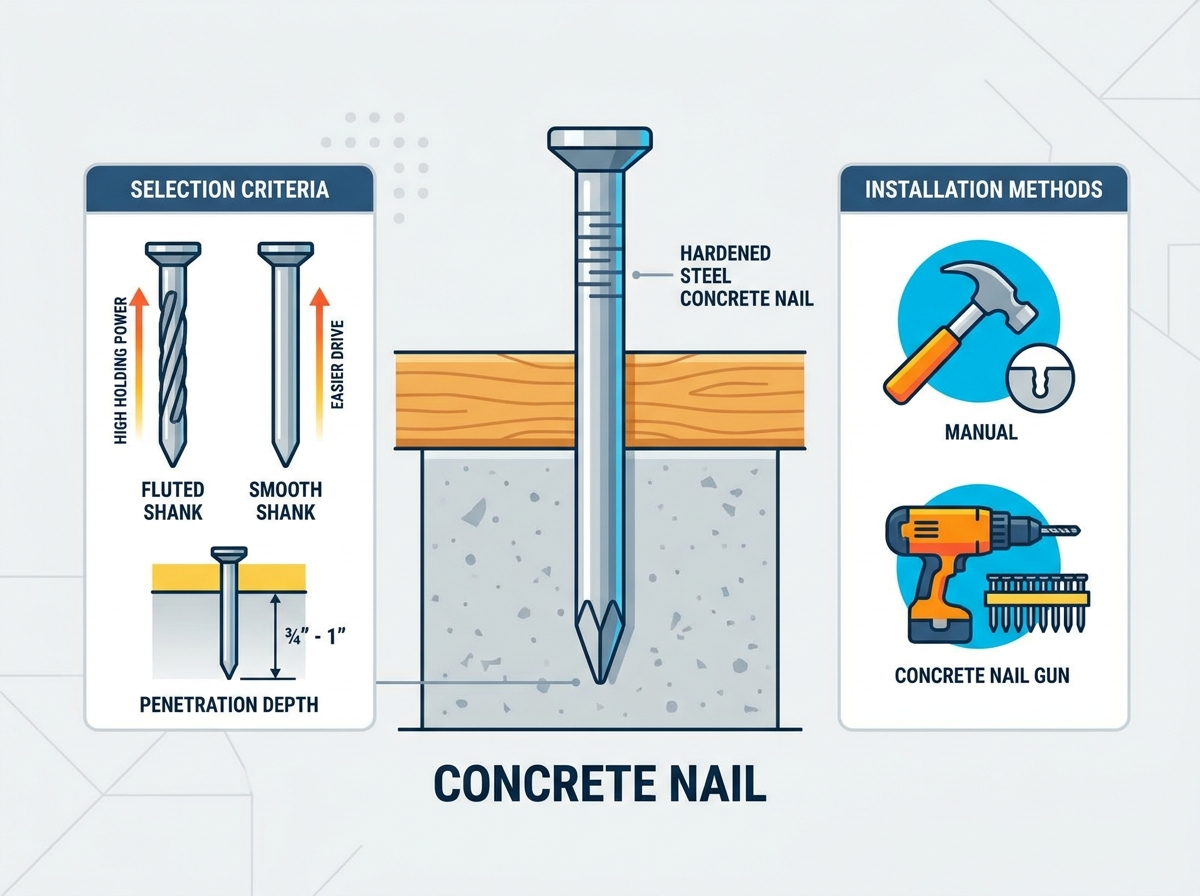
Manual installation works best for low-volume fastening tasks. We strongly suggest hand-driving for minor home improvement projects. It also excels perfectly in tight, restricted spaces. You cannot easily fit large pneumatic tools into cramped floor corners or narrow closets.
Implementation requires serious physical effort and proper technique. You need a heavy framing hammer. A small hand sledge or club hammer also works exceptionally well. Normal lightweight carpentry hammers will merely bounce off the metal head. We highly recommend drilling pilot holes first for manual driving. Use a high-quality masonry bit and a hammer drill. Pilot holes actively prevent disastrous concrete blowout. This precautionary step remains crucial when working on older, brittle slabs.
High-volume commercial projects demand much greater efficiency. Commercial framing relies entirely on rapid fastening. Large-scale basement finishing also requires immense speed. You must use a specialized Concrete nail gun for these repetitive fastening tasks. Manual hammering becomes physically impossible on large sites.
Tooling considerations are strict and unforgiving. You cannot load bulk manual fasteners into a powered magazine. You require specific Concrete nails for nail gun systems. These come exclusively as collated pins. A durable plastic strip or welded wire holds them at a precise angle.
Evaluate your power source carefully before renting or buying. You can choose gas-actuated or pneumatic driving systems. Gas-actuated tools use small combustible cartridges. They offer maximum mobility on busy, crowded job sites. You get immense driving force without dragging a heavy air compressor. Conversely, pneumatic systems rely entirely on compressed air hoses. Pneumatic tools remain highly cost-effective for indoor use. They suit continuous, high-volume indoor framing perfectly.
How do you select the completely correct hardware? You cannot simply guess. We must evaluate several distinct technical criteria to ensure a permanent structural hold.
Different shank profiles offer vastly different holding capacities. You must match the shank to your exact application.
| Shank Type | Friction Level | Ideal Project Application |
|---|---|---|
| Fluted / Grooved | Maximum | Permanent sill plates, basement framing |
| Smooth | Moderate | Temporary bracing, lightweight fixtures |
| Spiral | High | Cinder block walls, deep mortar joints |
Length selection follows strict industry-standard construction math. You cannot randomly guess the required fastener length. The fastener should penetrate the masonry properly to hold weight. Industry standards strictly dictate ¾ inch to 1 inch of penetration into the base material.
Consider this highly practical field example. You are fastening a standard 2x4 wooden board to a slab. A modern 2x4 actually measures exactly 1.5 inches thick. You want exactly 1 inch of penetration deeply into the slab. Therefore, your project requires a 2.5-inch fastener. Over-penetration causes the hardened steel to bend violently. Under-penetration results in catastrophic holding failure.
Untreated steel rusts incredibly fast in damp environments. You must evaluate the required corrosion resistance carefully. Electro-galvanized fasteners receive a very thin zinc coating. They work well enough for dry, climate-controlled indoor applications. Hot-dipped galvanized fasteners receive a thick, highly durable zinc layer.
You must use hot-dipped coatings for all outdoor projects. They are strictly mandatory when fastening ACQ-treated lumber. Modern ACQ lumber contains extremely high levels of copper. This chemical copper rapidly corrodes untreated carbon steel through galvanic action. Using the wrong coating causes severe structural failure within mere months.
Installing hardened steel directly into dense rock carries inherent physical risks. You must mitigate these workplace dangers actively.
Driving fasteners too close to the slab edge causes major problems. The concrete slab will experience severe spalling. Large chunks of masonry will break off completely. You must follow standard minimum edge distance rules. Keep fasteners at least three inches away from any outside edge. Ignoring this rule causes deep structural cracking.
Hardened steel interacts unpredictably against hard stone aggregates. Sometimes the sharp point strikes a dense, buried piece of gravel. The fastener cannot pierce this completely solid rock. Instead, it deflects violently sideways. This deflection causes highly dangerous ricochets. The heavy metal can fly backward at extreme speeds.
Strict safety compliance prevents serious job site injuries. You must wear mandatory Personal Protective Equipment (PPE) constantly. ANSI-rated shatterproof eye protection is completely non-negotiable. Hearing protection is equally vital for your long-term health. Gunfire-level noise occurs often, especially around explosive powder-actuated tools.
Proper tool alignment prevents many dangerous high-speed deflections. You must maintain strictly perpendicular tool alignment always. Keep the nailer exactly 90 degrees to the work surface. Leaning the tool sideways slightly encourages the fastener to skate dangerously across the floor.
Let us briefly review the most critical project takeaways. The right fastener actively balances several interconnected structural factors. You must thoughtfully weigh the shank design against your required holding needs. You must also calculate exact length requirements using industry math. Furthermore, your chosen installation method must perfectly match the specific density of your base material.
Take clear actionable next steps before starting your next project. First, assess your overall project scale honestly. Decide clearly between slow manual hammering and a rapid pneumatic system. Next, verify your exact lumber type closely. Determine if you are using standard indoor softwood or harsh chemically treated lumber. Gather this critical information before purchasing loose or collated fasteners. Careful planning ultimately guarantees a highly secure, permanent structural hold.
A: Yes, into relatively green or standard poured concrete. You can carefully hand-drive them using a heavy club hammer. However, mature, high-PSI concrete poses a significant challenge. Older slabs become extremely brittle over time. For these hard surfaces, you often require a pilot hole. Using a masonry bit prevents nail bending. It also stops severe concrete cracking.
A: The terms are largely interchangeable throughout the construction industry. However, slight nuances exist. "Masonry nail" is sometimes used broadly. It often includes softer fasteners meant for yielding mortar or hollow cinder block. Conversely, "concrete nail" strongly implies hardened, heat-treated steel. Builders reserve this term for fastening into dense, high-PSI poured slabs.
A: Yes, absolutely. You cannot use loose, hand-drive nails in a powered gun. You must purchase specialized collated concrete pins. Manufacturers bind these pins together using plastic strips or wire welds. They are specifically angled and uniquely sized. You must match them exactly to your brand and model of concrete nail gun.


