
Views: 0 Author: Site Editor Publish Time: 2026-07-27 Origin: Site
Selecting the wrong fastener for delicate trim or woodworking projects leads to split materials. Insufficient holding power or tedious repair work often ruins your final product. A successful brad nail purchase matches the fastener gauge and length perfectly. You must align these specs to both the material thickness and your specific 18-gauge nailer. Doing this ensures secure attachment while minimizing surface marring. Professional results require precision rather than guesswork.
This guide strips away marketing noise to give you a clear framework. We provide the hard numbers needed for evaluating fasteners. You will discover exactly how to choose the right lengths and applications for your next project. We focus entirely on practical application, material compatibility, and tool constraints. Read on to master these essential woodworking principles.
Many beginners often ask exactly What are brad nails used for when starting a home renovation. We define these specific fasteners by their 18-gauge wire profile. They feature a remarkably thin shank and a minimal head. This slender design drastically reduces the need for wood filler. It virtually eliminates the risk of splitting thin, dry, or delicate woods. Materials like MDF trim or soft pine benefit immensely from this specific profile.
Professional carpenters rely on 18-gauge fasteners for cosmetic applications. They prioritize surface appearance over sheer holding strength. The tiny entry hole left behind requires only a microscopic dab of putty. Sometimes, a simple coat of thick paint hides the hole entirely. This saves countless hours during the finishing phase.
You should deploy these fasteners in scenarios requiring minimal surface disruption. They excel when securing lightweight materials. Consider these primary applications:
Understanding limitations prevents catastrophic project failures. These thin fasteners cannot withstand heavy forces. They will easily bend or snap under pressure. You must avoid them in specific environments.
Common Mistake: Relying solely on 18-gauge fasteners for chair rails in high-traffic rooms. Chairs bumping against the rail will easily pull the slender fasteners loose over time.
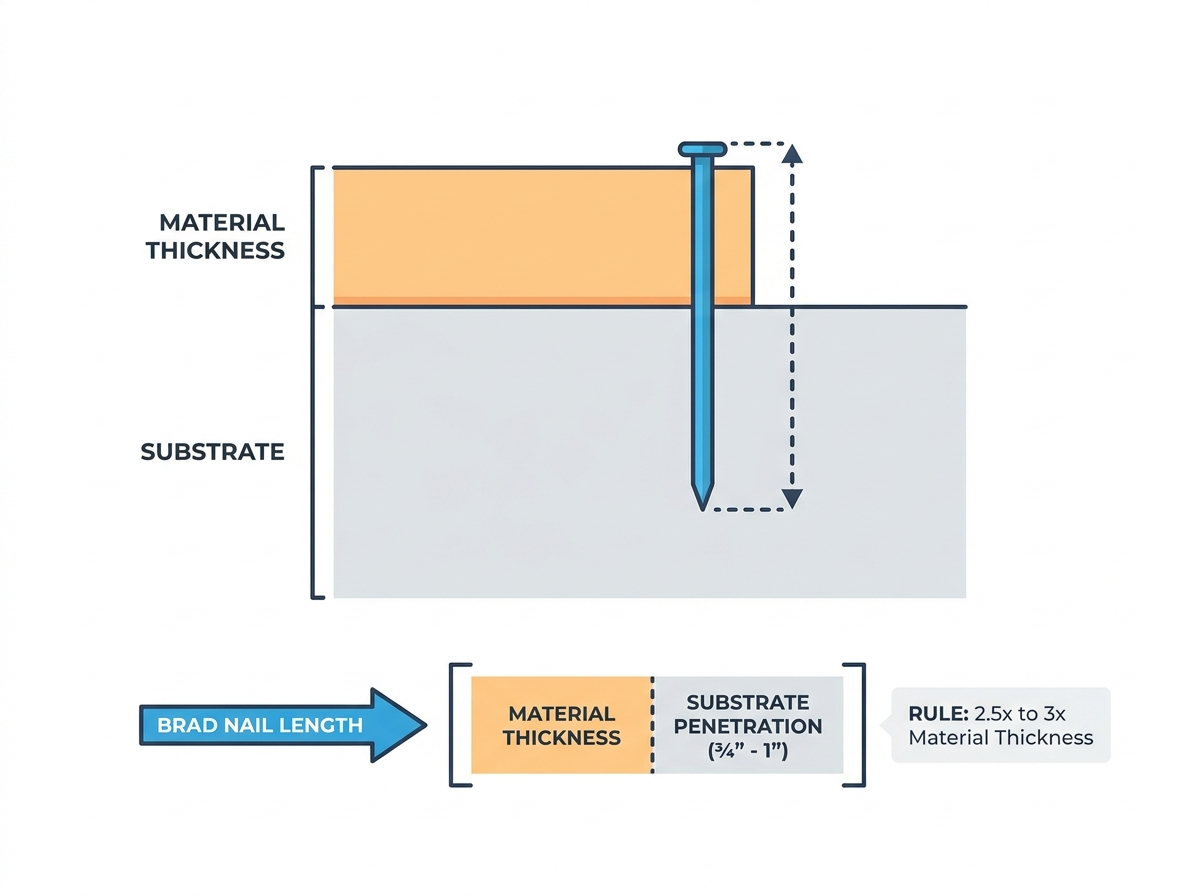
Selecting the correct Brad nails sizes requires a strict mathematical approach. Guessing leads to weak joints. It also causes "blowouts," where the sharp tip exits the side of your wood piece. You must calculate the required length based on two distinct factors. These factors are your material thickness and the required substrate penetration.
Industry standards dictate a straightforward penetration formula. You take your material thickness and add the required substrate penetration. For a secure hold, you need at least ¾-inch to 1-inch of penetration into the solid anchor material. The anchor material is usually a wooden wall stud or a solid wood frame.
If you attach a ½-inch thick baseboard, you must account for the drywall behind it. Standard drywall is ½-inch thick. You need the fastener to pass through the baseboard, pass through the drywall, and bite into the stud. Therefore: ½" (baseboard) + ½" (drywall) + 1" (stud penetration) equals a 2-inch fastener requirement.
Understanding standard Brad nail lengths helps you stock your toolbox efficiently. Different projects demand different fastener dimensions. Here is how professionals categorize them:
Application Length Guide
| Material Thickness | Wall Condition | Recommended Length |
|---|---|---|
| 1/4 inch | Wood to Wood (Direct) | 3/4 inch to 1 inch |
| 1/2 inch | Wood to Wood (Direct) | 1-1/4 inch |
| 1/2 inch | Over 1/2" Drywall | 2 inch |
| 3/4 inch | Over 1/2" Drywall | 2 inch (Maximum capacity for most nailers) |
Over-sizing your fastener length introduces unnecessary risks. Pushing a 2-inch metal spike blindly into a wall is dangerous. It heavily increases the risk of hitting hidden plumbing pipes. It also raises the chances of striking electrical wiring. Furthermore, longer shafts suffer from deflection in dense grain. Default to the shortest length possible. Ensure it simply provides a minimum of ¾-inch penetration into your solid anchor material.
Comparing Brad nails vs finish nails represents a major hurdle for novice builders. Both serve finishing purposes, but they target entirely different structural demands. Understanding the core gauge difference eliminates purchasing confusion.
Wire gauge determines the thickness of the metal shaft. A higher number indicates a thinner wire. Therefore, 18-gauge fasteners are notably thinner. Finish nails typically utilize 15-gauge or 16-gauge wire. This makes finish nails significantly thicker and more robust. They have larger heads and wider shafts.
You must balance holding power against the resulting surface damage. Each fastener type offers a specific trade-off.
Finish Nails: They provide superior holding power. They easily secure heavy MDF pieces, large crown molding, door jambs, and stair treads. However, this strength comes at a cosmetic cost. You will need to fill noticeably larger holes with wood putty. You must also sand those spots thoroughly. Furthermore, they carry a higher risk of splitting thin materials near the edges.
Brad Nails: They offer a weaker structural hold but leave a microscopic footprint. They look almost invisible upon entry. They act perfectly for delicate pieces where you want to minimize post-installation sanding. They speed up the painting process significantly.
Follow these numbered steps to determine your exact purchasing verdict:
Woodworkers must manage their hardware inventory wisely. You face a choice between variety packs and massive single-size quantities. Purchasing a Brad nail kit solves different problems than buying bulk boxes. Let us break down the efficiency of each strategy.
Variety packs bundle multiple lengths into one convenient plastic case. You typically get staggered lengths ranging from tiny 5/8-inch pins up to 2-inch fasteners.
Pros: They are highly cost-effective for multi-phase DIY projects. They suit occasional punch-list work perfectly. You always have a few different lengths on hand for unexpected workshop repairs. They save you from buying four separate massive boxes.
Cons: You will inevitably run out of the most common size first. Most people drain the 1-1/4" compartments quickly. Meanwhile, you leave the extreme sizes completely untouched. This leads to long-term waste and annoying half-empty storage cases.
Bulk boxes typically contain 1,000 to 5,000 identical fasteners per package. They cater to large-scale, uniform installations.
Pros: You achieve maximum efficiency and a lower per-nail cost. High-volume projects demand this approach. If you plan on trimming an entire house, you need bulk boxes. You will not waste money on lengths you never touch.
Cons: You face a higher upfront cost if your project actually requires multiple sizes. Buying three separate bulk boxes costs noticeably more than one mixed kit.
We recommend a hybrid purchasing approach. Purchase a multi-size kit for prototyping, crafting, or general homeowner toolboxes. Keep it on the shelf for weekend repairs. However, buy specific 1,000+ count bulk boxes for dedicated room renovations. Once you calculate the exact wall depth for a new baseboard project, buy a single bulk box matching that specific math.
Buying the correct fastener means nothing if your tool rejects it. Tool compatibility dictates your final hardware selection. You must verify several mechanical constraints before loading your pneumatic or battery-powered gun.
Not all 18-gauge nailers accept all lengths. You must check your tool’s specification sheet carefully. Many compact or battery-powered nailers cap out at 1-1/4" or 1-1/2". If your gun maxes out at 1-1/2 inches, a 2-inch fastener purchase becomes completely useless. The magazine simply will not close. Conversely, some heavy-duty guns struggle to feed tiny 5/8-inch pins accurately.
Manufacturers use adhesive to glue these metal pins together into strips. Ensure the fasteners are collated using straight strips. Angle-collated 18-gauge brads are exceedingly rare. They virtually do not exist in standard hardware stores. However, mistakenly buying angled 15g finish nails for an 18g straight nailer remains a very common purchasing error. Always verify you are holding a straight-collated 18-gauge box.
Standard bright steel hardware will rust over time. Moisture causes rapid oxidation. If you purchase hardware for exterior trim, you must upgrade your metal type. Damp environments like bathrooms also demand better materials. Evaluate galvanized or stainless steel options. Galvanized coatings prevent rust from forming. Rust causes ugly brown bleed-through on painted surfaces. Stainless steel provides the ultimate protection for humid climates.
Best Practice: Always test-fire your chosen length into a scrap piece of wood. Ensure the tool drives the head slightly below the wood surface. Adjust your tool's depth dial if the head sits proud of the surface.
Selecting the ideal 18-gauge fastener ensures beautiful, split-free woodwork. Your final shortlisting logic relies on a few critical measurements. First, identify your material thickness. Next, multiply that thickness by 2.5, or simply add ¾-inch for wall penetration. Always verify your nail gun's maximum length capacity before heading to the checkout aisle.
Choose between a targeted bulk box or a mixed variety kit based on your project scale. For your immediate next steps, measure your thickest piece of trim today. Check your exact wall composition and drywall thickness. Once you possess those exact numbers, you can confidently add the perfect fasteners to your cart.
A: Yes, 18-gauge brad nails (typically 1-1/2" to 2" long) are excellent for standard baseboards. They leave tiny holes that require minimal filling. However, if the baseboard is thick, heavy MDF, or heavily warped, 16-gauge finish nails offer better holding power to pull the board tight against the wall.
A: Yes, a 2-inch brad nail can easily pass through standard 1/2-inch drywall. It will then penetrate 1 inch into a wooden stud. This achieves the required depth for securely holding trim pieces in place without causing structural damage.
A: While not strictly necessary for simple wall trim, combining wood glue with these fasteners is highly recommended. For cabinet building and furniture, the thin metal acts as a temporary clamp. It holds the wood tightly together while the liquid glue forms a permanent structural bond.
A: Generally, yes. Most major tool brands (DeWalt, Ryobi, Milwaukee, Bostitch) accept universal 18-gauge straight-collated fasteners. You simply must ensure the purchased length does not exceed the tool's specified maximum capacity, which is usually stamped directly on the tool magazine.


