
Views: 0 Author: Site Editor Publish Time: 2026-07-23 Origin: Site
Specifying the wrong fastening system severely compromises structural integrity. It risks strict building code violations and dramatically inflates project liability. Every construction professional must evaluate structural demands carefully. Selection requires balancing exact load requirements, such as shear versus tension. You must also assess base material conditions and maximize installation efficiency on the job site. Ignoring these variables often leads to catastrophic joint failure.
This guide provides an evidence-based framework for construction teams. We will help you evaluate, specify, and install anchoring systems correctly. We specifically focus on commercial and heavy-duty residential applications. You will learn how to match fastener mechanics to environmental constraints. We also explore the critical importance of proper field execution. By following these engineering principles, you can ensure safe, code-compliant installations every single time.
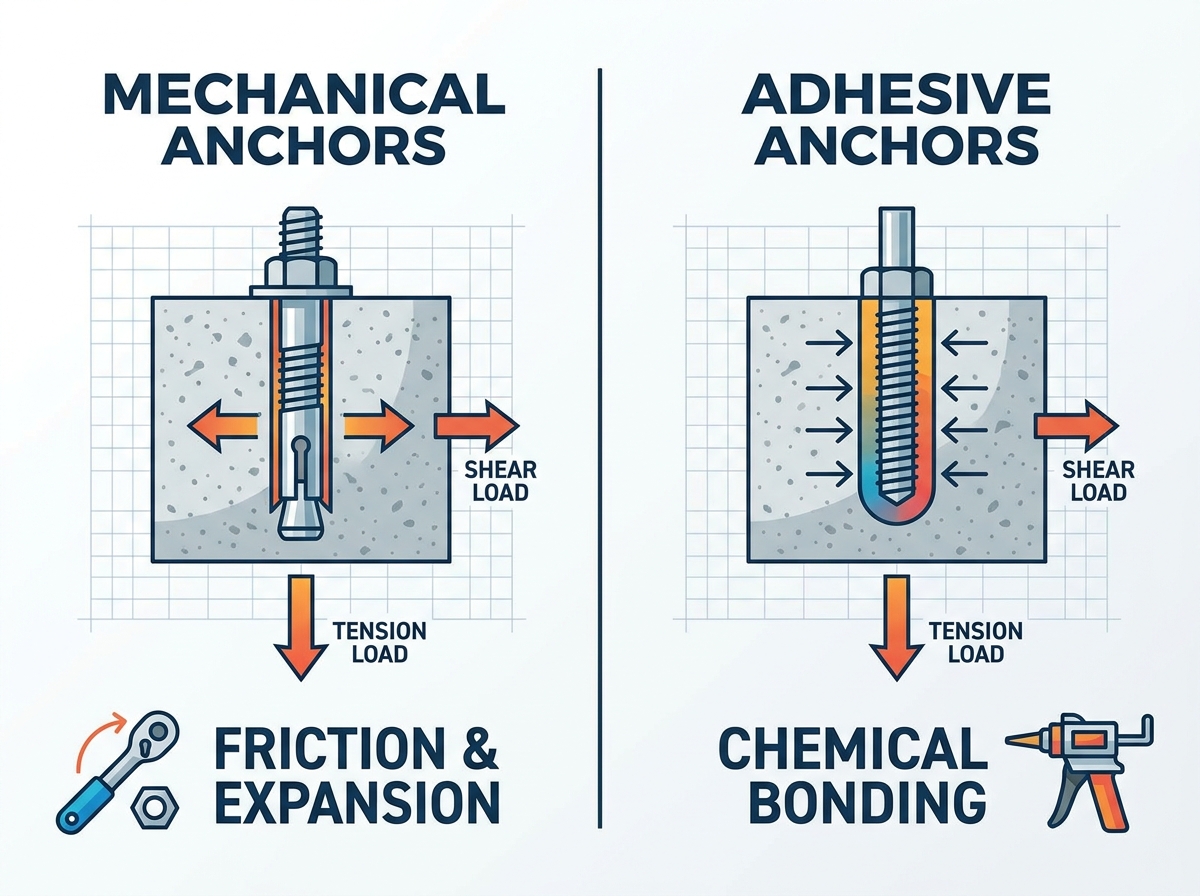
Categorizing solutions based on their expansion mechanism and load transfer method helps you specify the right product. Engineers generally divide these systems into two distinct families. They either use mechanical friction or chemical bonding to secure the load. Understanding these mechanisms prevents costly specification errors.
Mechanical fasteners rely on physical expansion against the base material walls. As you tighten them, they wedge themselves outward. This creates immense friction.
Wedge Anchors: These remain the industry standard for Heavy duty concrete anchors. They feature a steel stud featuring a tapered mandrel. As you tighten the nut, a metal clip rides up the taper. It bites aggressively into the solid concrete. They provide exceptional holding power. However, they are entirely non-removable once you torque them down. You must cut them flush if you need to clear the surface later.
Concrete Anchor Screws (Tapcons/Masonry Screws): These fasteners utilize a hardened steel thread. They cut their own threads directly into the base material. You benefit from extremely fast installation. They are also fully removable. Because they do not exert outward expansion pressure, they allow for much closer edge distances. When contractors need temporary holds, Concrete anchor screws perform exceptionally well.
Drop-in Concrete Anchors: These feature internally threaded, flush-mount inserts. They require a specific setting tool to strike an internal plug. This plug forces the bottom of the shield to expand. They are ideal for overhead threaded rod installations, including HVAC ductwork and sprinkler systems. Using Drop-in concrete anchors leaves a clean, flush finish when you remove the threaded rod.
Sleeve Anchors: These versatile expansion fasteners suit highly irregular base materials. The steel sleeve expands along the entire length of the fastener. You can confidently use them in cinder block, brick, or older masonry. They distribute the expansion force over a larger area, preventing blowouts in softer materials.
Chemical systems utilize a two-part injection resin. They typically rely on epoxy or acrylic compounds. They bond a threaded rod or ribbed rebar directly to the concrete pores.
You will find them essential for cracked concrete and severe vibratory loads. They also excel in close-to-edge installations where mechanical expansion would cause concrete spalling. Adhesives distribute the load stress evenly along the entire embedment depth. Selecting from the various Types of concrete anchors ensures you match the physical mechanism directly to the structural demand.
Engineers must evaluate technical data sheets rigorously. You cannot base a structural decision solely on a catalog's highest listed number. Real-world conditions reduce these theoretical capacities significantly.
Forces act on fasteners in different geometric directions. Tension represents the pull-out force. This pulls the fastener straight out of the hole. Shear load refers to a perpendicular force. This pushes down or cuts across the fastener shaft. You must verify manufacturers' data against the specific direction of the applied force. A fastener might boast high shear strength but fail rapidly under moderate tension.
Never design a framing system using the ultimate load capacity. The ultimate load represents the exact point of catastrophic material failure. The industry standard mandates applying a strict 4:1 safety factor. This translates to using just 25% of the ultimate load. You must use this allowable load for all safe working calculations. Failing to apply this safety factor invites severe structural liability.
Procurement and engineering teams must aggressively look for ICC-ES Evaluation Reports (ESRs). These documents prove independent, third-party verification of performance claims. If you build in earthquake-prone regions, you desperately need seismic approvals. Check for Category C through F certifications. Commercial specification strictly requires these validations. Inspectors will reject uncertified hardware instantly.
| Load Type | Force Direction | Primary Consideration | Safety Factor Rule |
|---|---|---|---|
| Tension | Pulling straight out (Vertical) | Embedment depth and base material strength | Use 25% of Ultimate Load |
| Shear | Pushing across (Horizontal) | Steel strength and cross-sectional area | Use 25% of Ultimate Load |
| Dynamic | Vibratory or cyclic | Chemical adhesives resist loosening better | Requires engineering evaluation |
Matching the fastener to its specific application remains critical. Structural framing, heavy machinery, and MEP all demand highly unique approaches. You must align the hardware capabilities with the environmental realities.
When securing wood sill plates to foundations, shear strength dominates the engineering requirement. The hardware must resist high winds and lateral shifting. Specifying Concrete anchor bolts for framing requires focusing heavily on local building code mandates. These codes dictate exact spacing intervals and strict edge distances. Framing hardware must penetrate deeply enough to bypass the weaker top layer of the foundation slab.
Equipment that vibrates introduces severe dynamic stress. Industrial presses, commercial vehicle lifts, and backup generators will shake standard mechanical fasteners loose over time. The cyclic loading wears down the concrete friction points. Chemical adhesives or heavy-duty undercut fasteners are strictly required here. They resist cyclic loading and maintain structural integrity under continuous, violent vibration.
Suspended piping, heavy cable trays, and strut channels present unique safety hazards. They operate entirely in the tension zone. Gravity pulls them downward constantly. Leveraging specific fasteners designed explicitly for overhead use is vital. Note the strict safety data restrictions on certain mechanical fasteners. Many wedge styles are explicitly prohibited in tension-zone overhead applications due to pull-out risks during seismic events. Always verify overhead approval via the ICC-ES report.
Common Mistake: Using standard wedge expansion fasteners for suspended overhead loads in seismic zones. The vibration can widen the hole, causing the wedge clip to lose its bite and drop the load entirely.
The surrounding environment and the physical base material dictate your final choice. A high-quality fastener will fail miserably in the wrong substrate.
Concrete naturally cracks as it cures, settles, and bears weight. Tension zones in concrete slabs usually exist on the underside of a suspended slab. Engineers assume these zones are cracked. Specific fasteners are mandated for these environments. Standard friction fasteners may slip if a micro-crack widens. Adhesive epoxies or specialized undercut systems accommodate these micro-fissures safely.
Wedge fasteners fail completely in hollow CMU blocks. The expansion pressure blows out the back of the fragile concrete web. When facing hollow materials, you must pivot your strategy. Toggle bolts or screen-tube adhesive systems work best. A screen tube contains the epoxy while allowing it to form a solid plug inside the void. Every single Concrete Anchor relies entirely on the structural integrity of what surrounds it.
Choosing the wrong metal leads to rapid, dangerous degradation. Moisture and chemicals will eat through standard steel quickly.
Best Practice: Never mix dissimilar metals in wet environments. Mating a galvanized nut to a stainless steel threaded rod triggers galvanic corrosion, destroying the connection rapidly.
Even the best-engineered product fails if contractors install it poorly. Field execution determines ultimate safety. You must train installation teams on strict protocols.
You must use ANSI-standard carbide drill bits exclusively. Worn or non-standard bits create oversized or irregular holes. An oversized hole reduces friction dramatically. This causes catastrophic failure under load because the expansion clip cannot grip the walls. Always replace bits according to manufacturer wear-mark guidelines. A bit that loses just a fraction of a millimeter in diameter ruins the holding power.
Dust left in the hole acts as a dangerous, frictionless lubricant. It severely degrades both mechanical expansion grip and chemical adhesive bonding. You must implement the strict "Blow-Brush-Blow" method.
This strict protocol ensures a pristine bonding surface. Leaving dust in an adhesive application prevents the epoxy from penetrating the concrete pores, causing the cured plug to slip out entirely under tension.
Relying on "feel" represents a major structural liability. Over-torquing stretches the steel past its yield point. It can also induce a concrete breakout failure by crushing the base material. Conversely, under-torquing allows the fastener to slip downward. The necessity of calibrated torque wrenches during rollout cannot be overstated. You must follow the exact foot-pound specifications listed on the packaging.
For chemical adhesive solutions, project scheduling must explicitly account for curing. Gel times and full cure times are highly temperature-dependent. Cold weather significantly delays the cure. Extreme heat accelerates it to unmanageable speeds, hardening the epoxy before you can insert the rod. Always consult the technical data sheet for temperature charts before injecting epoxy. Do not apply load until the full cure time elapses.
Reliable fastening remains a holistic, system-level decision. It requires perfect alignment between the hardware type, load data, and exact installation protocols. Neglecting any of these elements jeopardizes the entire structure. To ensure successful project outcomes, keep these action items in mind:
A: Embedment depth depends entirely on the fastener type, diameter, and load requirements. Always follow the manufacturer's specified minimum embedment depth found in the technical data sheet. Generally, heavier tension loads demand deeper embedment to prevent concrete cone failure. Drilling deeper than required is fine, but falling short reduces capacity exponentially.
A: No, the expansion clip permanently bites into the concrete walls once torqued. You cannot pull it out without destroying the surrounding concrete slab. To remove the tripping hazard, you must cut the threaded stud flush with the surface using an angle grinder and pound the remainder downward.
A: Use masonry screws when you need fast installation, removability, or close edge distances for light to medium loads. Choose a wedge design for permanent, heavy-duty structural applications where ultimate tension and shear load capacities are paramount, such as securing heavy machinery.
A: Standard acrylic adhesives fail in damp or water-filled holes. If you encounter wet conditions, you must specify specialized epoxies engineered and certified explicitly for water-saturated environments. Always clear standing water unless the specific product holds a rating for submerged installation.


