
Views: 0 Author: Site Editor Publish Time: 2026-08-13 Origin: Site
Selecting the wrong fastener represents a silent structural risk. You might accidentally drive an indoor nail into treated exterior lumber. Or you might choose an incorrect gauge for load-bearing walls. These errors often lead to failed inspections, severe corrosion, or structural withdrawal over time.
The decision requires more than just picking a length. You must carefully align your choice against building codes and International Residential Code (IRC) requirements. You also need to consider environmental exposure and tool compatibility. Pneumatic tools and hand-driven techniques demand entirely different approaches.
This guide breaks down exact framing nails specifications, sizing frameworks, and finish requirements. You will learn how to confidently procure the right fasteners for your specific project. We aim to help you guarantee structural integrity while avoiding costly mistakes.
Properly evaluating Framing nails specifications starts by examining the fastener head and shank. Head types directly influence both tool capacity and structural holding power. Clipped head nails feature a distinctive D-shaped top. This design allows dense collations in nail gun magazines. You fit more fasteners per strip, saving reloading time. However, building inspectors sometimes restrict clipped heads in hurricane or high-wind zones. Full round head nails provide maximum holding power. They are universally code-compliant across all jurisdictions. They resist pulling through structural sheathing much better than clipped heads.
Shank profiles determine how the fastener interacts with wood fibers. You must choose the right profile for your specific task.
Common Mistake: Using smooth shanks for subfloors often leads to squeaky floors. As the wood dries and shrinks, smooth fasteners slowly pull loose.
You cannot approach fastener selection through guesswork. The local International Residential Code (IRC) dictates exact fastening schedules. These schedules mandate precise details. For example, they define exactly how many nails you need for a stud-to-plate connection. Building inspectors strictly enforce these spacing and quantity rules.
Engineers design specific shear wall requirements based on regional seismic activity. You must check ICC-ES evaluation reports when substituting fastener types. These reports prove structural equivalency. If you plan to use alternative collated fasteners, always verify their ICC-ES certification first. This ensures your chosen product legally matches the performance of a traditional common nail.
You will frequently encounter the "penny" system when purchasing fasteners. The letter "d" historically stood for denarius, a Roman coin. Centuries ago, a 16d designation indicated the cost of 100 nails. Today, the "d" measurement simply acts as a proxy for physical length. Understanding this system is crucial for selecting the proper Framing nails size.
Different structural connections require specific fastener lengths. We have compiled a standard matrix to simplify your selection process.
| Penny Size (d) | Length (Inches) | Primary Application |
|---|---|---|
| 16d | 3 ½ inches | The universal standard for framing 2x dimensional lumber. Ideal for nailing through a top plate into a wall stud. |
| 12d | 3 ¼ inches | Used for doubling up standard 2x lumber, such as headers or trimmers. |
| 10d | 3 inches | Also used for doubling lumber where a longer 16d might poke through the opposite side. |
| 8d | 2 ½ inches | Standard for attaching OSB or plywood sheathing to wall members. Excellent for tying in subfloors. |
You must understand the structural difference between common nails and sinker nails. A common fastener features a thicker gauge and a wider head. It delivers the maximum structural rating possible. However, the thick diameter makes it prone to splitting dry or brittle wood.
Sinker nails utilize a slightly thinner gauge. They feature a textured head to prevent hammer slippage. Manufacturers usually coat sinkers in a thin layer of vinyl. This vinyl acts as a lubricant, making them drive much easier. You must always check local building codes before substituting sinkers for commons in sheer walls. The thinner gauge reduces overall shear capacity.
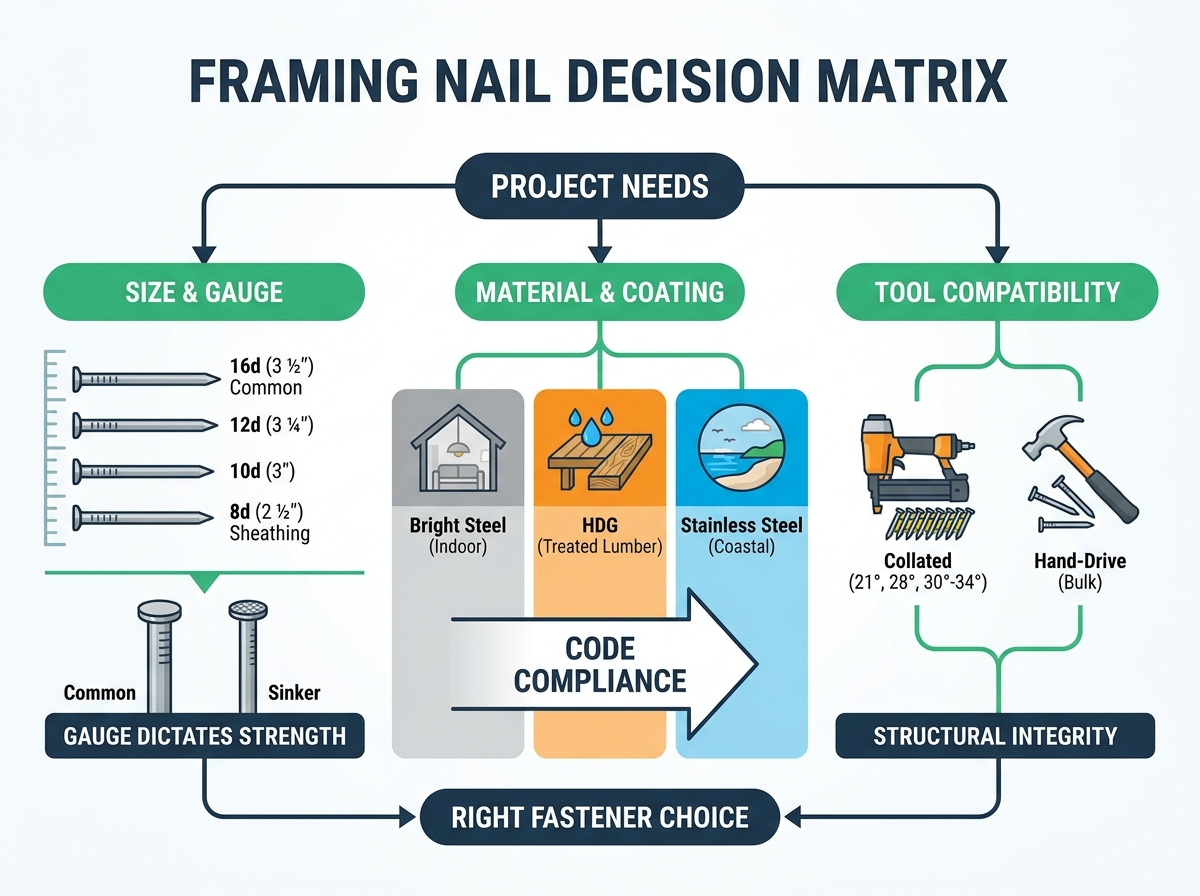
Bright steel fasteners lack any protective coating. They offer excellent driveability and high shear strength. You should reserve them strictly for interior framing. They work perfectly for interior partition walls and protected roof assemblies. However, their primary limitation is zero corrosion resistance. They will rust quickly if exposed to ambient moisture. Furthermore, they offer no protection against the highly corrosive chemicals found in pressure-treated wood.
Electro-galvanized fasteners feature a very thin layer of zinc. Manufacturers apply this zinc via an electrical current. You can use EG products for interior applications with slight moisture exposure. They also work for temporary exterior use. However, the zinc layer remains too thin for permanent structural exterior framing. You must never use EG finishes on pressure-treated lumber. The chemicals will eat through the thin zinc immediately.
Hot-Dipped Galvanized represents the baseline standard for exterior framing. You should use HDG for decks, outdoor stairs, and fencing. They are absolutely mandatory for any contact with modern ACQ pressure-treated lumber. The manufacturing process creates a thick, rough barrier of zinc. This barrier effectively resists aggressive chemical corrosion. They cost more than bright steel, but they guarantee exterior structural longevity.
Stainless steel delivers the ultimate protection against severe environments. You should select Type 304 or 316 for coastal construction zones facing salt spray. They also prevent ugly black tannin staining in cedar and redwood applications. You must use them for permanent treated-wood foundations. The main trade-off is the highest upfront cost. However, stainless steel entirely eliminates the risk of fastener failure in severe weather conditions.
Pneumatic and cordless nailers deliver unmatched speed and massive scale. These tools require specialized collated strips or coils. You must carefully match the collated angle to your tool's exact magazine angle. Failure to match the angle results in severe tool jams.
Sometimes a bulky nail gun simply cannot reach the target. In these scenarios, manually driving the fastener becomes necessary. You should purchase Framing nails for hammer when doing punch-out work. They also excel in tight spaces where a gun won't fit physically. Small DIY projects often do not justify the cost of pneumatic equipment.
Hand-driving requires bulk cartons of loose fasteners. We highly recommend choosing vinyl-coated sinker nails for manual work. Hammer friction melts the vinyl coating slightly as you strike it. The melted vinyl acts as a temporary lubricant to sink the fastener easily. Once the metal cools, the vinyl sets as a mild adhesive inside the wood.
Before placing a bulk order, you should finalize a few technical details. Check your specific tool to verify the nail gun angle. Next, confirm your exact lumber type. Treated lumber dictates an entirely different finish than untreated wood. Finally, consult the local building inspector’s fastening schedule. Confirming these details ensures you purchase exactly what the project requires.
Fastener selection remains an engineering decision, not just a casual hardware choice. You must analyze the specific application before buying supplies. Balancing tool compatibility with environmental demands prevents structural failures. The golden rule is simple: Correct size plus correct coating plus code compliance equals structural longevity.
Always align your purchases with IRC requirements and material demands. We strongly encourage you to review your project plans against the matrix provided above. Direct your attention to specific fastener categories like HDG, Bright, Collated, or Loose configurations based on your unique criteria.
A: It depends heavily on your local building codes. Sinkers utilize a slightly thinner gauge than common fasteners. This thinner profile reduces wood splitting but offers lower overall shear strength. Many jurisdictions legally prohibit replacing commons with sinkers in engineered shear walls. Always verify your local shear strength requirements before making a substitution.
A: Bright steel offers absolutely no corrosion resistance. Modern pressure-treated lumber contains high levels of copper preservatives. These chemicals trigger rapid galvanic corrosion when they contact untreated steel. Your fasteners will rust and disintegrate very quickly. This chemical reaction inevitably leads to complete structural failure.
A: They remain widely accepted in many inland regions. However, inspectors restrict them heavily in specific high-wind or seismic zones. States like Florida and California enforce strict withdrawal strength regulations. Full round heads provide significantly higher holding power against uplift. You must always defer to your local IRC amendments.
A: Nails naturally bend under sideways pressure. This flexibility provides excellent shear strength during building shifts or settling. Screws offer vastly superior withdrawal strength, resisting pull-out forces aggressively. However, screws can be quite brittle. They tend to snap rather than bend under heavy shear loads.


