
Views: 0 Author: Site Editor Publish Time: 2026-07-23 Origin: Site
Specifying fasteners for high-load environments carries immense responsibility. A single point of failure can lead to catastrophic consequences. You simply cannot afford guesswork when securing critical infrastructural elements. When heavy-duty applications fail, they immediately trigger structural damage, massive safety hazards, and severe compliance liabilities.
This guide provides a definitive, decision-stage framework. It helps structural engineers and contractors evaluate, shortlist, and select the exact fastening solutions needed. You will learn how to navigate complex load dynamics, assess varying substrate conditions, and understand harsh installation realities.
We avoid marketing fluff to focus purely on load physics, code compliance, and material limitations. By analyzing sheer forces, tension requirements, and environmental threats, you can pinpoint the correct fastening mechanism. Read on to build a safer, more resilient structure from the ground up.
Evaluating an anchoring scenario requires breaking down the exact forces acting on the connection. Structural integrity depends on understanding how applied forces interact with the concrete substrate over time. You must accurately model the mechanical stress to avoid premature failure.
Every connection faces two primary types of mechanical stress. You must calculate these metrics independently before combining them.
Most real-world applications involve combined loading. An anchor supporting a heavy steel bracket experiences both tension pulling it outward and shear pressing it downward. Engineers must calculate interaction formulas to ensure the connection survives both forces simultaneously.
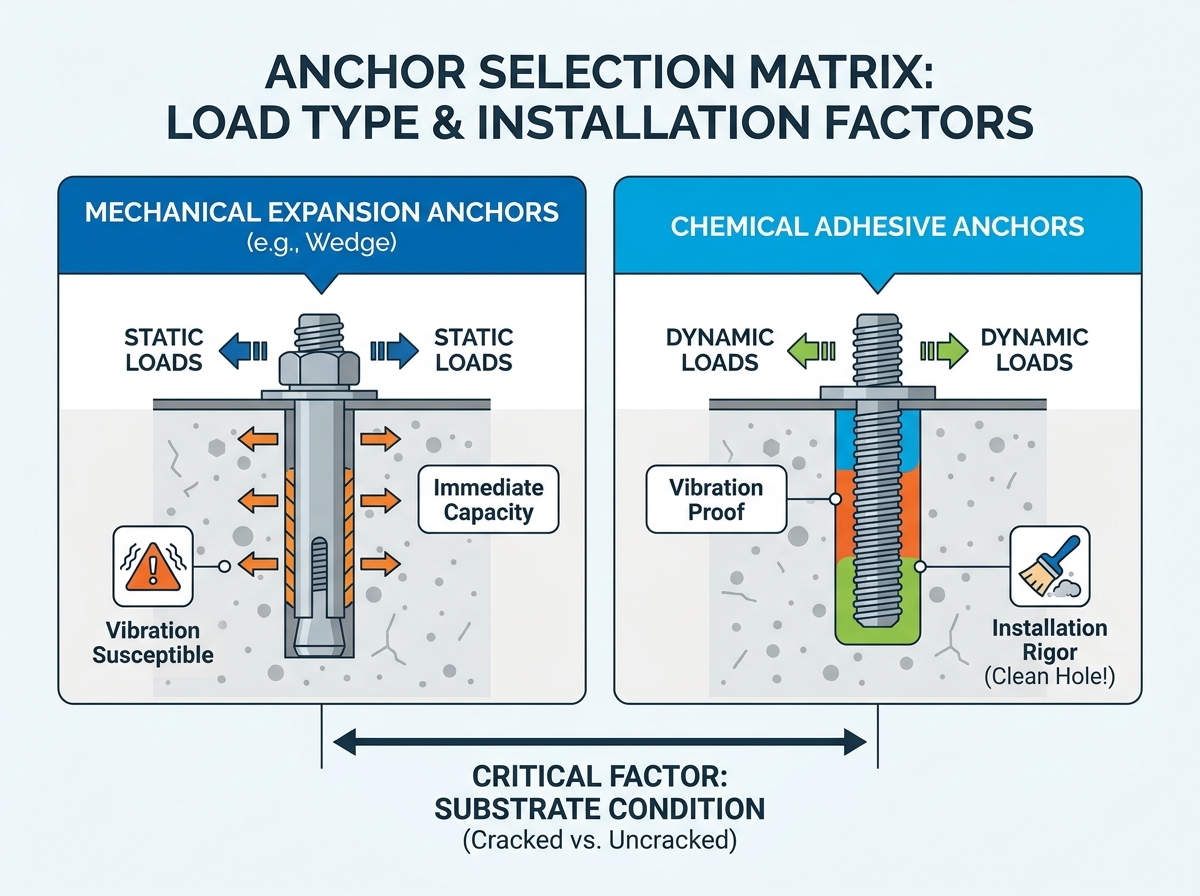
Static loads consist of dead-weight structural elements. They do not move, vibrate, or shift. Standard mechanical anchors handle static loads efficiently.
Dynamic loads create continuous, shifting energy. Machinery vibration, high wind loads, and seismic activity introduce cyclical stress into the concrete. Over time, this movement degrades the friction grip of standard mechanical anchors. Dynamic environments mandate specialized decision frameworks. You must prioritize chemical adhesives or specialized expansion mechanisms designed to resist micro-movements.
Modern building codes, including ACI 318, operate on a specific assumption. They assume all concrete will eventually crack under tension. Micro-cracks naturally intersect with drilled holes. This interaction relieves the internal friction necessary for mechanical anchors to hold.
Therefore, Heavy duty concrete anchors must carry cracked concrete ratings. These specialized components feature unique sleeve designs or adhesive bonding properties. They accommodate substrate expansion without causing blowouts. Ignoring this rating during seismic events guarantees a catastrophic loss of load capacity.
Navigating the various Types of concrete anchors requires objectivity. Each mechanism possesses distinct limitations and ideal use cases. By matching the mechanical action to your load profile, you ensure long-term structural safety.
Wedge anchors utilize friction-based locking mechanisms. As you apply torque to the nut, the internal wedge pulls upward. This action expands the metal clip forcefully against the concrete walls.
Pros: They provide immediate load capacity upon installation. You do not wait for curing times. They offer high shear and tension values in uncracked concrete.
Cons: They remain highly susceptible to loosening under extreme vibration. The continuous expansion force can cause edge spalling if installed too close to the concrete boundary.
Chemical anchors bond directly to the concrete pores. Installers inject a two-part epoxy or acrylic resin into the drilled hole before inserting a threaded rod or rebar.
Pros: They deliver ultimate holding power. Because they create no expansion stress, they are perfect for close-to-edge applications. They are entirely vibration-proof, making them ideal for dynamic loads.
Cons: They require precise installation techniques. Curing times halt immediate loading. Installers must carefully monitor ambient temperatures during application.
These fasteners cut their own threads directly into the concrete substrate. They do not rely on expansion clips or chemical bonds.
Pros: They install rapidly. Because they create zero expansion pressure, they excel in edge-close installations. Concrete anchor screws are completely removable. They serve perfectly for temporary heavy loads or racking systems requiring future reconfiguration.
Cons: They may strip the concrete threads if over-torqued. They typically offer slightly lower ultimate tension values compared to deep-set epoxies.
Drop-ins feature a hollow, internally threaded cylindrical body. Installers drive an internal expansion plug down to the bottom of the anchor using a setting tool. This forces the base to flare out and lock into the concrete.
Pros: They provide a flush finish. You can repeatedly insert and remove threaded bolts without damaging the anchor. Drop-in concrete anchors are ideal for overhead threaded rod suspension.
Cons: They require precise hole depths. They are generally restricted to solid, uncracked concrete applications.
Selection goes beyond picking a category. You must cross-reference your chosen mechanism against spatial geometry, environmental threats, and security requirements.
Holding power relies on the volume of the concrete stress cone. Shallower embedment yields smaller stress cones, drastically reducing tension capacity. Manufacturers publish strict minimum embedment depths for every diameter.
Edge distance dictates shear performance. Mechanical anchors exert massive outward pressure. If placed too close to a slab edge, this pressure fractures the concrete outward, causing a blowout. A standard rule of thumb demands mechanical anchors maintain an edge distance of at least ten times their diameter. Conversely, chemical anchors generate no expansion stress. You can safely place them much closer to edges.
Steel degradation destroys structural connections. Matching the metallurgical properties to the environmental threat is critical.
| Environment | Threat Level | Recommended Material | Typical Applications |
|---|---|---|---|
| Interior / Dry | Low (Climate Controlled) | Carbon Steel (Zinc-Plated) | Indoor racking, dry HVAC suspension, interior handrails. |
| Exterior / Moisture | Moderate (Rain, Humidity) | Hot-Dipped Galvanized (HDG) | Outdoor steel framing, sill plates, exterior signage. |
| Marine / Chemical | High (Saltwater, Chlorides) | 316 Stainless Steel | Coastal infrastructure, wastewater plants, chemical facilities. |
Evaluate human interference alongside environmental threats. Standard hex head applications work well for enclosed industrial facilities. However, infrastructural and public works require tamper-resistant features. Anti-vandalism designs utilize specialized driver heads. They prevent unauthorized removal in penitentiaries, public transit stations, and urban infrastructure grids. If a connection secures a public asset, specify secure-head variations early in the planning phase.
Bridging the gap between theory and execution requires practical scenarios. Here is how engineers specify solutions for common high-load challenges.
Securing a building's skeleton demands uncompromising shear strength. Wind and seismic events push laterally against the structure, transferring massive shear loads into the base connection.
Recommendation: Specify heavy-duty wedge anchors or specialized Concrete anchor bolts for framing. Focus heavily on code-compliant shear strength. Ensure the selected fasteners hold ICC-ES approvals for cracked concrete. Use hot-dipped galvanized variants if the framing contacts treated lumber, as timber preservatives rapidly corrode standard zinc plating.
Industrial presses, generators, and robotic arms create intense, continuous vibration. Mechanical clips degrade quickly in these scenarios. The micro-movements pulverize the concrete directly surrounding the expansion clip, leading to eventual pullout.
Recommendation: Utilize chemical anchors or specialized dynamic-load mechanical anchors. Adhesive systems bond the entire threaded rod to the concrete matrix. This distributes vibration evenly and prevents concrete fatigue. It ensures the machinery stays securely bolted over decades of continuous operation.
Hanging thousands of pounds of infrastructure overhead requires flawless tension performance. Gravity constantly works to pull these connections out of the ceiling. Furthermore, these environments often face strict fire-rating requirements.
Recommendation: Rely on internally threaded inserts or drop-ins. These systems prioritize high overhead tension ratings. They allow contractors to thread standard rods directly into the ceiling flush-mount. Always verify the fire-resistance standards of the chosen anchor to ensure it will not melt or yield during a structural fire.
Even the finest engineering specifications fail if field execution is poor. The gap between a data sheet and job site reality is where catastrophic failures occur.
Adhesive systems fail primarily due to poor hole cleaning. Up to 50% of chemical anchor failures happen because installers ignore manufacturer cleaning instructions. Drilling creates fine silica dust. This dust coats the inside of the concrete pores.
If you inject epoxy without cleaning, the resin bonds to the loose dust, not the solid concrete. Strict adherence to the "blow-brush-blow" method is mandatory. Workers must use compressed air to blow out dust, scrub the walls with a wire brush, and blow it out again. This protocol removes the silica barrier and guarantees ultimate adhesive performance.
Contractors often believe tighter is better. With a mechanical Concrete Anchor, over-torquing is disastrous. Exceeding torque specifications forces the expansion wedge too far up the shaft. This crushes the concrete substrate immediately surrounding the clip.
Once the localized concrete fractures, the anchor loses its friction grip. The holding value drops instantly. Always require calibrated torque wrenches on the job site. Never allow installers to set expansion systems using unregulated impact drivers.
Never rely solely on a manufacturer's internal testing claims. Guide buyers and procurement teams to demand verifiable data. Reputable structural components must carry independent certifications.
Emphasize checking for ICC-ES Evaluation Reports (ESR). These reports confirm the product meets the rigorous testing criteria of the International Building Code (IBC) and International Residential Code (IRC). An active ESR document ensures the anchor passed independent, third-party validation for shear, tension, and seismic performance before you approve bulk procurement.
Choosing the correct fastening solution requires balancing complex load physics, environmental threats, and installation precision. You must categorize your load as static or dynamic, calculate required shear and tension capacities, and account for cracked concrete conditions. Mechanical expansion systems excel in static, uncracked applications, while chemical adhesives dominate high-vibration and edge-close scenarios.
Field execution remains just as critical as the initial specification. Strict adherence to torque limits and dust-removal protocols prevents catastrophic job site failures.
As your next step, consult your structural engineer using the framework provided here. Access technical data sheets (TDS) and ICC-ES submittal documents in your supplier's product catalog. Verify the data against your exact site requirements to guarantee a compliant, failure-proof installation.
A: Chemical adhesives generally offer the highest ultimate tension capacity. They bond seamlessly with the concrete pores along the entire embedment depth. This distributes the load evenly. Provided the concrete substrate is robust and hole preparation is flawless, epoxies outperform mechanical options in sheer holding power.
A: Yes. Large-diameter structural concrete screws are rated for extremely heavy loads. They cut their own threads into the substrate, generating zero expansion stress. This gives them the distinct advantage of complete removability while maintaining high shear and tension capacities.
A: Follow the standard rule of thumb regarding anchor diameter multipliers. Space mechanical anchors at least ten anchor diameters apart. This spacing prevents their internal stress cones from overlapping. Overlapping stress cones drastically weaken the surrounding concrete and lead to premature failure.
A: You risk catastrophic failure. Concrete naturally cracks under tension or settling. If a micro-crack intersects an unrated anchor hole, the anchor loses its expansion friction and pulls out instantly. Using unrated fasteners violates modern building codes and creates severe compliance liabilities during seismic events.


