
Views: 0 Author: Site Editor Publish Time: 2025-11-19 Origin: Site
Flange nuts are an engineering marvel designed to simplify assembly lines and improve holding power, but they are frequently misunderstood. While these fasteners streamline operations by eliminating the need for separate washers, incorrect installation can lead to catastrophic failures like vibration loosening, thread galling, or permanent surface damage. The integrated flange acts as a load-distributing base, yet many technicians treat it exactly like a standard hex nut, missing critical nuances in torque application and surface preparation. Whether you are securing structural steel or assembling sensitive electrical components, understanding the mechanics of the flange face is non-negotiable.
This guide covers the professional protocols for installing serrated and smooth face flange nuts across various industrial and automotive applications. We will explore material compatibility, specific torque requirements, and the physics behind the locking mechanisms. This content is designed for industrial technicians, DIY automotive enthusiasts, and facility managers who demand compliant, durable fastening solutions that won't fail under pressure. You will learn exactly how to achieve structural integrity without damaging your workpiece.
The "No-Washer" Rule: Flange nuts are designed to replace separate washers; adding one often compromises the locking mechanism.
Serrated vs. Smooth: Use serrated faces for vibration resistance and smooth faces for surface protection (e.g., coated busbars).
Torque Control: "Hand-tight" is insufficient for structural integrity; calibrated torque is required to activate the flange tension.
Reusability: Distorted thread flange nuts are typically single-use; serrated nuts wear down the mating surface upon reuse.
Before you even reach for a wrench, successful installation begins with selecting the correct hardware variant. Not all flange nuts perform the same function. Misidentifying the locking mechanism or choosing incompatible materials creates weak points in your assembly before a single thread is turned. You must assess the environment—specifically vibration levels and surface sensitivity—to make the right choice.
The primary distinction between variants lies in how they maintain clamp load. Choosing the wrong type often results in either a loose assembly or a damaged substrate.
| Variant Type | Mechanism | Primary Application | Installation Note |
|---|---|---|---|
| Serrated Flange | Friction / Biting | High-vibration environments (automotive, machinery). | Requires torque to set the "teeth" into the metal. |
| Distorted Thread (Top Lock) | Thread Interference | Critical structural joints exposed to extreme shock. | Hard to install; requires tools immediately after starting threads. |
| Smooth / Plain Flange | Load Distribution | Oversized holes or soft materials. | Non-locking; strictly used to protect surfaces and spread load. |
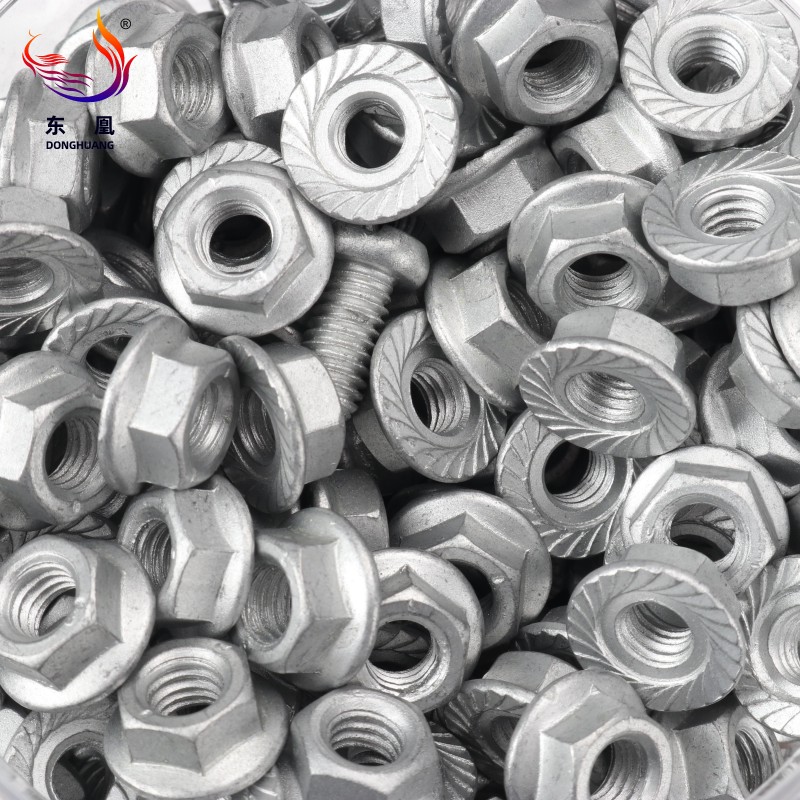
These are the industry standard for vibration resistance. The underside of the flange features angled serrations or teeth. When tightened, these teeth bite into the mating surface, creating a ratchet-like effect that resists counter-clockwise rotation. They are excellent for steel-on-steel applications but can be destructive to painted surfaces or soft alloys.
Top lock nuts rely on thread interference rather than surface friction. The top portion of the nut is slightly deformed (ovalized) during manufacturing. This deformation creates significant friction against the bolt threads, preventing loosening even if clamp load is lost. These are generally harder to install because you cannot spin them down by hand; you need a tool as soon as the bolt reaches the distorted section.
If your goal is purely to cover an oversized hole or prevent the nut from sinking into a soft material (like wood or plastic), a smooth flange is ideal. It acts strictly as a built-in heavy-duty washer. It offers no inherent locking capability beyond standard thread friction.
A common failure point involves chemical interactions between the nut and the bolt or base material. You must ensure compatibility to prevent corrosion and stripping.
Mixing metals is a recipe for disaster. If you pair stainless steel flange nuts with zinc-plated bolts or aluminum surfaces, you invite galvanic corrosion. In the presence of moisture, the less noble metal (anode) corrodes rapidly. If dissimilar metals are unavoidable, you must use a dielectric separation barrier or a high-quality anti-seize compound to inhibit the electron flow between materials.
The strength of your nut must match the strength of your bolt. Fastener systems are designed so that the bolt yields before the nut threads strip. If you use a lower-grade nut on a high-strength bolt (e.g., a Grade 5 nut on a Grade 8 bolt), the internal threads of the nut will fail under torque before the bolt achieves proper tension. Always verify that the nut's proof load matches or exceeds the bolt's tensile strength.
Once the correct hardware is selected, the installation process requires discipline. Rushing through these steps leads to cross-threading and inconsistent clamping force. Follow this professional protocol to ensure a secure fit.
The area under the flange acts as the bearing surface. If this area is dirty, the nut cannot seat flush. Debris, rust, or thick paint under the flange creates a temporary bridge. Over time, this debris crushes or moves, causing the nut to lose tension—a phenomenon known as embedment relaxation.
Clean the mating surface thoroughly. Simultaneously, inspect the bolt threads. Burrs or dings on the bolt can cause the nut to seize prematurely, giving a false torque reading. You might think the nut is tight, but it is actually just stuck on a damaged thread, leaving the joint loose.
Power tools are efficient, but they are the leading cause of cross-threading. Never start a nut with an impact gun. Always start the nut by hand for the first two to three threads.
Pro Tip: Place the nut on the bolt and turn it counter-clockwise first. You will eventually feel a distinct "click" as the start of the nut thread drops past the start of the bolt thread. This aligns the helixes perfectly. Once you feel the click, begin turning clockwise. This simple tactile check virtually eliminates cross-threading.
Run the nut down the bolt until the flange base touches the workpiece. If you are using standard serrated nuts, this should be smooth and effortless.
For Top Lock/Distorted Thread variants, expect resistance. You will likely need a wrench long before the base hits the surface. This resistance is the locking feature working correctly, not a defect. However, if the resistance feels like immediate binding or grinding (galling), stop immediately. True locking resistance is smooth and consistent; galling feels abrupt and gritty.
Tightening is the most critical phase. The goal is to stretch the bolt slightly, creating a clamp load that holds the assembly together.
These require sufficient torque to force the serrations to bite into the metal surface. "Hand-tight" is never enough for serrated flanges. Without proper torque, the teeth merely rest on the surface rather than digging in. Refer to standard torque charts (such as SAE J429 or metric ISO 898) relevant to your bolt size and grade. Use a calibrated torque wrench for structural applications.
When installing flange nuts on brittle substrates like porcelain toilets or plastic housings, standard torque specs do not apply. Following a steel-on-steel chart here will crack the workpiece. The rule of thumb for these delicate applications is "snug plus one-quarter turn." This compresses the gasket or washer slightly without exerting crushing force on the substrate.
This is perhaps the most debated topic in fastener installation. Many technicians instinctively reach for a flat washer out of habit, but doing so with a flange nut is usually a mistake.
The short answer is: Generally, No.
Flange nuts are engineered specifically to eliminate the need for washers. The wide flange distributes the load just like a washer would. If you place a flat washer under a serrated flange nut, you create a failure point. The serrations will bite into the washer, locking the nut to the washer effectively. However, the washer itself often remains smooth on the bottom side. This creates a "skate" or free-spinning surface against the workpiece. Under vibration, the washer—and the nut attached to it—can rotate together, causing the assembly to loosen. The locking mechanism is essentially neutralized.
There are rare exceptions where protecting the surface takes precedence over vibration resistance. This is common in electrical applications, such as connecting cables to copper or aluminum busbars, or on painted automotive body panels.
Scenario: You are securing a terminal to a soft copper busbar. A serrated nut would gouge the copper, creating deep grooves that promote oxidation and increase electrical resistance.
Solution: Do not use a serrated flange nut with a washer to "fix" this. Instead, switch hardware entirely. Use a smooth face flange nut which distributes pressure without gouging. Alternatively, use a standard hex nut paired with a flat washer and a lock washer. This ensures surface protection without relying on an incompatible locking method.
Even seasoned professionals encounter issues. Most failures stem from environmental factors or technique errors rather than defective hardware. Here is how to diagnose and fix the most common problems.
Cause: This is often due to "embedment relaxation." If you installed the flange over thick layers of paint, rust, or dirt, that material will eventually compress or crumble under the pressure. As the material thins out, the distance between the nut and the bolt head effectively shortens, causing a loss of tension.
Fix: Ensure surfaces are bare metal or thinly coated before installation. For critical equipment, implement a re-torquing schedule. Retorque the nuts after the first heat cycle or a set number of operation hours to take up any slack caused by relaxation.
Cause: This is prevalent when using stainless steel fasteners. The oxide layer that protects stainless steel can break down under the high friction of tightening, causing the metal threads to fuse together. This typically happens when using high-speed impact drivers.
Fix: Slow down. High speed generates heat, which accelerates galling. Install stainless steel nuts by hand or at low RPMs. Additionally, use a suitable anti-seize lubricant. Note that adding lubricant reduces friction, so you may need to reduce your target torque setting by 20-30% to avoid over-stretching the bolt.
Limit: The flange is designed to bridge holes, but it has limits. Ideally, the flange must cover the hole completely, with at least 50% of the flange area overlapping solid material. If the hole is too large, the edges of the flange unsupported. Under load, the flange will "cup" or dish inward like a funnel. This deformation weakens the nut and can cause it to pull through the hole entirely.
Fix: If the hole is excessively large, a flange nut alone is insufficient. You must use a thick, hardened structural washer (not a standard thin washer) beneath the flange to bridge the gap rigidly.
The term "flange nut" can mean different things depending on the industry. Context is vital to ensure you are using the right tool for the job.
In the IT world, technicians often talk about "installing nuts on rack flanges." In this context, they are usually referring to Cage Nuts, not hex flange nuts. Cage nuts are square nuts inside a spring steel cage that clip into square holes on server racks.
Pro Tip: Installing these requires a specific insertion tool. Attempting to compress the spring clips with your bare fingers often results in cuts or pinched skin. Always use the proper leverage tool or a flat-blade screwdriver to compress the cage clip during insertion.
Automotive applications introduce high heat and road salt. Exhaust manifolds specifically use copper-plated or specialized alloy flange nuts. These are designed to withstand thermal expansion cycles without seizing permanently to the stud.
Warning: Never replace a heat-rated exhaust flange nut with a standard zinc-plated nut from a hardware store. The standard nut will corrode rapidly and seize, likely snapping the stud the next time you try to remove it.
Correct installation of flange nuts is less about brute force and more about compatibility. It requires matching the flange type—whether serrated or smooth—to the mating surface and resisting the urge to add redundant washers. By understanding the mechanics of the flange face, you ensure that the load is distributed evenly and the locking mechanism functions as intended.
Your final decision factor should always be the operating environment. If the application involves high vibration, prioritize serrated or prevailing torque flange nuts and adhere strictly to torque specifications. If surface protection is paramount, opt for smooth flanges. By following these protocols, you transform a simple fastener into a critical component of structural reliability.
A: The wide "skirt" or flange always touches the surface of the workpiece. The hexagonal part faces away from the surface so you can grip it with a wrench. Installing it upside down prevents the flange from distributing the load and renders the locking serrations useless.
A: It depends on the type. Serrated flange nuts can be reused if the serrations are still sharp, though they may hold less effectively. Distorted thread (top lock) nuts should ideally be replaced every time, as the locking deformation wears out after the first use.
A: Yes, for any structural, automotive, or critical machinery application. Tightening by "feel" or "hand-tight" is subjective and unreliable. Proper torque is required to stretch the bolt and engage the locking teeth of the flange.
A: This is likely a grade mismatch. If the nut is made of harder metal than the bolt (e.g., a Class 10 nut on a Class 4.6 bolt), the nut's internal threads will act like a cutting die and strip the softer bolt threads. Always match the grades.


