
Views: 0 Author: Site Editor Publish Time: 2026-08-08 Origin: Site
Fastening materials to masonry or poured concrete requires overcoming significant compressive strength. Using the wrong fastener doesn't just result in a weak bond—it creates immediate safety hazards through shattering or ricochets. Contractors and DIYers face a strict daily challenge. They must accurately balance holding power, specifically pull-out and shear strength, against overall installation efficiency. Standard hardware often fails abruptly in high-stress masonry environments. You need absolute certainty before striking the first blow. We structured this definitive evaluation framework to help you navigate these complex choices. It reliably guides buyers to select the exact nail chemistry, shank design, and installation method required. You will learn how to approach your specific structural or residential project safely. Careful selection prevents costly repairs and structural delays. Ultimately, picking the right fastener ensures a permanent, secure hold every time.
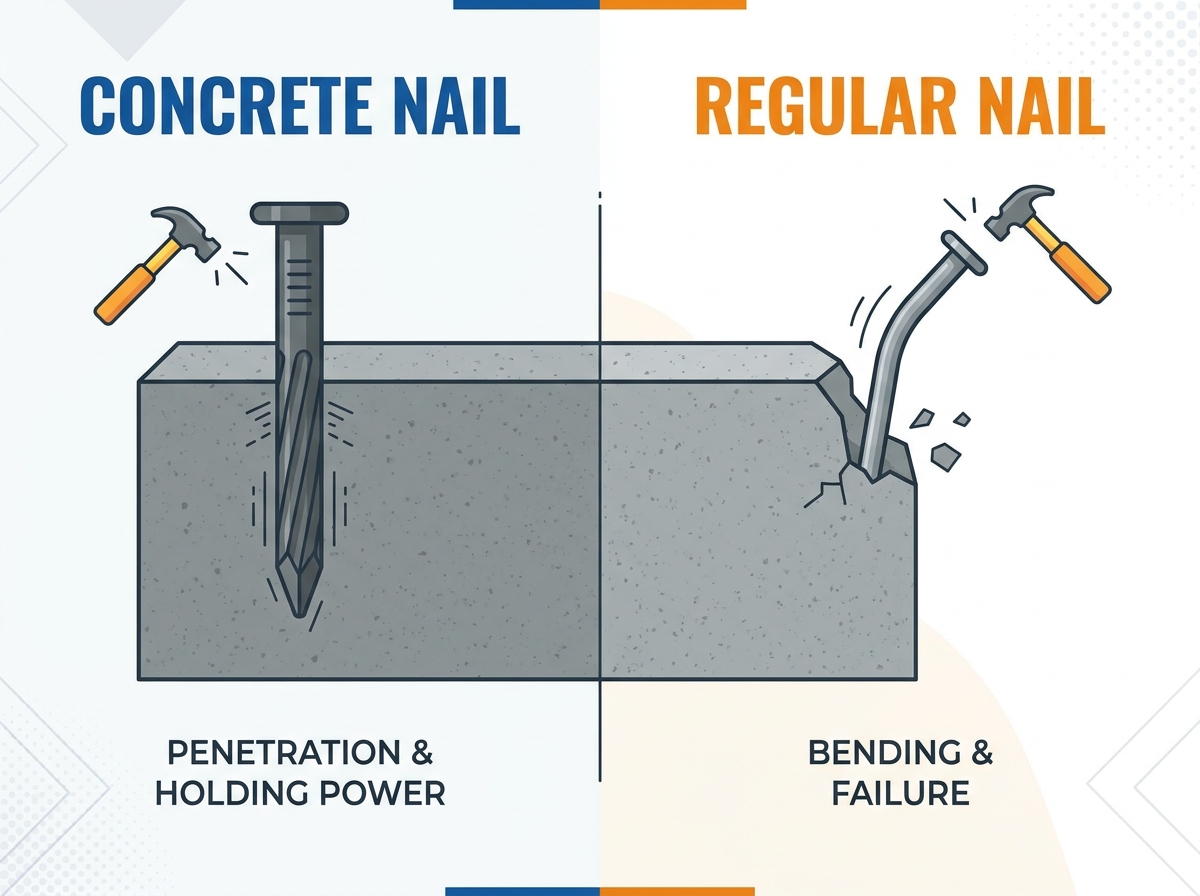
Understanding fastener performance begins at the metallurgical level. A standard Concrete Nail relies on high-carbon steel. Manufacturers subject this metal to intense heat treatment. This thermal process significantly increases structural hardness. Such extreme hardness prevents bending upon heavy impact. You strike it forcefully, and it stays perfectly straight. Conversely, regular common nails consist of mild steel. Mild steel is naturally softer and highly ductile. It bends safely when encountering dense knots. Wood framing heavily relies on this specific flexibility. Masonry, however, destroys soft steel almost instantly.
Shank architecture dictates how well a fastener grips. Regular wood nails typically feature smooth or ringed shanks. They primarily function by separating soft wood fibers. Masonry fasteners require an entirely different engineering principle. They utilize fluted, twined, or deeply knurled shanks. Driving them into dense materials displaces fine dust. The fluted grooves create immense surface friction. Displaced dust packs tightly into these empty grooves. This precise mechanical action locks everything firmly into place.
Head and point profiles also vary significantly between designs. Masonry options feature much thicker head profiles. They must withstand heavy, repetitive strikes constantly. Thin heads easily shear off under intense hammer blows. A robust head profile guarantees energy transfers directly downward.
Best Practices: Always inspect the shank fluting before purchasing. Deeper flutes generally provide superior holding power in aged slabs.
Common Mistakes: Never substitute standard roofing hardware for masonry tasks. The thin heads will snap immediately under heavy strikes.
Fastener Specification Comparison
| Feature | Masonry Fastener | Regular Wood Fastener |
|---|---|---|
| Steel Composition | High-carbon, heat-treated | Mild, low-carbon steel |
| Shank Design | Fluted, twined, knurled | Smooth, ring-shanked |
| Impact Resistance | Extremely high (resists bending) | Low (bends easily under pressure) |
| Primary Holding Mechanic | Friction and dust compression | Wood fiber separation |
Selecting the correct fastener depends entirely on your specific application. Certain scenarios absolutely demand heavy-duty masonry hardware. Attaching wooden furring strips to cinder blocks is one prime example. You need maximum penetration without cracking the hollow block. Securing heavy sill plates to poured slabs also requires them. Code compliance often dictates using specialized Concrete nails for framing in these critical basement areas. Furthermore, they excel in various general structural tasks. When tackling interior renovations, utilizing proper Concrete nails home improvement solutions guarantees lasting stability. This includes tacking down carpet strips or anchoring metal shelving tracks safely.
Regular nails remain perfectly sufficient for standard framing duties. Frame-to-frame connections rely on wood expansion and contraction. Exterior siding tasks also require traditional fastening methods. General carpentry benefits immensely from lateral shear flexibility. Houses naturally settle and shift over time. Mild steel bends slightly to accommodate this structural movement.
You must actively avoid the dreaded cross-over mistake. Many novices mistakenly use masonry fasteners for standard wood-to-wood joints. This creates a severe structural failure point immediately. High-carbon steel is incredibly hard but dangerously brittle. It cannot handle lateral structural shifts well. If house framing shifts, brittle pins simply snap in half. Regular mild steel bends safely, keeping the joint fully intact.
Best Practices: Map out your material transitions clearly. Use masonry hardware strictly where wood meets stone or cement.
Common Mistakes: Using brittle masonry pins for deck joists. They will inevitably snap under normal dynamic loads.
Implementation realities heavily dictate your choice of tooling. Manual hammering represents the traditional, time-tested method. It requires using heavier framing hammers weighing 20 ounces or more. Standard lightweight claw hammers simply lack sufficient driving momentum. Manual installation works best for small-scale, low-frequency fastening tasks. Tacking a single carpet strip perfectly fits this manual category. However, manual driving carries a significant physical caveat. It causes immense physical fatigue very quickly. You also face an increased risk of bending fasteners in high-PSI slabs. Glancing blows easily ruin perfect alignment.
Automated fastening systems completely transform large-scale productivity. Professional crews transition to pneumatic and powder-actuated systems rapidly. You should introduce a dedicated Concrete nail gun for any high-volume commercial work. Ramset tools and specialized pneumatic nailers drive pins flawlessly. These systems utilize specific Concrete nails for nail gun magazines or collated strips. Collated pins differ greatly from loose bulk varieties. They frequently feature a plastic washer or alignment flute. This plastic component ensures perfect tool alignment and enhances holding power.
Consider this evaluation lens when upgrading your toolkit:
Buying the correct hardware requires transparent, vendor-neutral evaluation metrics. You must first accurately assess your specific base material. Fastening into green, fresh slabs differs from aged substrates. Fresh cement accepts pins much easier due to higher moisture. Aged, high-PSI materials violently resist penetration. Cinder blocks and mortar joints also behave uniquely. Note carefully: mortar holds significantly less weight than solid block. Never anchor heavy structural loads directly into soft mortar lines.
Corrosion resistance needs strictly dictate your finishing choice. You generally choose between electro-galvanized and hot-dipped galvanized finishes. Both provide unique levels of protective oxidation barriers.
You must calculate your precise load requirements carefully. Pull-out resistance and shear load dictate required fastener lengths. Short pins simply pop out under moderate strain. Industry standards provide a highly reliable rule of thumb here. The fastener must physically penetrate the base material adequately. Aim for at least 1 inch to 1.25 inches of absolute depth. Add the thickness of your attached material to this penetration depth. This simple math yields your required purchase length.
Job site reality proves fastening masonry carries distinct physical risks. Shattering and high-speed ricochets remain the most prominent daily threats. Because high-carbon steel is exceptionally hard, it is inherently brittle. Striking a pin slightly off-center causes instant shattering. Shrapnel flies outward at dangerous velocities. We constantly emphasize the mandatory use of ANSI-rated eye protection. Safety glasses featuring the Z87.1 rating provide adequate shatter resistance.
Concrete spalling, commonly known as blowouts, ruins structural aesthetics instantly. Fastening too close to any slab edge causes this frustrating damage. The immense displaced pressure physically cracks the surrounding material outward. You must strictly follow the standard minimum edge distance rule. Always keep fasteners at least 3 inches away from any unprotected edge. This simple buffer zone safely absorbs the intense radial expansion.
Sometimes direct nailing simply proves impossible or unsafe. You must recognize when to abandon the hammer entirely. Highly aged, 4000+ PSI mixtures bend even the hardest steel pins. High-vibration environments eventually rattle friction-based pins loose over time. Heavy-shear load applications demand superior mechanical threading. In these tough scenarios, transition to the pre-drilling alternative immediately. Use a high-quality masonry bit and a rotary hammer first. Then install threaded masonry screws, like Tapcons, for ultimate security. They cut physical threads directly into the stone itself.
Best Practices: Always sweep the work area to ensure secure footing before swinging heavy hammers.
Common Mistakes: Ignoring the 3-inch edge rule leads directly to costly, unrepairable blowouts.
The core choice between regular and masonry hardware requires careful consideration. It ultimately comes down to analyzing base material density precisely. You must also evaluate specific pull-out and shear load requirements. Mild steel flexes perfectly for wood, but dense stone demands high-carbon rigidity. Fluted shanks securely lock into place through raw friction and compression.
Your specific project scale dictates your immediate next steps. For a minor, one-off basement wall repair, keep it simple. Buy a 1-pound box of fluted masonry pins and grab a heavy hammer. For a full commercial framing job, upgrade your strategy entirely. Invest smartly in a reliable powder-actuated system and collated pins. Productivity gains will quickly offset the initial tool investment costs.
Safety and proper preparation remain your highest priorities today. Browse our expansive product catalog to find exact sizes and finishes. Download a comprehensive load-capacity spec sheet before starting structural framing. Contact an experienced technical representative today for bulk project quoting and tailored advice.
A: Not strictly necessary for direct-drive masonry nails. They are engineered to penetrate independently. However, we highly recommend pre-drilling for high-PSI, highly aged concrete. Pre-drilling significantly prevents aggressive spalling and reduces the chance of shattering brittle pins.
A: Yes, but a standard lightweight claw hammer performs poorly. A heavier framing hammer weighing over 20 ounces is necessary. A specialized hand-drilling hammer or club hammer is much safer and significantly more effective for these hard impacts.
A: No. Standard framing nailers lack the required driving force for dense masonry. Furthermore, they cannot accept specialized collated concrete pins safely. A dedicated Concrete nail gun is absolutely required for automated tasks.
A: Bending usually results from hitting hard aggregate stones buried in the mix. Using a glancing hammer blow also forces the shank off-center. Attempting to manually drive pins into fully cured 4000+ PSI concrete without a powder-actuated tool guarantees bent hardware.


