
Views: 0 Author: Site Editor Publish Time: 2026-07-22 Origin: Site
Choosing the wrong fastener for a structural project carries massive risks. Structural failures, building code violations, and costly project delays can instantly derail your construction timeline. Safety liabilities also skyrocket when improperly specified fasteners fail under extreme structural loads. You likely have a specific commercial or heavy-residential project in mind right now. You need a reliable decision framework, not just a list of basic fastener definitions. The right choice dictates the long-term safety and integrity of your entire build. This guide provides an objective, evidence-based evaluation of industrial fastening systems. We base this evaluation strictly on load metrics, base material realities, and rigid installation constraints. You will learn how to match specific hardware to your exact site conditions. We will also cover compliance standards to ensure your next project holds strong from day one.
Discussing the substrate thoroughly is crucial before drilling begins. The physical state of the concrete ultimately dictates whether your fastener will hold. Green concrete is newly poured and still curing. It lacks the compressive strength needed to withstand heavy expansion forces. Installing fasteners into green concrete often results in immediate material failure. Cured uncracked concrete provides an ideal, solid base for most hardware. It supports maximum holding values because the matrix remains perfectly intact. However, modern engineering standards assume most commercial slabs act as cracked concrete. Tension zones naturally develop microscopic cracks under heavy structural loads. You must assume all commercial concrete is cracked unless testing proves otherwise.
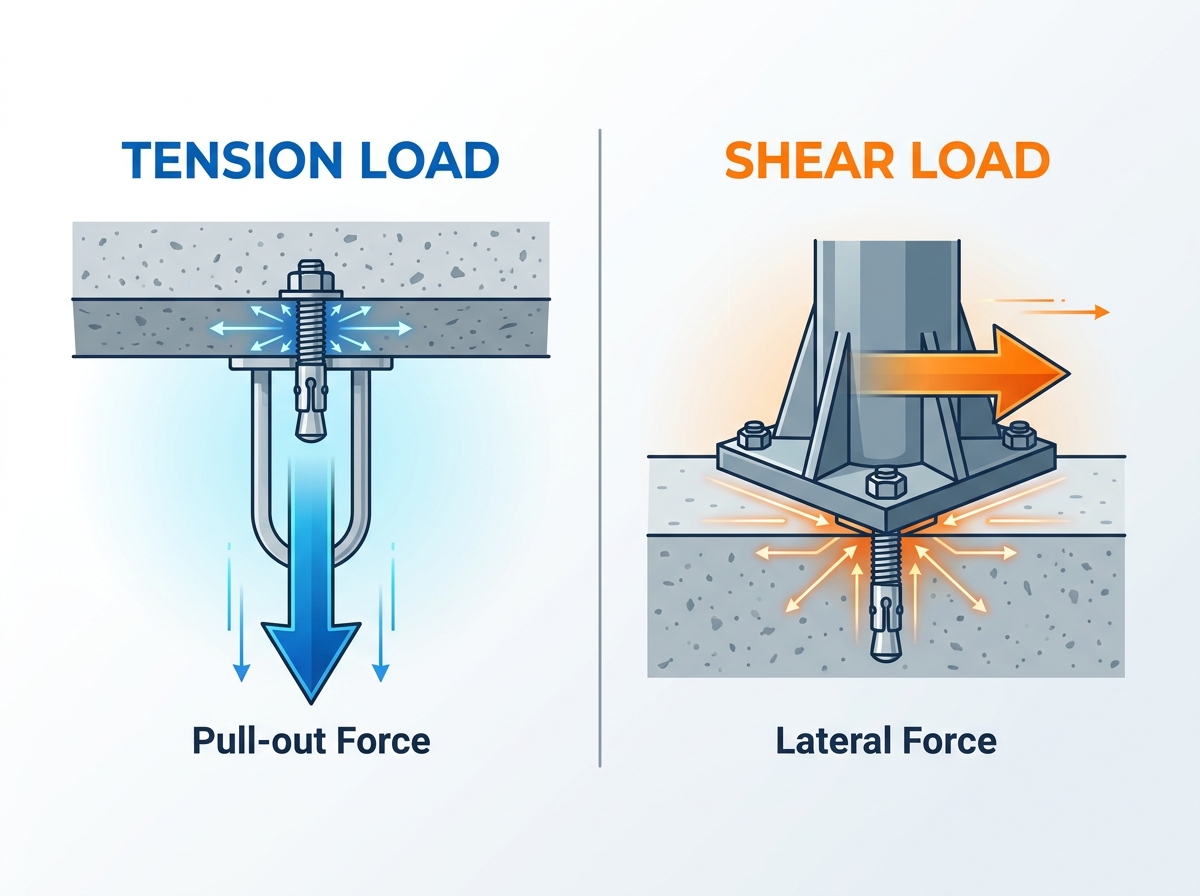
Evaluating load types requires a clear and objective decision matrix. Weight and force act on fasteners in two primary ways. Tension creates a direct, vertical pull-out force. Suspended loads like heavy lighting or overhead pipes exert pure tension. Shear applies a downward or horizontal force across the fastener shank. Heavy machinery mounting heavily relies on maximum shear strength.
| Load Category | Force Direction | Common Applications | Primary Risk Factor |
|---|---|---|---|
| Tension | Vertical pull-out (away from base) | Suspended ceilings, overhead HVAC, pipe rigging | Shallow embedment causing full anchor extraction |
| Shear | Horizontal/Lateral (across the shank) | Pallet racking, base plates, machinery bolting | Fastener snapping or concrete edge blowout |
Static loads remain completely constant over time. A heavy structural column provides a predictable static load. Dynamic loads fluctuate constantly and unpredictably. Wind shear, seismic activity, and vibratory machinery generate immense dynamic stress. Standard mechanical fasteners often fail completely under dynamic conditions. They slowly loosen under continuous vibration. You must specify appropriate dynamic-rated systems to prevent these creeping failures.
Understanding the vast Types of concrete anchors helps engineers prevent catastrophic structural failures. Each design serves a highly specific mechanical purpose.
These specialized fasteners dominate the structural construction industry. The mechanics rely on a simple but brilliant expansion clip design. You drive the fastener into a clean, pre-drilled masonry hole. Tightening the top nut pulls the tapered lower cone upward. This forces the stainless steel clip to expand outward violently against the hole walls. Heavy duty concrete anchors like these offer exceptionally high holding values. They excel particularly in solid, uncracked slabs. They also provide immediate load capability without waiting for curing times. However, they carry strict limitations. You cannot use them in hollow block materials. Installing them too close to unsupported concrete edges risks major spalling.
Tradesmen often call these Tapcons or masonry screws. They utilize advanced thread-tapping mechanisms directly into the base material. They offer incredibly fast installation for experienced crews. They are also entirely removable if project layouts change. You can confidently use Concrete anchor screws for tight, close-to-edge applications. They apply almost zero outward expansion force during installation. Unfortunately, they deliver much lower shear strength compared to thick wedge designs. The internal concrete threads will also wear out if you remove and reinsert them repeatedly.
These fasteners feature an internally threaded steel body. You expand them at the base using a specialized manual setting tool. You strike the tool heavily with a hammer to set the internal plug. This creates a completely flush surface on the finished slab. Workers can frequently insert and remove threaded rods without damaging the mount. Plumbers rely heavily on Drop-in concrete anchors for routing overhead HVAC systems. The main drawback involves precise hole depth requirements. You must drill the hole to the exact specified depth. They are also strictly designed for solid concrete, never hollow brick.
These units utilize a full-length metal expansion sleeve. They are highly versatile options for unpredictable job sites. They work seamlessly in solid concrete, hollow cinder block, and standard brick. The broader expansion area distributes weight evenly across weaker masonry. However, they generally hold a significantly lower load capacity than wedge variants. A single Concrete Anchor of this type handles medium-duty mounting tasks beautifully.
Engineers constantly weigh chemical adhesives against traditional mechanical fastening. Mechanical fastening relies heavily on generated friction. It utilizes massive outward pressure against the drilled walls. This creates a significant implementation risk in older materials. Over-torquing a mechanical unit can instantly shatter the surrounding base material. This localized blowout ruins the mounting point completely. Mechanical systems also create a cone-shaped stress field inside the slab. Placing them too close together causes these stress fields to overlap dangerously.
Adhesive or epoxy products function entirely differently. They create a continuous chemical bond along the entire hole depth. Two-part epoxy resins mix perfectly inside a static mixing nozzle during injection. This completely eliminates outward expansion stress on the concrete member. The cured chemical bond often exceeds the tensile strength of the substrate itself. Chemical systems distribute the load evenly across the entire embedded surface area.
Use this straightforward decision filter for your future projects. Frame adhesive as the mandatory, non-negotiable choice for cracked concrete. Use it exclusively for close-edge installations and high-vibration environments. Choose mechanical units strictly when you need rapid installation speed. Mechanical units remain the go-to solution for immediate load-bearing needs where waiting for epoxy to cure is impossible.
Different industrial environments dictate highly specific fastening strategies. Understanding these distinct use cases prevents costly rework and structural danger.
Wood and steel framing applications require exceptionally robust solutions. Securing wooden sill plates to structural foundations is a code-heavy requirement. Cast-in-place L-bolts sit directly in the wet cement during pouring. They offer unparalleled strength for completely new builds. Post-installed options handle retrofit framing applications perfectly when poured bolts are missing. Selecting properly rated Concrete anchor bolts for framing ensures rigid structural stability during severe wind events.
Heavy machinery and industrial racking demand highly specialized approaches. Forklift impacts and dense inventory pallets generate extreme shear forces. Vibratory conditions from stamping presses easily loosen standard fixings over time. We highly recommend heavy-duty wedge designs or high-strength epoxy for industrial racking. They resist continuous lateral vibration effectively. They also keep heavy base plates firmly anchored against the warehouse floor.
Suspended mechanical, electrical, and plumbing systems have distinct safety standards. Contractors hang heavy cast-iron pipes and dense conduit racks continuously. Drop-in units stand as the undisputed industry standard for these overhead applications. They allow rapid overhead threaded rod installation using trapeze hangers or strut channels. Maintenance teams can easily adjust or replace these suspended rods later without drilling new masonry holes.
Temporary versus permanent fixings require a completely distinct evaluation process. Concrete formwork and temporary wall bracing demand fast removability. Threaded masonry screws easily unscrew from the slab when the temporary job finishes. Permanent structural steel columns require unyielding, tamper-proof permanence. Thick wedge units lock structural steel base plates down forever.
Real-world installation practices dictate ultimate fastener success. Even the best engineering specifications fail through poor field execution.
Installation risks routinely compromise specified load capacities. We observe three leading causes of structural fastening failure on modern jobsites:
Strict compliance and authoritativeness ensure long-term site safety. Procurement teams and structural engineers must require ICC-ES evaluation reports. The International Code Council Evaluation Service rigorously tests these products globally. You absolutely need these documented reports for structural, seismic, or cracked-concrete applications. Building inspectors routinely check commercial sites for these specific compliance marks. Failing an inspection for non-compliant hardware causes severe project delays.
Implementation efficiency matters heavily on large-scale jobsites. We must shift the evaluation from single component tracking to full installation efficiency. Evaluate the specific labor time required per installed unit. Factor in heavy hammer drill time for deeper holes in dense slabs. Account for exact chemical curing times when using epoxy resins. Cold weather drastically extends epoxy gel times. Include overall hourly labor output in your final project timeline estimates. Focusing purely on installation speed often dictates the winning fastener choice.
No single fastening solution is universally superior for every commercial job. Base material integrity heavily dictates your best overall option. Load dynamics, vibration risks, and physical installation constraints also play crucial roles. You must evaluate tension forces, shear risks, and dynamic loads carefully before drilling.
Always consult official structural engineer specifications before proceeding with large installations. Review comprehensive manufacturer load tables closely prior to any final procurement. Request updated technical specification sheets for your selected products. Order in appropriate bulk quantities once your engineering team approves the final submittals. Taking these deliberate steps ensures your structural additions remain safely anchored for decades.
A: Wedge configurations typically provide the strongest mechanical hold in solid, uncracked slabs. Epoxy or chemical adhesives offer the highest overall strength for compromised, cracked, or vibrating substrates. The strongest option always depends directly on whether you face tension, shear, or dynamic loads.
A: You can easily remove and reuse threaded masonry screws for temporary applications. Drop-in styles allow you to unscrew the threaded rod, though the base stays permanently in the slab. Expansion wedge variants are strictly permanent and cannot be reused or removed without cutting.
A: The industry-standard rule of thumb requires specific spacing to prevent masonry blowout. You should space them at least 10 anchor diameters apart from one another. Additionally, place them a minimum of 5 diameters away from any unsupported slab edge.
A: Yes, you absolutely need a rotary hammer drill. Standard drill motors cannot penetrate hard masonry effectively. A hammer drill creates the accurate, clean, and perfectly round holes essential for achieving rated load capacities safely.


