
Views: 0 Author: Site Editor Publish Time: 2025-10-20 Origin: Site
You use machine screws every day and may not notice. These small threaded fasteners help join two or more things. They are used a lot with metal parts in many products. Machine screws have even threading and fit well into nuts or tapped holes. You can find them in electronics, machinery, cars, and buildings. Their accuracy and dependability make them a top choice for many industries. When you need strong and flexible fasteners, machine screws are a good answer.
Machine screws are small fasteners with threads. They join metal parts in many products like electronics and machines.
Pick the correct thread type and size for your project. This helps make the fit strong and exact.
Machine screws work well with nuts or tapped holes. This gives a solid connection and stops them from coming loose.
There are different head styles and drive types to choose from. You can pick the best one for what you need.
Using good materials like stainless steel or brass makes machine screws last longer. These materials also help stop rust.
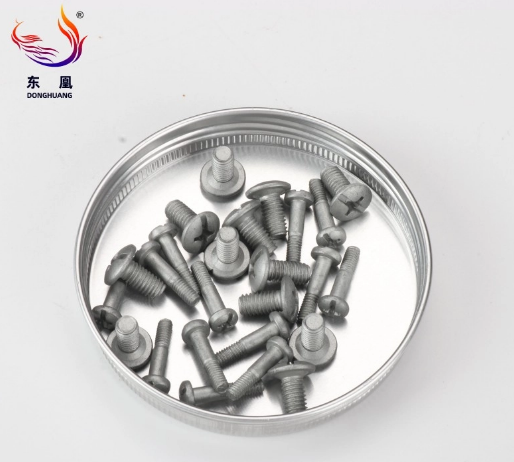
You see machine screws in many products around you. These small fasteners have a straight, uniform thread that runs from the top to the bottom. The thread size stays the same along the entire length. This design makes them different from other screws that have a tapered thread. Most machine screws have a diameter of 1/4 inch or less, but some can be as large as 0.75 inches. You can find them in many head types, such as slotted, Phillips, and even Torx.
Machine screws fit into nuts or pre-threaded holes. You use them when you need a strong and precise connection. They work well in electronics, machinery, vehicles, and appliances. You can choose from many materials, including steel, stainless steel, brass, and nylon. The most common thread patterns follow the Unified Thread Standard. You may see types like Unified National Coarse (UNC) and Unified National Fine (UNF). Metric machine screws use a different system, showing the diameter and thread pitch in millimeters.
Tip: When you select a machine screw, check the thread type and size. This helps you get the right fit for your project.
You might wonder how machine screws compare to other screws. The main difference comes from the threading and how you use them. Machine screws have uniform threads and need a pre-threaded hole or a nut. Other screws, like wood screws or sheet metal screws, often make their own hole as you drive them in.
Here is a table to help you see the differences:
Feature | Machine Screws | Other Screw Types |
|---|---|---|
Threading | Coarse (24 threads/inch) and Fine (32 threads/inch) | Usually tapered, create their own hole |
Usage | Used in pre-threaded holes for strong joints | Used in many materials, often without pre-threaded holes |
Applications | Electronics, engines, industrial equipment | Wood, sheet metal, general construction |
You use machine screws when you need a reliable and strong joint, especially in metal parts. They are common in electronics, engines, and industrial machines. Other screws work better in wood or thin metal, where you do not need a pre-threaded hole.
Machine screws give you a precise fit.
They are stronger than many other fasteners because they use nuts or tapped holes.
You find them in many industries, from electronics to vehicles.
When you choose between machine screws and other screws, think about the material and the strength you need. Machine screws work best when you want accuracy and a secure hold.
You use machine screws to make things stay together. The threading is very important for how these fasteners work. Each machine screw has threads that go evenly along its shaft. These threads grip tightly when you turn the screw into a nut or tapped hole. The threads help keep the screw in place. They stop it from coming loose when you use it.
When you twist the screw, you start fastening. This makes tension, called preload, which stretches the screw a little. Preload keeps the parts pressed together. If you pick the right locking method, you make the connection safer and more reliable. Loose screws can break machines, so fastening them well is important.
Here are some ways threading helps hold things tight:
Preload makes tension in the screw.
Locking methods like washers or thread-locking compounds stop loosening.
The thread design helps keep the fastening secure.
Tip: Always check the thread type and size before you install. This helps you avoid wrong parts and makes sure the fit is tight.
You can use machine screws with nuts or tapped holes. Nuts give a strong hold when you join parts. Sometimes, you need a washer to spread the load and protect surfaces.
Machine screws also work with tapped holes. Tapped holes have threads inside made by a tapping tool. These threads match the screw, so you can fasten parts without a nut. Tapped holes and threaded holes mean the same thing in many places.
Here is a quick look at how they work together:
Machine screws work with nuts for extra strength.
You can screw them into pre-threaded holes or through drilled holes.
Washers may be needed for good fastening.
Tapped holes have threads inside for machine screws.
Tapped holes give the grip needed for strong fastening.
Note: Tapped holes are used a lot in electronics and machines. They save space and give a smooth finish.
You want fasteners that work well for your projects. Makers use strict checks to make sure machine screws are high quality. Dimensional tolerances matter because they affect how the screw fits with nuts or tapped holes. If the screw is not the right size, it may not hold tight.
Makers check thread size, head size, and length with special tools. They look at surface roughness and check for problems. Quality control also means testing things like tensile strength and hardness.
Here is a table showing common quality checks:
Quality Control Measure | Description |
|---|---|
ISO 9001:2008 certified | Certification for quality management standards |
Compliance with customer requirements | Makes sure products meet client standards |
Mechanical properties testing | Checks tensile and yield strength |
Hardness testing | Tests Brinell and Rockwell hardness values |
Inspection equipment | Uses gauges, calipers, microscopes, and hardness testers |
Companies like Ningbo Donghuang Hardware Co., Ltd. use advanced tools and strict checks. This makes sure you get machine screws that fit well and work every time.
Tip: Always buy machine screws from trusted makers who use strict quality checks. This helps you avoid trouble and makes sure your screws last a long time.
There are many kinds of machine screws you can buy. Each has its own head style and drive type. These features help you pick the right screw for your job. Flat heads are good when you want the screw to be even with the surface. Pan heads are used a lot because they have a rounded top.
Drive types matter too. Phillips head machine screws are very common. You use a cross-shaped screwdriver for them. Slotted head machine screws have one slot. You use a flat screwdriver for these. Hex head machine screws need a six-sided wrench. Socket head machine screws use a hex key or Allen wrench. Torx head machine screws have a star shape for better grip. Combination head machine screws let you use more than one tool. Security head machine screws help stop people from taking them out.
Here are the main head styles and drive types you will see:
Head Styles: Flat, Oval, Pan, Truss, Round, Hex, Hex Washer, Slotted Hex Washer, Socket Cap, Button
Drive Types: Phillips, Slotted, Combination, Socket, Hex or Allen, Torx, Square, Security
Security head machine screws are used where you want to keep things safe. Combination head machine screws are helpful when you want more choices for tools.
Name | Description | Common Uses |
|---|---|---|
Button | Low profile, rounded head | Furniture, appliances, equipment assemblies |
Cap | Tall, flat head with recessed socket drive | Sleek designs, high-torque installation |
Cheese | Tall, cylindrical head | Metal, automotive lighting, machinery |
Flat | Countersunk, flat head | Flush finishes, minimal interference |
Hex | Six-sided flat head | Industrial equipment, construction |
Pan | Slightly rounded top, flat underside | General applications |
Round | Rounded head | Decorative finishes |
Truss | Short top, wide base | Low-profile decorative finish, larger bearing surface |
Security | Tamper-resistant design | Public spaces, safety equipment |
Combination | Multiple drive options | Flexible installation, maintenance |
Tip: Pick the right head style and drive type for your job. This helps you get the best results.
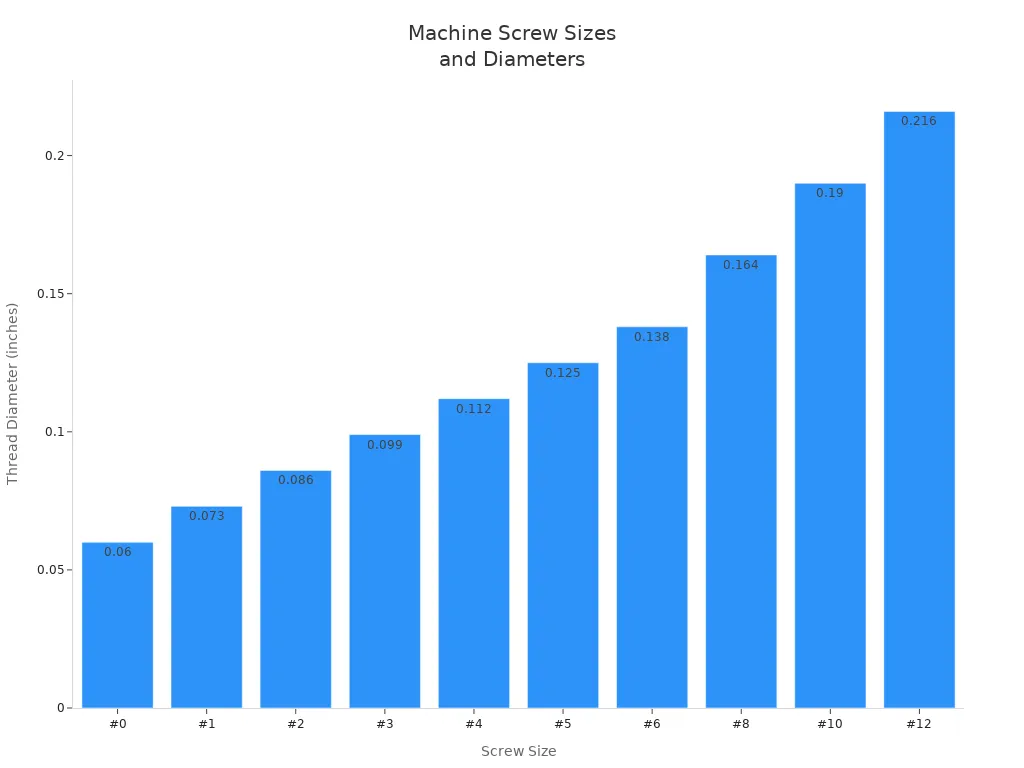
You need to choose the right size for your project. Machine screw sizes go from #0 to #12. These sizes work for electronics, machines, and building jobs. The thread diameter starts at 0.060 inches for #0. It goes up to 0.216 inches for #12. You see these sizes in many places.
Machine Screw Number Sizes | Nominal Thread Diameter (inches) |
|---|---|
#0 | 0.060 |
#2 | 0.086 |
#4 | 0.112 |
#6 | 0.138 |
#8 | 0.164 |
#10 | 0.190 |
#12 | 0.216 |
ISO metric threads are used all over the world. Unified Thread Standard is used a lot in North America. These rules help you pick the right machine screws for your area.
Note: Always check the size and thread standard before you buy. This helps you avoid problems when you put in the fasteners.
You can get phillips head machine screws, slotted head machine screws, hex head machine screws, socket head machine screws, torx head machine screws, combination head machine screws, and security head machine screws in many sizes. This gives you lots of choices for different jobs.
It is important to know the main machine screw materials. Steel, stainless steel, and brass are used most often. Each material has its own benefits for making machine screws.
Steel machine screws are strong and handle shaking well. You see them in machines and car parts. Stainless steel machine screws do not rust easily and are very strong. People use them outside, near water, or in damp places. Brass machine screws are not as strong but look nice and feel smooth. You find them in electronics and for decoration.
Here is a table that shows how these machine screw materials perform:
Property | Brass (C36000) | Stainless Steel (304, 316) | Steel (Carbon) |
|---|---|---|---|
Tensile Strength | 300–500 MPa | 500–1000 MPa | 400–800 MPa |
Yield Strength | 100–350 MPa | 200–600 MPa | 250–600 MPa |
Hardness (Brinell) | 55–100 HB | 150–250 HB | 120–220 HB |
Elongation at Break | 25–50% | 40–60% | 10–30% |
Fatigue Strength | ~100–200 MPa | ~200–600 MPa | ~150–400 MPa |
Modulus of Elasticity | ~97 GPa | ~190–210 GPa | ~200 GPa |
Impact Resistance | Moderate | High | Moderate |
Tip: Use stainless steel machine screws outside. Pick steel for tough jobs. Choose brass for electronics or decoration.
You want your fasteners to last a long time. The material and surface treatment affect how machine screws work. Stainless steel does not rust and lasts longer. Steel needs a coating to stop rust. Brass does not rust much but is softer than steel.
Common ways to treat machine screws include:
Black oxide
Electroplating (black zinc, black nickel)
Dacromet coating
White nickel
White zinc
Bare stainless steel
These treatments help machine screws fight rust and damage. At Ningbo Donghuang Hardware Co., Ltd., we use special treatments and careful checks. We have ISO 9001 for quality and ISO 898 for strength. Our machine screws are tested for strength, hardness, and rust resistance.
Standard | Type | Relevance |
|---|---|---|
ISO 9001 | Certifiable | Makes sure products are always good |
ISO 898 | Technical Standard | Shows how strong fasteners should be |
ISO 4042 | Technical Standard | Checks that coatings are done right |
IATF 16949 | Certifiable | Needed for car fasteners |
Note: Always look for quality certifications when you buy machine screw materials. Certified products work better and are safer.
If you need special machine screws or want help picking materials, contact our team at Ningbo Donghuang Hardware Co., Ltd. We have many fasteners for every job.
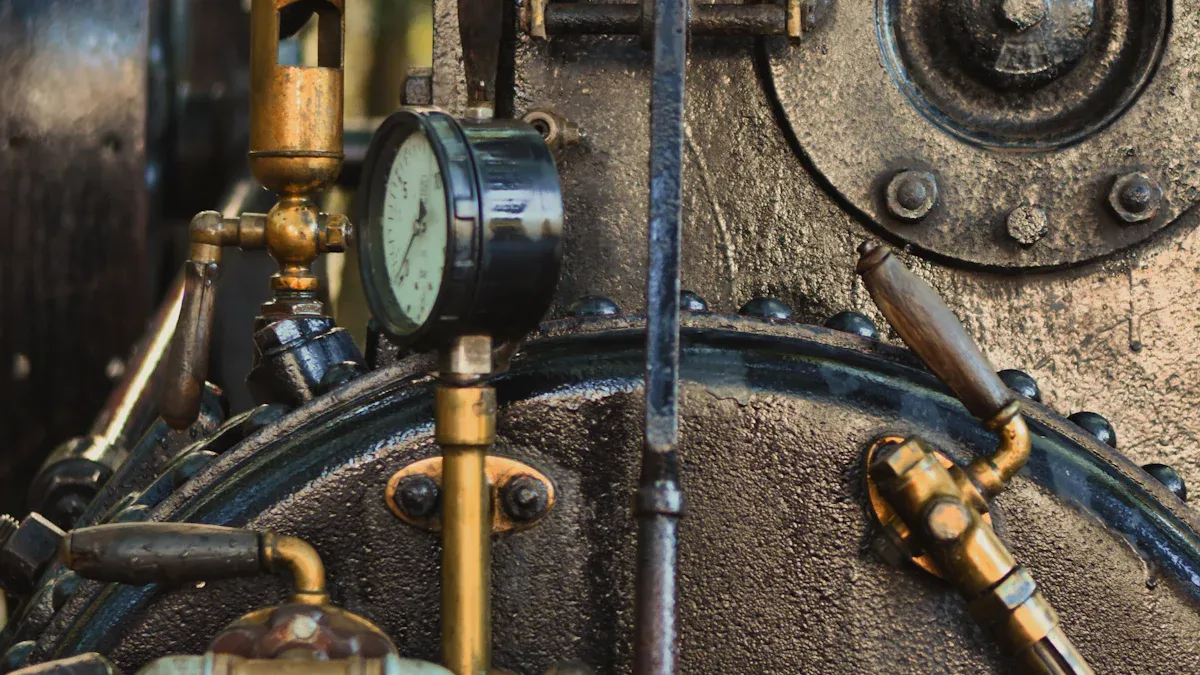
Machine screws are used in many industries. In electronics, they hold parts inside devices. Their small size helps fit parts in tight spaces. You see them in phones, computers, and home appliances. Stainless steel and brass machine screws do not rust. They also help with electricity.
In machinery and cars, machine screws keep parts together. You use them for license plates and headlights. They also hold engine parts. Construction workers use machine screws to join steel beams. They help build bridges and temporary buildings. Ships and airplanes need machine screws for strong connections.
Machine screws must handle shaking and movement. The material you pick affects how strong and tough they are.
Machine screws have many good points for your projects. Here are the main benefits:
Machine screws are small and fit many jobs.
They are strong and last a long time.
You can pick from materials like aluminum and stainless steel.
Machine screws handle shaking and stress better than other fasteners. Their shape and material help stop breaking, even in hard places. Using rust-proof materials keeps your screws working well, even with water around.
Benefit | Description |
|---|---|
Precise Fit and Compatibility | Custom screws fit your product parts perfectly. |
Design Flexibility | You can change screws for tough or special jobs. |
Improved Aesthetics | Custom screws make your product look better. |
Enhanced Performance | Special screws last longer and work better. |
Streamlined Assembly Process | Custom screws make building faster and easier. |
Intellectual Property Protection | Unique screws help stop people from messing with your products. |
Ningbo Donghuang Hardware Co., Ltd. can make screws just for you. You can ask for screws that match your drawings and needs. We check quality with plating, grinding, anodizing, heat treating, polishing, machining, thread rolling, and laser etching. These steps help you get strong and good screws for every job.
You want to install machine screws without problems. Try these tips for best results:
Pick the right screw for your job and material.
Drill pilot holes first to stop splitting and help placement.
Put screws in straight and at the right depth for best hold.
Press steady and change torque if needed.
Use more screws for heavy jobs to spread the weight.
Use anchors in hollow walls to keep things tight.
Use the same screw type and size for even strength.
Tip: Always read the maker's advice for installing and using screws. This helps you avoid mistakes and keeps your fasteners working well.
If you need special machine screws or help, contact Ningbo Donghuang Hardware Co., Ltd. We help with electronics, machines, ships, cars, and building. Our team gives you design help, ways to make screws, and strict checks for every job.
Machine screws help hold things together in many jobs. They are strong and fit tightly. You can pick different head styles for your tools. There are many thread types for different needs. Some threads are fast, some grip better and stop shaking. You can choose steel, stainless steel, brass, or aluminum. Pick the material that works best for your space. Always check the size and thread pitch before you buy. Follow rules like ISO or ANSI to make sure they fit. The table below shows what you should think about:
Factor | Description |
|---|---|
Head Styles | Pick for tool use and what you need |
Thread Types | Use coarse for speed, fine for grip and less shaking |
Material Selection | Choose steel, stainless steel, brass, or aluminum for your space |
Sizes/Standards | Look at diameter, thread pitch, and use ISO or ANSI rules |
Buy good screws from trusted companies like Ningbo Donghuang Hardware Co., Ltd. If you need help, ask for advice or special screws.
You use machine screws to join metal, plastic, or other materials. They work well in electronics, machinery, vehicles, and construction. You often see them in devices, engines, and building frames.
Check the hole size and thread type first. Match the screw diameter and length to your project. Use a table or chart for guidance. If you need help, ask Ningbo Donghuang Hardware Co., Ltd. for advice.
Stainless steel and brass machine screws resist rust best. Stainless steel works well outdoors or in wet places. Brass is good for electronics and decorative uses. Always pick the right material for your environment.
You can reuse machine screws if they show no damage or wear. Always check the threads and head before using them again. Replace any screw that looks bent or stripped.
You can buy high-quality machine screws from Ningbo Donghuang Hardware Co., Ltd. The company offers many sizes, materials, and custom options. Contact their team for expert support and fast delivery.


