
Views: 0 Author: Site Editor Publish Time: 2026-07-29 Origin: Site
Construction projects demand speed and reliability to stay profitable. You cannot afford constant equipment reloading when tight deadlines loom. A coil nail solves this problem by offering a high-capacity fastener collated in a circular roll. These rolls typically hold 150 to 300 nails designed for continuous pneumatic nailer operation. The primary return on investment comes from drastically reducing reload downtime during high-volume applications like roofing, framing, and pallet manufacturing.
However, specifying the wrong fastener brings serious risks to any project. Mismatched collation angles often cause frustrating tool jams and mechanical damage. Incorrect coatings lead to premature corrosion, structural failure, and expensive building code violations. You need to understand how these fasteners operate to maximize efficiency and maintain quality. We will explore the mechanics behind different collation types, shank designs, and environmental coatings. You will learn exactly how to match specific sizes and materials to your unique project requirements.
Understanding fastener mechanics helps you optimize labor efficiency on busy job sites. Builders constantly evaluate the trade-offs between tool weight and reload frequency. High-volume pneumatic fasteners change the dynamics of heavy construction entirely.
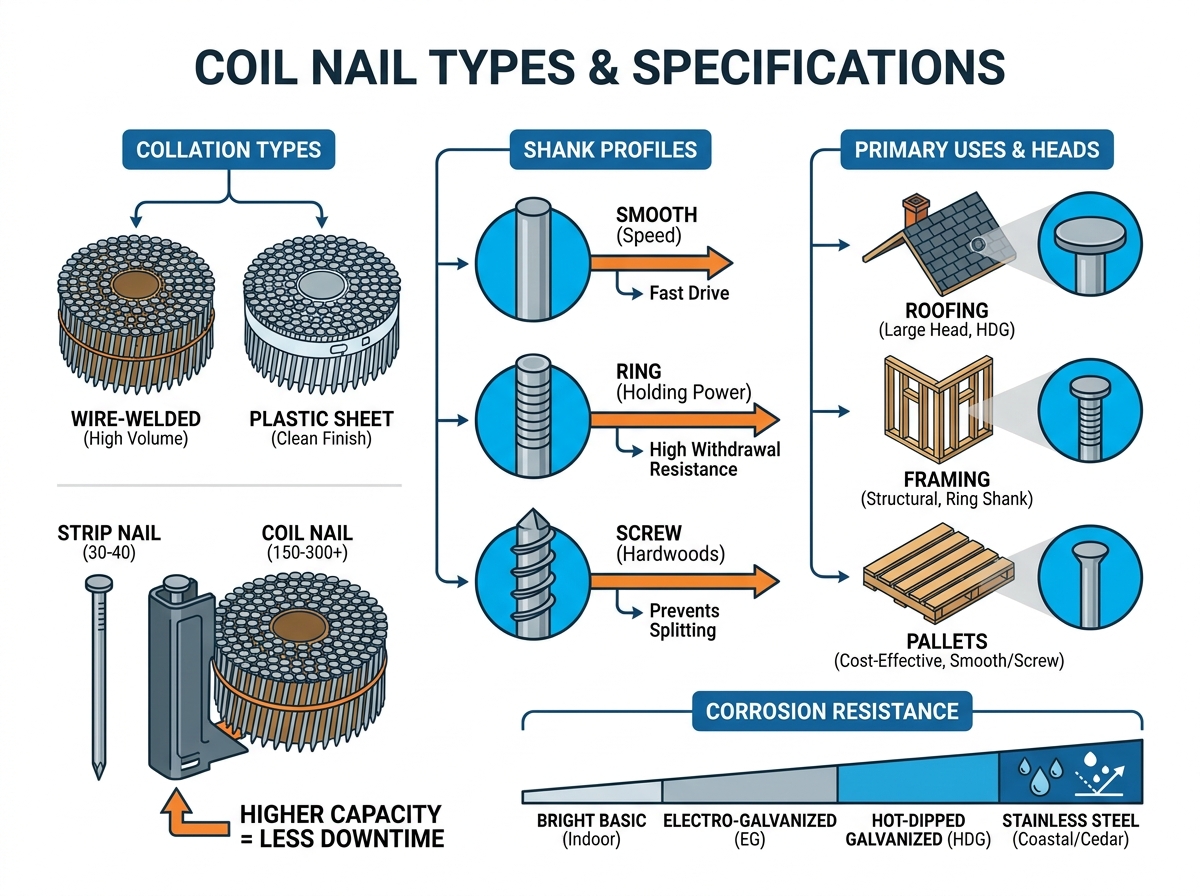
We must compare circular rolls to traditional strip fasteners to see the true value of high capacity. Standard strip clips hold roughly 30 to 40 fasteners. A framer using a strip nailer must stop, reach into a pouch, and reload the magazine frequently. This repetitive interruption kills momentum. A circular roll holds 150 to 300 fasteners depending on the gauge. Workers can fire continuously for extended periods. This uninterrupted workflow proves essential for repetitive tasks like sheathing and subflooring.
The added capacity does increase the physical weight of the tool. Roofers and framers accept this extra weight because the labor efficiency gains far outweigh the physical fatigue. Faster installation times directly translate to higher profit margins on fixed-bid jobs.
Manufacturers use different materials to bind these fasteners together in a roll. Your choice of collation material impacts tool performance and job site cleanliness.
Best Practice: Always wear high-impact safety glasses when operating wire-welded tools. The shearing action sends tiny metal fragments into the air. Switch to plastic collation when working on exterior trim or cedar siding where wire flags would ruin the visual aesthetic.
Selecting the right dimensions ensures structural integrity and prevents material damage. You must carefully verify Coil nail sizes against your pneumatic tool requirements. Ignoring this step guarantees feed jams and potential internal tool damage.
Shank diameter directly affects the physical strength of the connection. Thicker shanks resist shear forces better than thinner ones. Shear force happens when two joined materials try to slide past one another. Heavy framing requires thick shanks to withstand structural loads.
However, thicker shanks increase the risk of splitting the wood. Dense hardwoods and thin trim pieces split easily if you use an oversized diameter. You must balance structural holding power against the splitting risk of your specific lumber type.
Lengths typically range from 1 inch to 3-1/2 inches. Different length categories map directly to specific construction trades.
Most wire-collated tools operate at a strict 15-degree angle. The manufacturer tilts the fasteners inside the roll at 15 degrees to allow the tool's firing pin to strike the head squarely. The magazine coil canister is engineered specifically for this angle.
A dangerous exception exists in the market. Some plastic-collated rolls operate at a 0-degree angle. The fasteners sit perfectly vertical. If you purchase 0-degree rolls for a standard 15-degree framing tool, the gun will jam immediately. The firing pin will strike the edge of the head instead of the center. Always double-check your tool manual before purchasing boxes of collated fasteners.
The following Quick-Reference Size Chart details common combinations of length, shank diameter, and head diameter found in modern construction.
| Application Category | Typical Length Range | Common Shank Diameter | Head Diameter |
|---|---|---|---|
| Roofing (Shingles) | 7/8" – 1-3/4" | 0.120" (11 Gauge) | 3/8" (Large Flat) |
| Pallets & Crating | 1-1/2" – 2-1/2" | 0.099" – 0.113" | Standard/Modified |
| Siding & Fencing | 1-3/4" – 2-1/2" | 0.080" – 0.092" | Standard Round |
| Heavy Framing | 2-3/8" – 3-1/2" | 0.113" – 0.131" | Standard Round |
The texture of the metal cylinder determines how well it stays in the wood over time. Wood fibers react differently to smooth, ringed, and spiraled textures. You must choose the correct shank type to dictate holding power and withdrawal resistance.
A smooth profile offers the lowest withdrawal resistance. There are no ridges to grip the wood fibers. Because of the low friction, pneumatic tools drive them extremely fast and flush. They also cost less to manufacture.
Builders prefer smooth profiles for temporary framing, light box construction, and basic pallet building. You should use them in applications where sheer production volume outweighs the risk of structural pull-out. Do not use smooth profiles in floors or roofs where vibration and wind lift can slowly back them out over time.
Annular rings provide massive holding power. The manufacturer cuts deep horizontal grooves along the metal cylinder. When driven into wood, the wood fibers compress and then expand back into these grooves. The rings act as tiny wedges, locking the metal into place.
Pulling an annular profile out often destroys the wood itself. Building codes require them for subflooring, exterior sheathing, and high-wind coastal zones. They eliminate floor squeaks and prevent structural roofs from tearing off during hurricane-force winds.
Spiral profiles look like traditional wood screws. The cylinder turns as the pneumatic piston drives it into the material. This spinning action cuts a thread path, greatly reducing the outward pressure on the wood grain.
Pallet manufacturers rely heavily on spiral designs. They are ideal for dense hardwoods like oak or maple. The spinning entry prevents the hardwood boards from splitting. Spiral profiles provide a perfect balance between superior holding power and ease of driving in unyielding materials.
Different industrial sectors demand specialized fastener configurations. You cannot safely swap fasteners between these three main application categories. Each sector has strict performance expectations and compliance rules.
Roofing shingles require highly specific parameters to survive extreme weather. Coil nails roofing products feature large flat heads. The wide surface area holds the asphalt shingle securely without tearing through the delicate fiberglass mat. Lengths remain short, usually 7/8" to 1-3/4", to avoid penetrating entirely through the roof decking and exposing sharp points in the attic. Strict corrosion resistance is mandatory. Uncoated metal will rust quickly, stain the roof, and eventually fail during a storm.
Structural integrity defines the framing sector. Inspectors check framing connections rigorously against local building codes. These applications require heavier gauges to support the weight of the entire building. High-shear environments, like load-bearing walls and roof trusses, often require annular ring profiles. The fasteners must resist both the downward crush of gravity and the lateral twisting of high winds.
Logistics companies consume millions of pallets annually. In this sector, the cost-per-fastener dictates profitability. Manufacturers use high-volume wire collation to keep automated assembly lines moving. They frequently specify smooth or screw profiles depending on whether they use soft pine or hard oak lumber. The primary goal is fast, repetitive assembly in a factory environment.
Procurement mistakes cause massive delays and safety liabilities. You need a systematic approach to selecting your hardware. Use this decision framework to guarantee you order the correct supplies for your next project.
Moisture is the enemy of steel. You must match the metal coating to the exact environment where the lumber will live. Ignoring corrosion risk leads to catastrophic structural failures down the road.
Never assume a random roll will fit your gun. Create a compatibility checklist before contacting your supplier. First, check the required degree angle (15-degree is common, but verify). Second, check the magazine length capacity. A siding nailer cannot fit a 3-inch framing fastener. Third, confirm the collation material. If your manual specifies plastic insert only, do not load wire-welded rolls. Following this checklist prevents expensive equipment repairs.
Municipal codes legally dictate your hardware choices. Building inspectors will halt your project if they find non-compliant fasteners. Regional environments dictate these rules. For instance, coastal hurricane zones mandate ring shank HDG fasteners for all exterior sheathing to prevent roof lift-off. Seismic zones have specific shear-strength requirements. Always remind your purchasing department to review local IRC (International Residential Code) or IBC (International Building Code) amendments before ordering bulk supplies.
Common Mistake: Ordering a massive pallet of smooth shank EG fasteners for a deck building project. The inspector will fail the framing inspection, forcing you to pull apart the entire deck and rebuild it using approved HDG or stainless ring shanks.
Choosing the correct high-capacity fastener requires careful attention to detail. The right selection relies on a strict balance of tool compatibility, required holding power, and environmental survival. A mismatched angle will jam your equipment. A smooth shank might fail in a hurricane zone. An uncoated finish will rust away in treated lumber.
You can optimize your job site by taking immediate action today. First, audit your current pneumatic tool fleet and document their exact collation and length specifications. Second, review your local building codes to confirm your current inventory meets regional structural demands. Finally, reach out to a reputable fastener specialist to request a manufacturer sample. Testing a physical sample in your equipment ensures flawless performance before you commit to a large-scale procurement order.
A: The difference lies in how the fasteners sit inside the collated roll. A 15-degree roll tilts the fasteners at an angle, usually bound by wire welding. A 0-degree roll holds them perfectly vertical, typically bound by a plastic sheet. You must match this angle to your pneumatic tool's magazine design, or the tool will jam instantly upon firing.
A: No. Framing fasteners have small round heads and longer lengths. Roofing requires large flat heads to hold down asphalt shingles without tearing them. Roofing lengths are also shorter to prevent piercing through the roof decking. Using framing hardware for roofing violates building codes and guarantees severe weather damage.
A: Jams occur primarily due to mismatched specifications. You may be using a 0-degree roll in a 15-degree tool. The wire collation might be damaged or bent from rough handling. Additionally, you might be attempting to load a length that exceeds the maximum capacity of your specific pneumatic magazine.
A: No. Pneumatic tools are strictly divided into strip nailers and coil nailers. A strip nailer uses a straight or angled rectangular magazine. A coil nailer uses a circular drum canister. You cannot load a circular roll into a straight strip magazine under any circumstances.


