
Views: 0 Author: Site Editor Publish Time: 2026-07-06 Origin: Site
Selecting the wrong fastener easily compromises structural joint integrity. When you choose an incorrect size, you risk catastrophic assembly failure. This issue frequently causes severe material splitting in high-stress applications. We see this problem constantly across flat-pack furniture, aerospace, and marine manufacturing sectors. Identifying the exact combination of thread pitch, barrel diameter, and length is critical. Getting these dimensions right ensures perfect alignment and proper load distribution. A mismatched fastener stresses the surrounding wood or metal. Over time, this stress leads to cracks and complete structural breakdown. In this article, you will discover an evidence-based breakdown of standard specifications. We provide clear data detailing both metric and imperial sizes. You will also learn a practical framework for evaluating dimensions. Finally, we cover methods for sourcing the correct specifications for your next project.
Every structural fastener requires a precise dimensional match. You must understand four primary physical traits. Missing any single dimension leads to sloppy joints. Sometimes it causes complete assembly failure. You must specify a correct Barrel Nut for your specific application. Let us break down the foundational sizing elements.
You must carefully evaluate the thread pitch first. Manufacturers design these internal threads to grip machine screws securely. If you force an incompatible bolt into the cylinder, you destroy both components. We always recommend using a dedicated thread gauge. It confirms the exact pitch before installation. Metric threads include a pitch designation. An M6x1.0 thread differs entirely from an M6x0.75 thread. You must verify this specific number.
The outer diameter requires exact attention. Precision matters immensely here. If you drill a hole slightly too large, the cylinder shifts. This shifting causes alignment issues when inserting the cross-dowel bolt. Conversely, a hole drilled too small forces you to hammer the fastener. Hammering often splits fragile wood grain.
Overall length directly influences load capacity. Short cylinders concentrate stress into a tiny area. Softwoods easily crush under this concentrated pressure. You should utilize longer cylinders for softer materials. They spread the clamping force over a wider internal section. This broader distribution prevents localized material failure.
Finally, hole position dictates application suitability. Centered variants serve standard perpendicular joints beautifully. However, some designs require bolts positioned extremely close to a material edge. Off-center options solve this specific problem. They shift the threaded receiver toward one end. This offset allows you to maintain structural integrity near material boundaries.
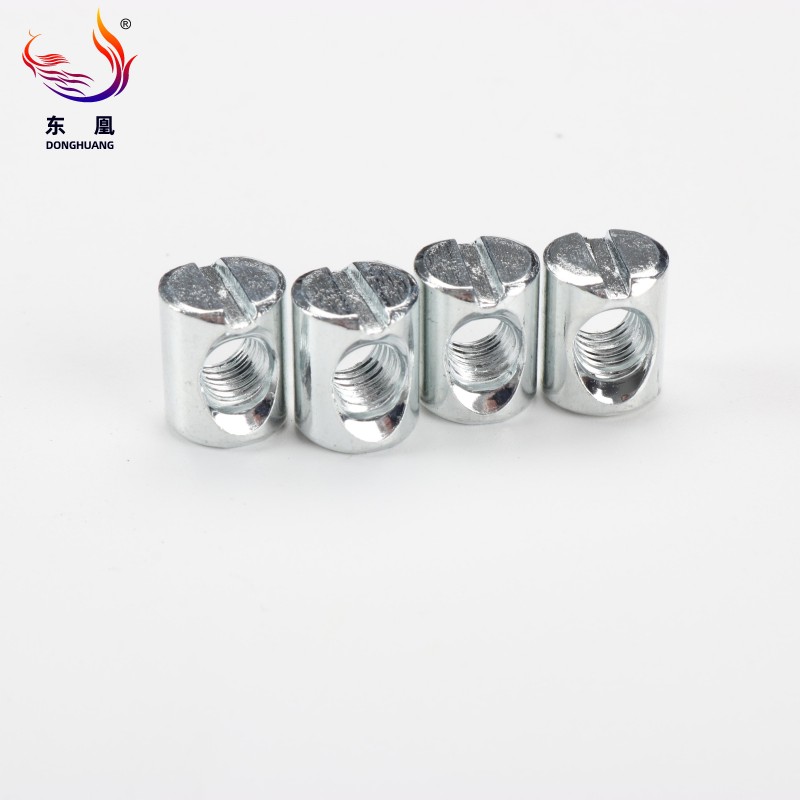
Metric specifications dominate global manufacturing operations. Modern ready-to-assemble designs rely heavily on these standards. Using a predictable sizing matrix helps engineers reduce custom-machining requirements. We see consistent reliance on specific metric thread configurations.
| Thread Size | Common Outer Diameters | Standard Lengths | Primary Use Case |
|---|---|---|---|
| M6 | 10mm | 12mm, 13mm, 14mm, 16mm, 20mm | Standard furniture assembly, cabinetry, lightweight fixtures |
| M8 | 12mm | 20mm, 30mm | Heavy-duty joinery, bed frames, structural connections |
| M10 & Larger | 14mm+ (Varies) | Custom Orders (30mm+) | Industrial machinery, high-load architectural applications |
M6 configurations represent the industry baseline for consumer goods. Manufacturers typically pair an M6 thread alongside a 10mm outer diameter. You will find standard lengths running at 12mm, 13mm, 14mm, 16mm, and 20mm. These dimensions perfectly suit standard furniture assembly tasks. They also excel inside cabinetry frames. Engineers specify them frequently for lightweight structural fixtures. The 10mm diameter requires a standard drill bit size. This standard sizing simplifies factory production lines immensely. You easily find M6 variants in flat-pack bookshelves and desks. They handle everyday static loads without issue.
M8 configurations handle significantly higher shear loads. They usually feature a thicker 12mm outer diameter. Standard lengths jump to 20mm or 30mm. These larger dimensions distribute increased mechanical forces efficiently. You should specify M8 hardware for heavy-duty joinery. They work exceptionally well inside wooden bed frames. Large dining tables require their enhanced clamping strength. The thicker walls resist deformation under high tension. You can apply significant torque when tightening M8 bolts. The surrounding wood absorbs the stress safely through the increased surface area.
M10 and larger configurations serve highly specialized roles. They rarely appear in standard commercial furniture. These sizes are reserved for industrial machinery. High-load architectural applications also demand their robust characteristics. You rarely find these off-the-shelf at local hardware stores. Instead, project engineers often custom-order them. You must source these robust variants from specialized commercial distributors. Heavy timber construction often utilizes custom M10 cross dowels. They anchor massive wooden beams securely. Aerospace applications occasionally adapt similar oversized designs. They secure heavy bulkheads inside aircraft frames.
Despite global metric adoption, standard imperial sizes remain heavily entrenched. North American woodworking heavily relies on Unified National Coarse threads. Understanding these SAE sizing matrices is vital for domestic manufacturing. We utilize these standards daily across various production facilities. Let us review the most common standard sizes.
| Thread Size | Common Outer Diameters | Standard Lengths |
|---|---|---|
| 1/4"-20 | 3/8", 7/16" | 1/2", 5/8", 3/4" |
| 5/16"-18 | 1/2" | 5/8", 7/8" |
The 1/4"-20 sizing matrix serves as the standard workhorse. Common outer diameters include 3/8" and 7/16". You will typically see standard lengths set at 1/2", 5/8", or 3/4". This configuration stands as the most widely used US standard. It dominates commercial woodworking applications. You will find it inside countless ready-to-assemble consumer products. The 1/4"-20 thread provides excellent clamping force for medium-density fiberboard. It holds particle board joints tightly closed. North American designers default to this size for chairs and small tables. The number 20 indicates threads per inch. This metric dictates the spacing between thread peaks. A higher number indicates a finer thread.
The 5/16"-18 sizing matrix offers increased mechanical strength. Standard designs usually utilize a robust 1/2" outer diameter. Manufacturers generally produce these in 5/8" and 7/8" lengths. You implement this size specifically where higher pull-out resistance is strictly required. They easily handle dynamic loads in thick hardwood joints. We often see 5/16"-18 fasteners used in commercial seating. Public benches and solid oak tables require this enhanced durability. The larger diameter prevents the cylinder from tearing through the wood grain. The 18 threads per inch bite aggressively into mating bolts.
Always cross-reference the outer diameter against your standardized drill bit sets. Using an imperial dowel inside a metric hole creates unwanted movement. For example, placing a 3/8" cylinder into a 10mm hole leaves dangerous gaps. The joint will inevitably loosen over time. You must maintain strict tooling discipline. Separate your metric and imperial drill bits carefully. Mark them clearly to prevent factory floor confusion.
You cannot rely on visual estimates when specifying cylindrical fasteners. Accurate sizing requires precise measuring techniques. Strict quality control prevents assembly disasters. Minor dimensional deviations ruin automated production runs entirely. We recommend following a strict verification protocol every time.
You must account for material expansion and contraction. Wood absorbs atmospheric moisture. It slightly swells around the hardware over time. A perfectly snug fit in dry factory conditions might become impossibly tight later. Testing samples under real-world humidity conditions mitigates these dimensional risks.
You must also evaluate the slot or drive type on the cylinder end. Most designs feature a flat-head screwdriver slot. This slot allows you to align the internal threads perfectly. Ensure the slot depth accommodates your assembly tools. Shallow slots strip easily during rapid factory assembly. Deep slots provide superior control during final tightening. We always verify slot dimensions alongside the primary measurements. Ignoring the drive slot often causes frustrating delays during final assembly.
Choosing the right specification goes beyond simply matching threads. You must evaluate environmental conditions. You must calculate maximum load expectations accurately. Partnering with reliable commercial suppliers ensures consistent quality across production batches. You need a systematic approach for hardware evaluation.
Material and finish selection dictates long-term durability heavily. Zinc-plated steel provides a highly cost-effective solution. It delivers standard corrosion resistance perfectly suited for indoor environments. Most domestic furniture utilizes zinc-plated carbon steel. Stainless steel variations serve demanding environments. Grades like 304 or 316 resist oxidation aggressively. You must specify stainless steel for marine applications. Outdoor patio furniture requires it strictly. Highly corrosive atmospheric conditions degrade zinc quickly. Alloy and aviation-grade materials handle extreme physical demands. These specialized metals are strictly required for high-stress applications. They benefit weight-sensitive aerospace designs immensely.
Load-bearing considerations are equally vital. You must carefully match the fastener length and diameter. These dimensions must align against the shear limits of your host material. Softwoods require longer cylinders. This extra length prevents wood fiber crushing. Hardwoods can often utilize shorter configurations. They handle concentrated forces without risking structural failure. You should consult engineering load tables for critical joints. Never guess load capacities when structural integrity is required.
Shortlisting vendors requires rigorous commercial evaluation. You must evaluate commercial suppliers based on strict quality metrics. Look for the immediate availability of detailed technical drawings. Verify strict ISO compliance protocols. Ensure they offer comprehensive lot traceability for every batch. Always review a supplier's quality control documentation thoroughly. Request specification PDFs for your engineering team to review. Finally, demand physical samples for prototype validation. You must validate these physical prototypes before proceeding to full-scale procurement. Doing so prevents costly manufacturing errors downstream.
Correctly sourcing a Barrel Nut dictates the success of your entire product line. Commercial partners should act as technical advisors. They should guide you toward standard sizes whenever possible. Standard sizes minimize lead times significantly. They also reduce the risk of supply chain disruptions.
Correct standard sizing relies on a highly precise dimensional match. You must align the thread specification exactly. You must verify the outer diameter and overall length perfectly. Getting these three dimensions right ensures maximum mechanical stability. A poorly specified fastener will eventually cause structural joint failure.
Audit your current joint designs against the standard sizing matrices outlined above. Standardizing your hardware choices significantly reduces custom-machining requirements. Request detailed technical samples from reputable fastener distributors immediately. You need these physical samples to verify acceptable manufacturing tolerances. Implementing these steps guarantees superior assembly quality across your entire product line.
A: No. Even closely matched sizes (like M6 and 1/4") have different thread pitches and will cross-thread, ruining the fastener.
A: Centered nuts have the threaded hole exactly in the middle. Off-center nuts place the hole closer to one end, used when the intersecting bolt hole must be drilled closer to the edge of the material.
A: The barrel length should be slightly less than the thickness of the material it is embedded in, allowing for maximum surface area contact without protruding and disrupting the finish.
A: Yes. While nominal sizes are standard, exact outer diameters can vary slightly. Always reference the manufacturer's specification sheet or technical drawing before finalizing a high-volume order.

