
Views: 0 Author: Site Editor Publish Time: 2026-08-01 Origin: Site
The relentless pace of high-volume construction relies entirely on uninterrupted workflows. Small fastening errors often lead to massive downstream problems. A single jammed nailer can halt an entire framing crew. Incorrect fastener selection hides significant operational risks. Tool jamming, compromised structural integrity, and failed building inspections cost contractors valuable time. Selecting the wrong gauge or inferior coating compromises your entire build quality. Misfires and pull-outs ultimately ruin production schedules.
We will explore how to evaluate and source correct specifications for every project phase. You will learn about application requirements, material science, and yield efficiency. This guide serves as a technical baseline. Procurement managers can use it to secure reliable, code-compliant fasteners. Contractors gain actionable insights to prevent costly rework. Integrating a high-quality coil nail into your daily operations ensures long-term structural resilience and protects your bottom line.
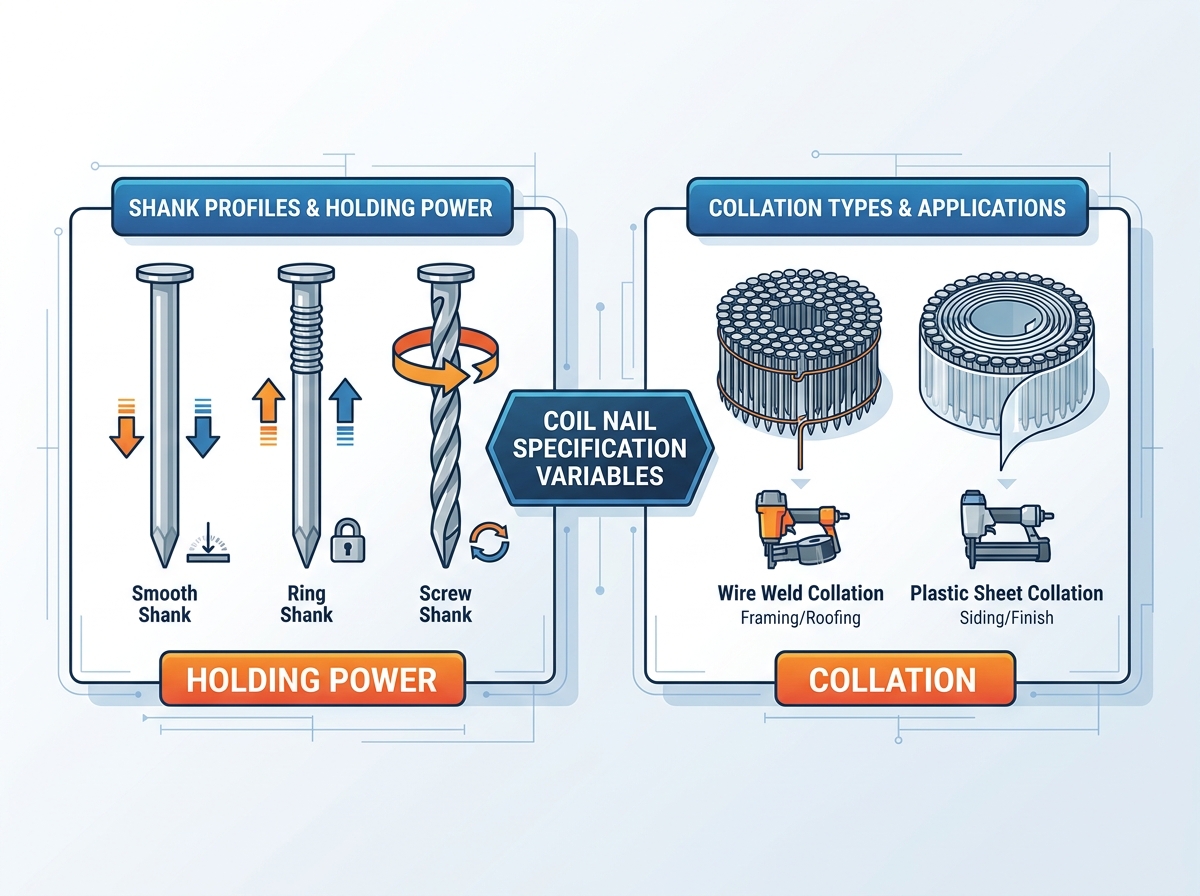
Nail performance depends heavily on structural design. You must match the shank profile to the specific wood density and load requirement. Choosing an incorrect shank profile guarantees future structural failures.
Smooth shank fasteners offer rapid driving capabilities. They encounter minimal friction during insertion. Contractors favor them for basic framing and sheathing tasks. These applications prioritize sheer strength over extreme withdrawal resistance. Smooth profiles excel when lateral movement poses the primary structural threat.
Ring shank fasteners operate differently. They feature small directional ridges along the metal body. These rings act like wedges during penetration. They aggressively separate wood fibers. The fibers then relax and lock into the grooves. This mechanism provides exceptional pull-out resistance. You must use ring shanks in high-stress environments like flooring, subflooring, and exterior siding.
Screw or twist shank profiles deliver specialized holding power. They literally spin as pneumatic tools drive them into the substrate. This torque effect mimics a traditional screw. It prevents squeaking in floor joists. It also prevents splitting when fastening dense hardwoods. Twist shanks offer maximum friction grip for specialized structural applications.
Metal corrosion destroys structural integrity over time. Understanding coating differences is critical for meeting regional building codes. Various environmental exposures demand specific chemical protections.
Always verify a manufacturer's coating claims. Request official salt-spray test results before finalizing large procurement orders. Trustworthy vendors readily provide these standardized corrosion resistance metrics.
Fastener dimensions must perfectly align with pneumatic tool specifications. A mismatch in gauge or length causes immediate mechanical failure. You must carefully audit standard dimensions before starting construction.
Construction requirements dictate a wide spectrum of dimensions. Standard gauges typically range from .080 inches for light siding up to .131 inches for heavy structural framing. Length spans vary significantly. You will commonly see lengths starting at 1-1/4 inches and extending up to 3-1/2 inches. Selecting correct Coil nail sizes guarantees proper substrate penetration. Industry standards require fasteners to penetrate the underlying material by at least one inch.
The Standard Sizing Evaluation Chart below illustrates common dimensional pairings.
| Application Category | Common Gauge Range | Typical Length Span | Primary Collation Method |
|---|---|---|---|
| Heavy Framing | .113" to .131" | 2-3/8" to 3-1/2" | Wire Weld |
| Siding & Fencing | .080" to .092" | 1-1/4" to 2-1/2" | Plastic Sheet / Wire |
| Roofing Shingles | .120" (11-12 Gauge) | 3/4" to 1-3/4" | Wire Weld |
| Pallet Assembly | .099" to .113" | 1-1/2" to 3" | Wire Weld |
Collation materials hold the fasteners together in a spiral format. Wire weld collation typically features a 15-degree angle. Two thin metal wires spot-weld to the fastener shanks. This method offers extreme durability. It withstands rough handling during framing and roofing operations. It dominates rough construction tasks.
Plastic sheet collation utilizes a rigid plastic band. Angles typically sit at 0 degrees or 15 degrees. Siding and finishing applications heavily rely on plastic collation. It prevents metal flagging. Metal flagging occurs when wire fragments remain trapped under the fastener head. These wire fragments eventually rust and bleed through exterior paint. Plastic collation completely eliminates this aesthetic risk.
You must verify tool compatibility to prevent continuous misfires. Magazine angles must exactly match collation angles. Follow this brief framework before loading tools:
Roofing environments introduce extreme weather variables. High winds, torrential rain, and chemical reactions demand specialized fasteners. Using generic construction fasteners on a roof guarantees catastrophic failure.
A standard framing fastener cannot secure asphalt shingles. Specialized Coil nails roofing designs feature distinct anatomical differences. They require a massively oversized 3/8-inch head diameter. This large surface area pins the fragile shingle flat against the decking. It prevents the material from tearing during high wind events. The shank thickness generally sits around 11 to 12 gauge. This robust thickness prevents bending when striking tough roof decking.
Local building authorities strictly govern roofing installations. You must reference industry-standard evaluation lenses like the International Building Code (IBC). Coastal regions often enforce stringent Miami-Dade standards. These codes mandate specific pull-out resistance thresholds to combat wind uplift. If an inspector discovers non-compliant fasteners, they will halt the project. Furthermore, shingle manufacturers immediately void their 30-year warranties if you use unapproved fasteners.
Roofing applications present unique chemical challenges. Asphalt shingles contain specific petroleum compounds. These chemicals react negatively with raw steel or thin electro-galvanized layers. The reaction accelerates metal degradation exponentially. Hot-dipped galvanized or stainless steel materials are absolutely non-negotiable for roofing durability. The thick zinc coating isolates the steel from the corrosive asphalt. This chemical barrier ensures the roof remains securely fastened for decades.
Smart procurement extends far beyond negotiating the lowest unit price. You must evaluate the true operational cost of cheap materials. Fastener quality directly impacts daily labor efficiency.
Evaluating yield involves looking past the invoice. A low bulk price often hides high defect rates. Consider a standard 50-coil project. If each coil contains 300 fasteners, the project requires 15,000 total drives. A mere 2% defect rate equals 300 bent wires or broken collation strips. This translates into 300 distinct tool jams. Your framing crew must stop work, clear the magazine, and reset the tool 300 times. This lost labor time rapidly devours any initial savings gained from cheap materials. High-yield coils guarantee continuous operation.
Vendor specification sheets reveal manufacturing quality. You should actively look for three critical consistency markers. First, examine the wire drawing tolerance. Consistent wire diameter prevents tools from jamming during rapid firing. Second, inspect the point cutting precision. Uniform diamond points ensure clean substrate penetration without splitting the wood. Finally, verify automated collation precision. The spacing between each shank must remain mathematically perfect. Irregular spacing forces the pneumatic feed claw to skip, causing blank fires.
Establish a strict shortlisting logic when selecting supply partners. Apply these evaluation criteria:
Even premium fasteners fail if handled incorrectly on the job site. You must train teams to manage inventory properly. Poor handling compromises collation integrity before the work even begins.
Weather severely impacts collation materials. Implementation reality often differs from controlled warehouse conditions. Plastic collation bands become incredibly brittle in freezing temperatures. The plastic shatters upon impact, clogging the tool magazine. Conversely, wire weld collation suffers in high-humidity storage environments. The thin welding wire rusts quickly, weakening the bond between fasteners. You must implement climate-appropriate inventory management. Store plastic-collated boxes in heated trailers during winter. Keep wire-welded boxes sealed in moisture-resistant bags during humid summer months.
Pneumatic tool depth-of-drive settings require precise calibration. Inconsistent coating thickness plays a major role in driving depth. If a manufacturer applies hot-dipped zinc unevenly, the tool hits varying resistance levels. This causes over-driving or under-driving. Over-driving crushes fragile materials like fiber cement siding or architectural shingles. It breaks the waterproof seal. Under-driving leaves heads exposed, preventing subsequent layers from sitting flat. Source materials with highly controlled coating tolerances.
Workers frequently complain about jammed magazines. You can usually trace this problem back to poor coil winding tension during the manufacturing process. If the factory winds the spiral too tightly, the tool struggles to advance the feed. If wound too loosely, the coil collapses onto itself inside the drum. This reinforces the necessity for rigorous quality sourcing. Proper tensioning guarantees a smooth, predictable unwinding process during rapid application.
Standardizing fastener specifications represents a crucial risk-management exercise. It protects your labor efficiency. It guarantees structural integrity under extreme environmental loads. Selecting the correct shank, matching collation angles, and demanding proper anti-corrosion coatings eliminates operational blind spots.
Procurement teams should take immediate action. Audit your current fastener failure rates on active job sites. Request official technical data sheets from your suppliers to verify coating weights. Contact vendor sales engineering teams to schedule a trial evaluation of upgraded gauges and profiles. Making data-driven sourcing decisions today prevents catastrophic structural failures tomorrow.
A: Quantities vary based on gauge and application. Heavy framing coils typically contain 120 to 225 fasteners due to their thick wire diameter. Wire-welded roofing and pallet coils use thinner gauges and can contain between 2,500 to 3,600 fasteners per roll. Always check the packaging data.
A: No. Matching the angle is only the first step. You must also verify length, gauge thickness, and collation material restrictions. Different tool brands design their feed mechanisms to accommodate specific wire or plastic types. Using incompatible dimensions causes severe jamming.
A: Wire-collated fasteners use metal wires to hold the coil together. They are rugged and ideal for structural framing or roofing. Plastic-collated fasteners use a plastic band. They prevent rusted metal wire fragments from bleeding through paint, making them perfect for aesthetic siding and finishing.
A: Base your choice on substrate thickness. Industry rules generally dictate the fastener must fully penetrate the base material by at least 1 to 1-1/2 inches. Ensure the gauge thickness provides adequate sheer strength for the expected weight load of the attached material.


