
Views: 0 Author: Site Editor Publish Time: 2026-07-28 Origin: Site
Selecting the wrong fastener inevitably leads to split trim, blown-out wood profiles, or joints that fail under stress. You might ruin expensive hardwood components. Poor choices also delay project timelines significantly. While often confused alongside finish or pin nails, the 18-gauge brad nail occupies a highly specific middle ground. It sits perfectly between delicate fastening and structural holding power. Professionals rely on this specific gauge daily. DIY enthusiasts need it for precise interior finish work.
This guide strips away marketing fluff. We objectively evaluate fastener applications, size requirements, and equipment limitations. You will learn how to specify the right fastener for your exact materials. Let us explore the technical details you need for flawless installation.
Many beginners ask exactly What are brad nails used for when starting a renovation. The primary goal is securing lightweight wood or composite trim. A successful application leaves a minimal entry hole. You want to require little to no wood filler after installation. This saves hours of sanding and painting prep on large jobsites.
Technical specifications define their unique capability. The wire diameter is strictly 18-gauge. This measures approximately 0.0475 inches thick. It features a slight T-head or flat head profile. This design provides marginal holding power. It prevents excessive surface damage during penetration. The small head acts as a wedge. It secures the material gently without shattering brittle profiles.
Consider the best environments for this tool. You will achieve optimal results on specific interior tasks. Professional carpenters strictly divide their applications into acceptable and unacceptable categories.
They possess zero structural integrity for load-bearing wood joints. You must respect these limitations to avoid catastrophic failure. Overestimating their holding power is a common beginner mistake.
Understanding Brad nails vs finish nails requires evaluating a strict trade-off. You must balance holding power against potential surface damage. Holding power involves shear and pull-out resistance. Surface damage includes hole size and splitting risk. Woodworkers face this decision constantly on mixed-material projects.
The 18-gauge options rarely split delicate trim. They require minimal patching before painting. A quick swipe of lightweight spackle usually suffices. However, they offer limited holding power overall. They can deflect easily if they follow dense wood grain. You cannot rely on them for heavy exterior doors.
Finish nails use a thicker 15-gauge or 16-gauge wire. They deliver exceptional shear strength. This makes them suitable for heavy doors. They handle thick baseboards and exterior trim effortlessly. The larger gauge significantly increases your risk of splitting thin stock. You will need heavier patching and sanding afterward. The entry wounds are highly visible.
| Feature | 18-Gauge (Brad) | 15/16-Gauge (Finish) |
|---|---|---|
| Wire Thickness | Thin (0.0475 inches) | Thick (0.0625 to 0.0720 inches) |
| Splitting Risk | Very Low | High on thin materials |
| Shear Strength | Low to Moderate | High |
| Primary Application | Quarter round, delicate trims | Doors, heavy baseboards, crown molding |
You should default to finish nails when hanging heavy architectural millwork. Use them when working alongside thick hardwoods. Choose the 18-gauge option when material is thinner than 5/8-inch. It remains the best choice for splitting-prone profiles. Proper decision-making elevates your craftsmanship.
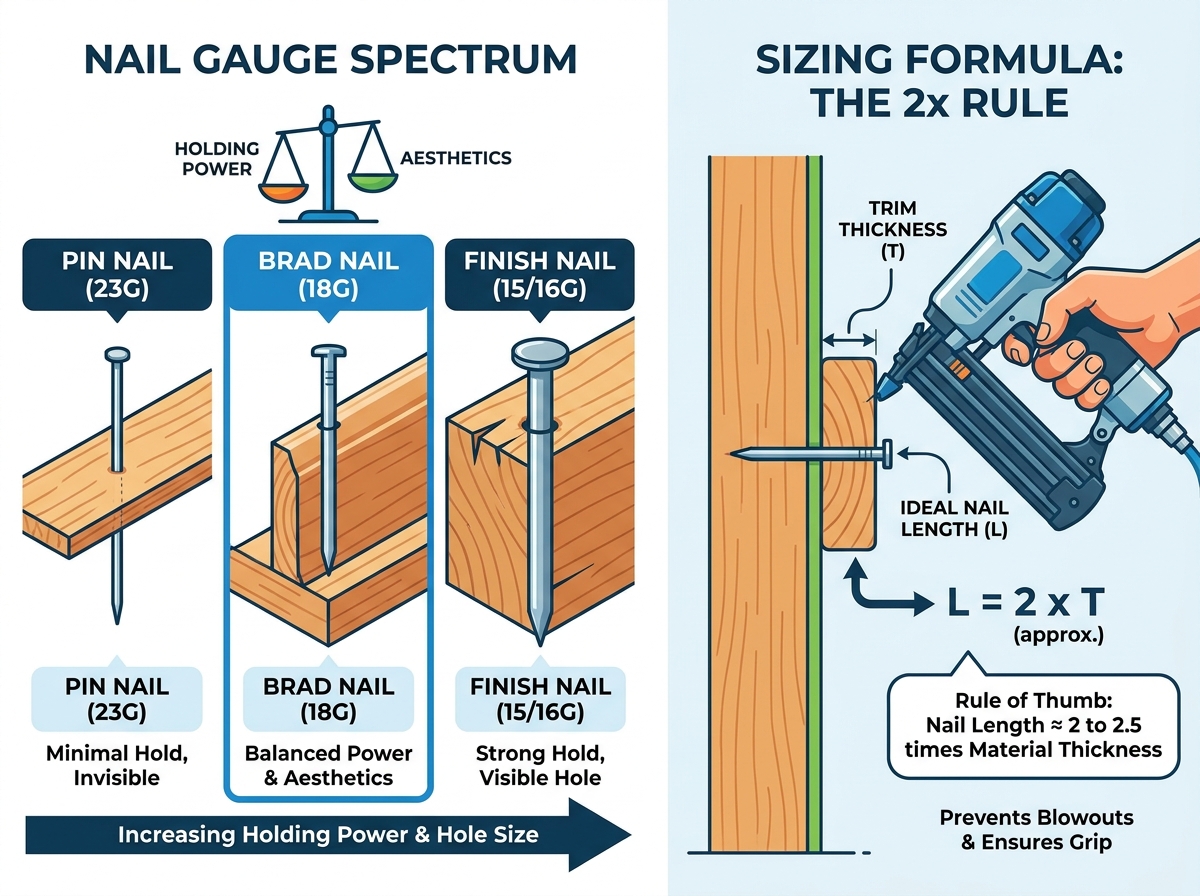
Choosing accurate Brad nails sizes guarantees your trim stays securely fastened. Selecting incorrect sizes causes material damage or loose joints. The sizing formula relies on basic multiplication. You multiply material thickness by two. Sometimes you multiply by 2.5 for extra grip. This equals your ideal length. Following this formula prevents guesswork.
Calculating exact Brad nail lengths ensures deep penetration into the substrate. Fastening a 1/2-inch thick trim piece requires specific dimensions. You need a 1-inch to 1.25-inch fastener. This allows half the nail to enter the base wall. It provides structural security without penetrating plumbing behind the drywall.
Manufacturers produce several standard sizes for different applications. You must match the size to your specific task.
Material density impacts your selection process heavily. Hardwoods like oak or maple require shorter lengths. Shorter lengths prevent dangerous tool deflection. Softwoods like pine accommodate maximum lengths easily. MDF materials also handle two-inch lengths without issue. Dense wood grains fight fastener penetration fiercely.
Professionals learn these lessons through difficult experiences. You can avoid ruined materials by understanding three major risks. Careless installation leads to expensive rework. Anticipating these problems makes you a better carpenter.
Risk 1: Fastener Deflection (Blowouts). An 18-gauge wire bends easily inside dense material. The nail might hit a hidden knot. You might fire it at a slight angle. It can hook outward unexpectedly. It will blow through the finished face of your trim. It can even cause injury. Mitigation requires strict tool discipline. Keep the gun strictly perpendicular to the wood grain. Never tilt the tool excessively.
Risk 2: Over-Penetration. Improper compressor pressure ruins delicate profiles. Incorrect depth-drive settings cause identical problems. The tool will sink the head too deep. It pulls the small head entirely through MDF or soft pine. This destroys all holding power. Mitigation involves careful calibration. Always test-fire on scrap material first. Calibrate the tool's depth adjustment dial. Ensure your air compressor runs between 70 and 100 PSI.
Risk 3: Environmental Corrosion. High-moisture environments destroy standard fasteners quickly. Bathrooms and exterior trim expose metal to constant dampness. Using standard galvanized products leads to rust bleed. Rust creates ugly brown streaks across white paint. It degrades the joint integrity eventually. Mitigation demands better materials. Specify stainless steel variants for damp applications. Stainless steel resists corrosion completely.
Purchasing a comprehensive Brad nail kit streamlines your entire workflow. Buying individual boxes of single-length fasteners is highly inefficient. Dynamic projects require rapid size changes. You might switch from baseboards to shoe molding within minutes.
You must evaluate variety when shopping for assortments. Look for multi-packs containing various lengths. A good kit includes 5/8", 1", 1-1/4", and 2" lengths. This covers the entire interior trim spectrum. Having every size readily available prevents workflow interruptions. You avoid driving excessively long nails into thin materials.
Collation quality matters just as much as metal quality. Collation refers to the glue holding the strip together. Low-quality adhesive strips cause massive headaches. They break apart inside the tool magazine. This causes frustrating jams during operation. Clearing jams wastes valuable time. Look for tightly collated strips. Buy from reputable name-brand manufacturers.
Tool considerations dictate your overall success. Ensure your chosen 18-gauge products are compatible with your fastening system. Nails are universally sized across brands. However, the drive mechanism matters greatly. Pneumatic air tools deliver immense power consistently. Cordless battery tools offer unmatched portability. Your drive mechanism dictates driving consistency. It determines how consistently the maximum 2-inch length sinks into hard materials.
The 18-gauge fastener remains indispensable for finish carpentry tasks. It offers the perfect balance of invisible entry holes. It provides adequate holding power for non-structural trim. Mastering its application saves time and prevents material waste.
Take these action-oriented next steps for your upcoming renovation:
A: Yes, 1-1/2 to 2-inch brad nails are excellent for standard 1/2-inch baseboards, provided you are nailing directly into wall studs. However, for thick, tall, or dense hardwood baseboards, 16-gauge finish nails are recommended.
A: An 18-gauge brad has a small head and provides moderate holding power. A 23-gauge pin nail is headless, leaves a virtually invisible hole, but relies almost entirely on wood glue for long-term structural holding.
A: Standard electro-galvanized brads are sufficient for interior trim. If you are working on exterior trim, bathroom millwork, or acidic woods like cedar, you must use stainless steel to prevent rust streaks.
A: This usually occurs due to firing maximum-length nails into dense hardwoods, using old or brittle nail collations, or operating an air compressor at insufficient PSI. Always match the nail length to the material density.


