
Views: 0 Author: Site Editor Publish Time: 2026-07-31 Origin: Site
You load your pneumatic nailer, press the tip against the wood, and pull the trigger. Instead of a clean drive, the gun spits, sparks, and violently jams. Selecting the wrong coil nail causes expensive tool damage and failed building code inspections. It also leads to accelerated material degradation. Fastener failure creates massive delays on active job sites.
A successful purchase perfectly aligns the fastener's collation, gauge, shank, and coating to your tool. You must also match these components to the strict environmental demands of your project. Small mismatches here lead to massive structural failures down the line.
This guide provides a strict, evidence-based evaluation framework. We designed this framework to help contractors, procurement managers, and heavy DIYers. You will learn exactly how to choose the right fasteners for maximum efficiency and strict building code compliance.
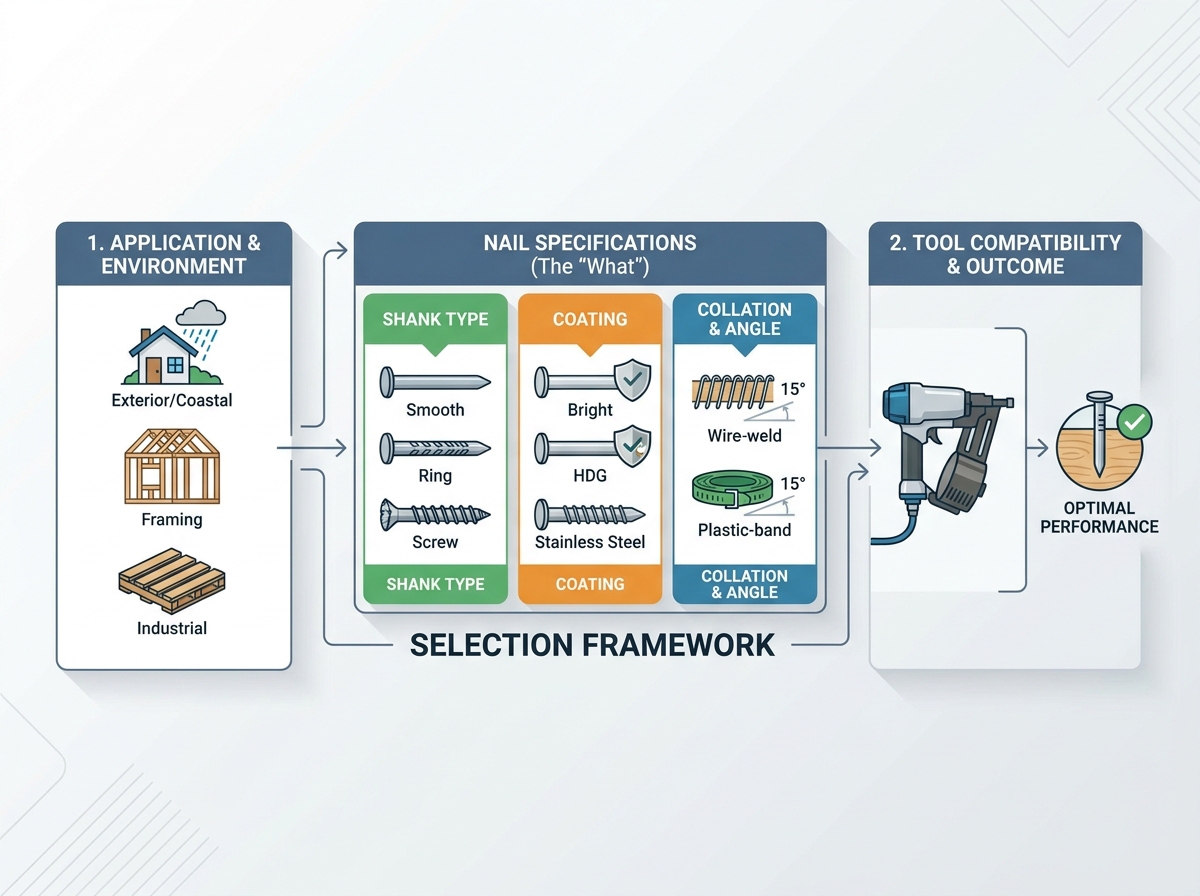
Understanding the basic anatomy of pneumatic fasteners helps prevent catastrophic job site failures. Fasteners rely on two critical components before they ever penetrate wood. First, the collation method binds them together. Second, the exterior coating protects the metal from the elements.
Collation refers to the material holding the fasteners in a continuous spiral. Manufacturers engineer these bands to feed smoothly into specific magazines. Choosing the incorrect collation material causes immediate misfires.
Corrosion destroys structures from the inside out. When steel rusts, it expands. This expansion splits wood framing and destroys exterior siding. You must strictly match the coating to the environmental exposure.
Precision matters deeply when securing heavy building materials. The structural integrity of your project relies heavily on understanding Coil nail sizes. You must balance penetration depth against the fastener's sheer thickness.
Length typically ranges from 1 inch to 3.5 inches for standard pneumatic tools. Gauge measures the thickness of the shank. A lower gauge number indicates a thicker piece of metal. Thicker gauges (.113 to .131) provide high shear strength. Shear strength prevents the fastener from snapping when framing members try to slide past one another laterally.
Different trades require entirely different specifications. Review the chart below to ensure you purchase the correct dimensions for your specific application.
| Application | Typical Length Range | Typical Gauge | Head Size & Characteristics |
|---|---|---|---|
| Roofing | 1" to 1-3/4" | .120 | Large 3/8" Head (Prevents tear-through) |
| Siding / Fencing | 1-1/4" to 2-1/2" | .080 to .092 | Slightly smaller head, easy concealment |
| Framing | 2" to 3-1/2" | .113 to .131 | Standard round head, max shear strength |
The shank dictates how tightly the fastener grips the surrounding wood fibers. You cannot rely on length alone for holding power.
Every construction discipline demands highly specialized fasteners. Generic hardware store purchases often lead to red tags from municipal building inspectors. You must understand the specific engineering behind each application.
Installing asphalt shingles requires precision. When selecting Coil nails roofing models, you will immediately notice the oversized heads. These large 3/8-inch heads prevent the fastener from tearing right through the soft asphalt fiberglass mat during extreme weather.
Roofing fasteners also require aggressive ring shanks. High winds create massive uplift forces on a roof deck. Smooth shanks will simply pull out during a storm. Furthermore, you must verify your local compliance checks. The International Residential Code (IRC) dictates strict wind uplift ratings. Using non-compliant fasteners voids shingle warranties and fails inspections.
Exterior trim and siding projects prioritize aesthetics alongside durability. Expensive cedar or fiber cement siding requires careful fastening. You must choose plastic-collated coils here. Wire collation spits tiny rust-prone metal fragments onto your fresh siding.
You must also use stainless steel or HDG ring-shank variants. Certain woods contain natural tannins. When plain steel or EG fasteners touch these tannins, a chemical reaction occurs. This reaction causes ugly black streaks to bleed down the side of your expensive building. Ring shanks ensure the siding boards do not warp and pull away from the studs during seasonal temperature shifts.
Industrial shipping materials endure brutal conditions. Forklifts smash into them constantly. Transit vibrations rattle them for thousands of miles. Pallet manufacturing relies on high-capacity wire coils. A single jumbo coil can hold up to 3,000 fasteners, keeping assembly line workers highly productive.
These applications strictly demand screw shanks. The twisting action locks the hardwood pallet slats to the stringers. This mechanical bond resists the constant jarring impacts of warehouse logistics.
Many buyers assume a universal fit exists across pneumatic tools. This assumption destroys expensive equipment. You must verify the mechanical tolerances of your nailer before loading a new coil.
Assuming all coils fit all nailers represents a very costly mistake. You must standardize on the precise degree. The vast majority of heavy construction utilizes a 15-degree angle. The collation wire holds the shanks at this exact slope. However, 0-degree models exist specifically for specialized siding nailers. Forcing a 15-degree coil into a 0-degree magazine bends the feed pawl and breaks the tool.
Every pneumatic gun features a clearly labeled acceptable length and gauge range. You must check these constraints before every job. Attempting to drive a 3.5-inch fastener in a gun rated for 2 inches maximum will cause immediate mechanical failure. The driver blade will strike the head, but the magazine cannot physically clear the length. Conversely, using a gauge that is too thin for the tool allows the fastener to slip sideways in the firing channel.
Matching the exact collation specification prevents double-firing. Double-firing happens when the tool's feed mechanism fails to accurately advance the coil. This usually results from using cheap, flimsy wire collation in a high-powered framing gun. Proper tool-to-fastener pairing prevents misfires and significantly reduces premature wear on your nailer's internal driver blade.
Ordering fasteners requires accurate job-site mathematics. Running out of materials mid-day ruins your crew's productivity. Conversely, over-ordering leaves you with deteriorating inventory.
You need to understand standard box counts to plan effectively. A typical box for framing holds roughly 3,600 fasteners. A standard box for roofing usually holds 7,200 fasteners. You calculate your total needs based on square footage and code requirements.
For example, standard 3-tab shingle installation generally requires 4 fasteners per shingle. A roofing "square" equals 100 square feet. This translates to roughly 320 to 350 fasteners per square. If you install an architectural shingle in a high-wind zone, code might require 6 fasteners per shingle, drastically changing your yield expectations.
Procurement managers must constantly assess freight efficiency. Shipping heavy steel is expensive. Stepping up to a full pallet purchase makes sense for high-volume commercial jobs. Pallets offer massive volume discounts and consolidate freight shipments into one predictable delivery.
However, single boxes make more sense for small residential jobs. Buying a full pallet for a three-week residential build invites problems. You want to prevent inventory rust. Unused boxes left outside overnight quickly become useless scrap.
Galvanized and bright steel degrades rapidly if left in humid, non-climate-controlled job site storage. Cardboard boxes absorb ground moisture easily. Once moisture penetrates the box, the copper collation wire and zinc coatings begin to oxidize. You must evaluate your crew's true turnover rate before ordering in bulk. Store extra inventory off the ground and under waterproof tarps.
Selecting pneumatic fasteners requires attention to structural engineering, environmental factors, and tool mechanics. Ignoring these variables leads to costly rework and damaged equipment.
Before you finalize that large pallet or box order, locate your pneumatic nailer's manual. Verify the specific degree and gauge tolerances printed inside. This simple two-minute check will save your crew hours of frustrating tool jams on the job site.
A: You typically need 320 to 350 fasteners per roofing square (100 square feet). This standard formula assumes a basic 4-nail per shingle installation. If local building codes require a high-wind 6-nail installation, you will need approximately 500 to 520 fasteners per square.
A: No. Even though the angle matches, the internal feed mechanisms differ. Plastic nailers use specific pawls designed to catch and advance plastic banding. Mixing collation types usually results in severe tool jams and can permanently damage the magazine's feeding track.
A: Jams typically stem from three root causes. First, cheap collation wire easily breaks apart in the magazine. Second, using an incorrect gauge allows the fastener to slip off the driver blade. Third, moisture exposure causes rust, increasing friction inside the tool.
A: Electro-galvanized (EG) fasteners have a very thin zinc layer applied via electrical current, suitable only for mild environments. Hot-dipped galvanized (HDG) fasteners are dipped in molten zinc, creating a thick, durable barrier. HDG is mandatory for exterior pressure-treated lumber applications.


