
Views: 0 Author: Site Editor Publish Time: 2026-07-27 Origin: Site
Woodworking projects demand strict precision from start to finish. Selecting the wrong fastener can easily ruin hours of hard work. A single misstep often leads to split trim, rusted joints, or structural failure in delicate assemblies. Navigating the crowded fastener aisle often leaves woodworkers overwhelmed by endless gauge and length options. Understanding how to match specific fastener specifications to your project requirements remains critical. You must balance maximum holding power against a flawless surface finish to achieve professional results. This guide breaks down exactly how to evaluate a brad nail for your specific needs before you make a purchase. You will discover a clear, evidence-based decision framework encompassing gauge, length, and material considerations. We will help you secure your next woodworking masterpiece flawlessly. Every detail matters when building furniture or trimming rooms.
When beginners ask, What are brad nails used for, we must first examine the fundamental design of the tool. Manufacturers construct these fasteners from 18-gauge wire. They feature a significantly reduced head compared to traditional woodworking fasteners. This specific wire profile allows them to leave a minimal footprint in the wood surface. You will barely see the entry point after installation.
Professional carpenters rely on them heavily for precise interior applications. They excel at attaching casing, baseboards, and intricate decorative molding. Cabinetry facias also benefit greatly from this low-profile fastener. You can even use them effectively when assembling temporary woodworking jigs in your shop. They act as rapid, invisible clamps.
The primary success criterion involves post-installation surface aesthetics. You want to leave a hole small enough to require minimal wood filler. In many scenarios, you might not need filler at all. Simultaneously, the fastener must provide sufficient shear strength. Shear strength prevents two joined pieces of wood from sliding laterally. This hold remains critical while your primary wood glue dries fully.
You must respect strict mechanical implementation risks. Never use these thin fasteners for load-bearing joints. Attempting to secure chair legs or structural frames will inevitably result in joint failure. The 18-gauge wire possesses very low tensile strength. Tensile strength resists forces pulling assembled pieces apart. If you apply structural stress, the wire will simply bend or snap under pressure. We always recommend understanding these mechanical limits before starting any assembly.
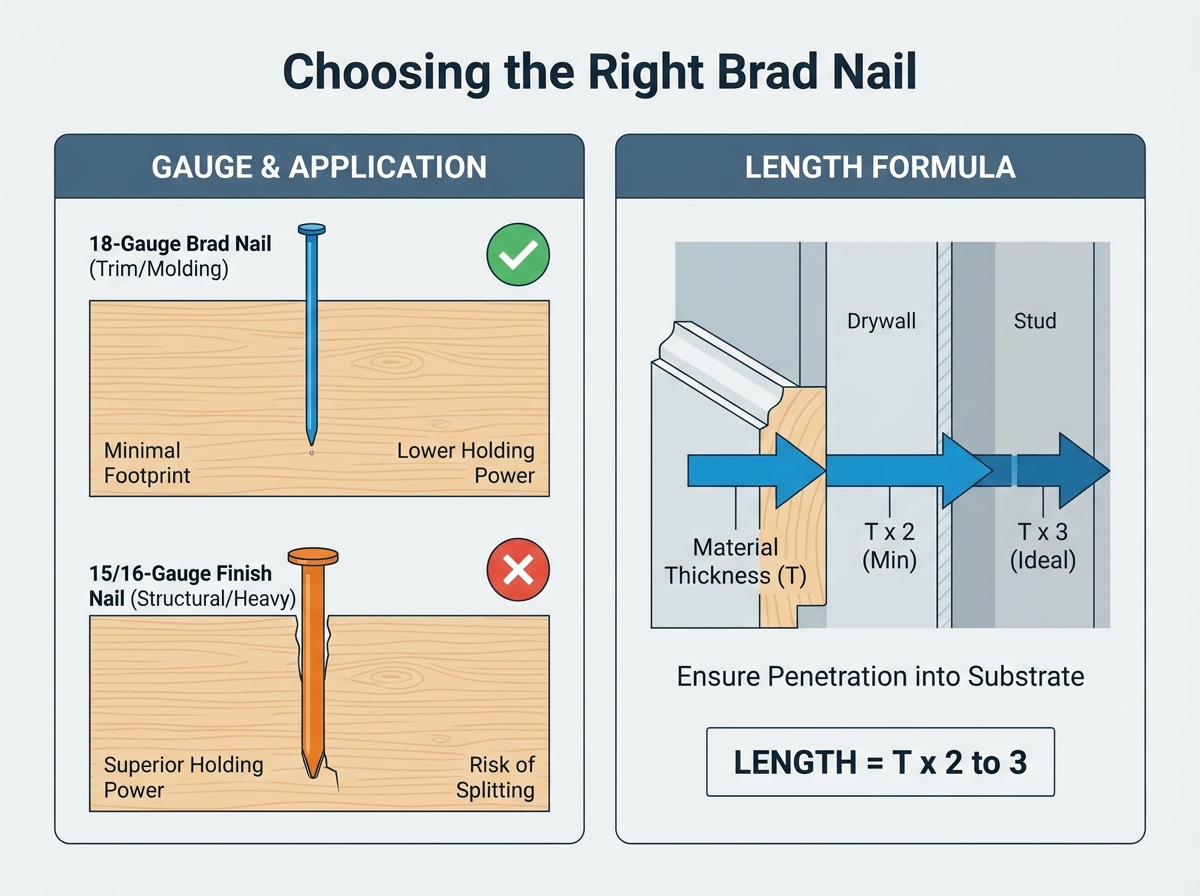
Making the correct choice between fasteners dictates the success of your trim work. Understanding the nuances of Brad nails vs finish nails saves time, money, and frustration. The primary distinction comes down to wire gauge. You are comparing an 18-gauge wire against a much thicker 15- or 16-gauge wire. This thickness difference dictates both holding power and potential surface damage.
Finish fasteners offer superior holding power due to their wider shank. However, this wider shank carries a much higher risk of splitting thin materials. Delicate hardwoods and brittle MDF often crack upon impact. You will also need significant amounts of wood filler to conceal the large entry holes left behind. They require more post-installation sanding and painting effort.
Conversely, 18-gauge options provide lower holding power but feature a much narrower shank. This thin profile virtually eliminates splitting in thin trim pieces. You can confidently secure delicate moldings without pre-drilling. They save countless hours of surface preparation during the final finishing stages.
| Feature | 18-Gauge (Brad) | 15/16-Gauge (Finish) |
|---|---|---|
| Holding Power | Moderate (Shear strength focused) | High (Better tensile strength) |
| Splitting Risk | Very Low | High on thin or brittle wood |
| Hole Size | Minimal (Often unnoticeable) | Large (Requires filler) |
| Best Uses | Veneers, baseboards, temporary jigs | Stair treads, door jambs, crown molding |
We use a simple decision matrix to guide daily shop choices. Follow these rules to ensure optimal results:
You must calculate penetration depth accurately for secure joints. Navigating various Brad nails sizes requires a simple but strict mathematical approach. We rely on a proven length equation to guarantee success. You should multiply your material thickness by two for a minimum hold. For an ideal hold, multiply the thickness by three.
Let us look at a practical shop example. Fastening a 1/2-inch thick piece of baseboard requires a 1-inch to 1.5-inch fastener. This specific formula ensures adequate bite into the substrate hidden below. It prevents the trim from pulling away from the wall over time as seasons change.
Looking at standard Brad nail lengths, they typically range from 5/8 inch up to 2 1/8 inches. You must evaluate the substrate penetration carefully across every single application. Ensure the fastener is long enough to penetrate any drywall completely. It must then bite at least 1/2-inch into the wooden stud hidden behind the wall.
Selecting a fastener that is too long increases the risk of a blowout. A blowout occurs when the thin wire hits dense wood grain and curves sharply. It then exits the side of your finished wood piece unexpectedly. This ruins the visual appeal and creates a dangerous sharp edge. Dense hardwoods heavily increase this specific risk. Always select the shortest possible length that still satisfies the 2x-3x multiplication rule.
Fastener longevity depends entirely on your specific material choice. Electro-galvanized options serve as the accepted industry standard. They offer excellent cost-effectiveness for most basic woodworking jobs. You get sufficient rust resistance for climate-controlled indoor projects. Installing baseboards, window casings, and crown molding in living rooms represent perfect applications. They perform beautifully in dry, stable environments.
However, electro-galvanized coatings carry distinct disadvantages in extreme conditions. They will corrode quickly if exposed directly to weather or high ambient humidity. The thin zinc layer cannot withstand prolonged moisture exposure. Once the zinc fails, the steel core rusts rapidly.
Stainless steel options act as your essential specialty fasteners. They provide maximum corrosion resistance under the harshest conditions. You must use them for woods containing natural acids, like cedar or redwood. Their primary drawback involves a significantly higher initial cost per box.
We strictly evaluate the project environment before loading our nailers. If the project will face direct weather, stainless steel is mandatory. If you are trimming high-humidity areas like bathrooms, stainless steel prevents future headaches. Acidic woods will actually eat through standard galvanized coatings over a few years. Using stainless steel remains the only compliant choice to prevent ugly rust streaks. Rust bleeding through expensive white paint ruins the entire aesthetic of a room.
Buying fasteners strategically keeps your shop budget fully under control. You generally choose between single-size bulk boxes and varied assortment kits. Bulk boxes often contain well over 1,000 pieces of identical length. They work best for large-scale, single-scope residential projects. Trimming an entire newly built house usually requires a universal 1.5-inch length. Buying in massive bulk saves significant money here.
Alternatively, purchasing a versatile Brad nail kit often makes better sense for varied, smaller jobs. These convenient multi-packs contain various lengths organized neatly together. A typical pack might include 5/8", 1", 1-1/4", and 2" options. We evaluate the cost-to-value ratio closely when stocking our toolboxes.
For hobbyist woodworkers, DIYers, or punch-list contractors, an assortment pack prevents unexpected project delays. It greatly reduces the long-term cost of buying individual bulk boxes for minor length variations. You always have the exact size needed for a random repair job.
You must always run a strict compatibility check before purchasing any fasteners. Verify the maximum and minimum firing specifications of your specific pneumatic or cordless gun. Some compact cordless models cannot fire anything longer than 1.5 inches. Attempting to load a 2-inch fastener from your new kit will jam the firing mechanism instantly. Check your tool manual to ensure the assortment aligns perfectly with your equipment capabilities.
A: Yes, they hold standard MDF or pine baseboards perfectly. You must ensure the fastener is long enough to penetrate the drywall completely. It must anchor securely into the wooden stud behind the wall. We typically recommend using 1.5 to 2-inch lengths for standard baseboard installations.
A: For basic wall trim, you do not need glue. However, for furniture building or cabinetry, they should only act as temporary internal clamps. They hold the wooden pieces tight while the wood glue cures. The cured wood glue provides the actual structural strength for the joint.
A: This issue usually indicates an air pressure problem if you use a pneumatic tool. It can indicate a low battery on cordless models. You might also be striking a hard wood knot or hidden metal plate. Adjust your tool's depth-of-drive dial and check your power source.


