
Views: 0 Author: Site Editor Publish Time: 2026-07-30 Origin: Site
Roofing professionals constantly face a delicate balancing act on the job site. You must minimize labor expenses and accelerate project turnarounds to stay profitable. Yet, you cannot compromise on installation quality or strict building codes. A single failed inspection can destroy a project's profitability.
For decades, hand-driving traditional loose nails was the industry norm. Today, fast-paced pneumatic systems rely on a collated coil nail to maximize efficiency. Choosing between manual hammering and rapid pneumatic firing directly impacts your crew's daily output. It also affects their physical stamina across a long roofing season.
This guide evaluates both fastening methods to help contractors and serious DIYers make smart tooling decisions. You will discover the operational differences regarding fastening mechanics, labor efficiency, warranty compliance, and ergonomic realities. Read on to determine which approach best fits your specific roofing operations.
Understanding the mechanical differences between these two methods is essential. They require completely different physical interactions from the installer. You must adapt your workflow to the tool in your hand.
Let us look closely at traditional bulk nails first. Hand-nailing involves a highly manual, repetitive process. You pull individual fasteners from a tool pouch. You place each one precisely on the shingle's nail line. Then, you drive it home with direct hammer strikes. This manual process offers incredible tactile feedback. When your hammer strikes the head, you feel the resistance instantly. You know immediately if the fastener hits solid wooden decking. If you hit a gap or a seam, the vibration tells you right away. You can then reposition the next fastener to ensure a secure hold.
Pneumatic systems operate on entirely different mechanical principles. They utilize a specialized collation method. Manufacturers typically weld these fasteners together at a 15-degree angle using thin copper wire. You load this rolled strip into a drum magazine. The mechanism of action is highly automated. When you depress the tool's nose piece and pull the trigger, compressed air drives a piston forward. The piston strikes the fastener head with immense force. The tool then instantly feeds the next fastener into the chamber.
You can adjust the depth-of-drive on the tool itself. This setting dictates how deep the piston pushes the fastener into the shingle. Modern pneumatic tools allow for rapid sequential firing. You can install shingles as fast as you can move your arm. However, you lose the tactile feedback of a hammer. You must rely entirely on visual inspection to confirm a solid deck hit.
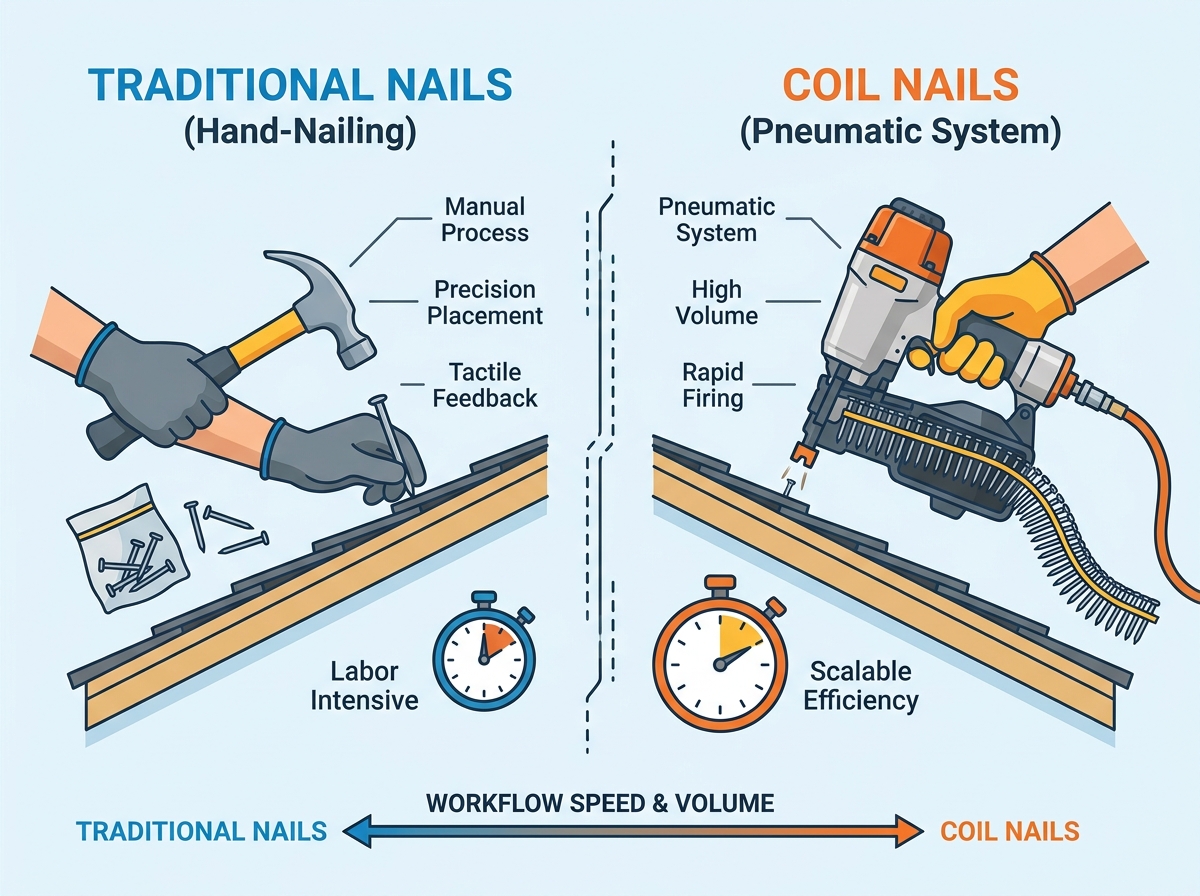
Speed is the most obvious advantage of pneumatic tools. Labor efficiency dictates your profit margin on residential replacements. The faster you finish a roof, the sooner you move to the next job.
Compare the volume and reload frequency of both methods. Hand-nailing requires constant reaching into a pouch. You must orient each fastener manually before striking. This micro-movement consumes valuable seconds. Alternatively, consider the continuous Coil nails roofing professionals rely on to finish squares rapidly. A single drum holds up to 300 fasteners. You can secure dozens of shingles without stopping. You eliminate the repetitive pouch-grabbing motion entirely.
We can quantify the potential man-hour returns easily. Consider a standard 30-square residential roof. A square equals 100 square feet. A 30-square roof requires roughly 2,400 standard architectural shingles. Most manufacturers mandate four fasteners per shingle. That equals 9,600 individual driving actions. Hand-nailing 9,600 times takes a skilled worker roughly 12 to 15 hours. A pneumatic tool reduces this driving time to just 4 or 5 hours. You save an entire working day of labor for a single installer.
Transitioning to pneumatic equipment fundamentally changes crew scalability. You can restructure your team dynamics. Follow these core steps to scale your crew efficiently:
Using this scaled approach, a three-person pneumatic team can match the daily output of a five-person hand-nailing crew. You reduce your daily labor payroll significantly while maintaining project momentum.
Speed means nothing if the installation violates building codes. Warranty compliance is a massive liability for roofing contractors. You must follow strict material and application standards to protect your business.
Manufacturer warranties contain strict clauses regarding fastener application. Poor placement or incorrect depth will void blow-off coverage instantly. Hand-nailing gives you precise depth control per strike. Pneumatic tools carry standardization risks. If your air pressure is too high, the tool over-drives the fastener. The metal head slices right through the shingle's fiberglass matting. This destroys the holding power. If the pressure is too low, it under-drives the fastener. A raised head lifts the overlapping shingle, creating a wind-catching gap. You must calibrate your compressor and tool depth perfectly.
Material standards are equally rigid. You cannot use just any fastener. Manufacturers dictate specific Coil nail sizes for different applications. Common lengths range from 1-inch to 1-3/4-inch. You choose the length based on shingle thickness and decking requirements. The point must penetrate the deck completely. If the deck is thick dimensional lumber, the point must embed at least 3/4 of an inch. ASTM standards also require a specific 11- or 12-gauge shank diameter. The broad head must measure exactly 3/8-inch across to provide adequate hold-down strength.
Corrosion resistance is another crucial compliance factor. Roofs endure extreme weather, moisture, and temperature fluctuations. Uncoated steel will rust, fail, and stain the roof. You have three main anti-corrosion options to consider.
| Coating Type | Manufacturing Process | Ideal Use Case & Compliance |
|---|---|---|
| Electro-Galvanized | Zinc layer applied via electrical current. | Standard residential roofs in dry or moderate inland climates. |
| Hot-Dipped Galvanized | Dipped in molten zinc for a thicker, textured coat. | High-humidity regions, long-term architectural shingle installations. |
| Stainless Steel | Solid corrosion-resistant alloy throughout the shank. | Coastal properties exposed to heavy salt spray. Often code-mandated. |
Both coil and traditional formats offer these corrosion-resistant variants. Always verify local building codes before ordering your materials. Coastal jurisdictions routinely reject standard electro-galvanized options during inspections.
Transitioning to pneumatic systems introduces new physical challenges. You must manage tool weight, site logistics, and mechanical maintenance. These realities affect your daily workflow significantly.
We must contrast the physical toll of both methods. A standard titanium or steel framing hammer is remarkably lightweight. It typically weighs between 14 and 22 ounces. You carry your fasteners in a waist pouch. This distributes the weight comfortably across your hips. Your arm swings freely without restriction.
A loaded pneumatic tool tells a different story. The gun itself weighs between 5 and 6 pounds. Once you load a full wire-collated drum, the weight increases. You must also factor in the trailing air hose. A heavy 50-foot rubber hose drags behind you constantly. It pulls downward on your wrist as you work. This sustained weight accelerates worker fatigue rapidly.
Fatigue becomes dangerous on steep pitches. Working on an 8/12 pitch or steeper requires intense physical balance. Holding a heavy pneumatic gun at awkward angles strains your shoulders. You must remain vigilant about hose placement to avoid tripping hazards. Hand-nailing provides much safer mobility on treacherous, high-pitch structures.
Mechanized tools inevitably fail. Traditional loose formats offer zero-downtime reliability. A hammer does not break down during a shift. You never wait for a hammer to build pressure.
Pneumatic systems introduce several downtime risks. You must actively maintain your equipment to keep production moving. Common failure points include:
A jammed gun halts production immediately. You must stop, unlatch the magazine, clear the jammed shank, and reset the coil. If your compressor dies, your entire crew stops working. You must have backup tools ready to mitigate these downtime risks.
Selecting the right fastening method requires careful financial evaluation. You must analyze upfront expenditures and ongoing material premiums. A clear decision matrix helps clarify the best investment for your specific business model.
First, analyze the initial capital expenditure. Purchasing a high-quality roofing hammer costs between $40 and $100. It requires zero supporting equipment. Moving to a pneumatic ecosystem demands serious capital. A professional-grade nailer costs $250 to $400. A reliable job-site air compressor runs $300 to $600. Add another $100 for high-quality polyurethane air hoses and quick-connect fittings. Outfitting a single worker can easily exceed $1,000 upfront.
Next, consider the per-nail cost differences. Manufacturing collated strips requires extra materials and complex machinery. Therefore, you pay a premium for wire-collated products. A 30-pound box of bulk loose fasteners is notably cheaper than an equivalent count of collated drums. Over the course of a busy roofing season, this material premium adds up to thousands of dollars. You must offset this premium through increased labor speed.
We can establish a clear shortlisting logic. Use this operational decision matrix to finalize your strategy:
| Choose Traditional Bulk Nails If: | Choose Pneumatic Coil Nails If: |
|---|---|
| You are tackling small storm damage repairs or missing shingle patches. | You run a commercial crew executing multiple full-roof replacements weekly. |
| You are detailing complex flashing, ridge vents, or working in tight obstructed spaces. | You want to scale your business operations where labor speed dictates profit margins. |
| You are operating on a strict, low-capital budget and cannot afford compressor setups. | You have the infrastructure to transport, secure, and maintain heavy job-site compressors. |
The roofing industry relies on both fastening methods for different reasons. Traditional bulk methods remain absolutely essential for localized precision work. Hand-nailing allows intricate control around delicate flashing and high-pitch valleys. However, the pneumatic approach is the undeniable industry standard for scalable, profitable roofing operations. The massive reduction in labor hours easily justifies the premium material costs and equipment maintenance.
Your next step is to audit your upcoming project volume. Evaluate your current crew size and daily output goals. Verify local building code requirements regarding corrosion resistance and fastener gauge. By aligning your tool investments with your true operational volume, you ensure optimal installation quality and maximum profitability.
A: No, they are not interchangeable. Roofing tools use a 15-degree drum magazine to hold specialized short fasteners with large 3/8-inch heads. Framing tools use angled stick magazines for long, narrow-headed fasteners. Using a framing gun on asphalt shingles will drive the narrow head straight through the fragile fiberglass mat, destroying it instantly.
A: The tool itself does not cause blow-off. Blow-off results from operator error. If you set the depth-of-drive too deep, the fastener slices the shingle mat. If set too shallow, the raised head catches the wind. Proper compressor calibration and accurate placement prevent blow-off entirely.
A: Standard lengths range from 1 inch to 1-3/4 inches. The length you need depends on the combined thickness of the shingles and the decking. The industry standard requires an 11-gauge or 12-gauge shank diameter and a flat 3/8-inch diameter head to ensure proper hold-down strength.
A: Yes, you absolutely should. Stainless steel is often legally mandated for coastal roofing. Salt-spray environments rapidly corrode standard electro-galvanized steel. Using stainless steel prevents premature fastener failure, stops rust bleeding on the shingles, and ensures you pass rigorous coastal building inspections.


