
Views: 0 Author: Site Editor Publish Time: 2026-07-07 Origin: Site
Selecting the wrong fastener introduces structural vulnerabilities, alignment issues, or unnecessary weight into engineered assemblies. You cannot always rely on standard hex nuts when working in restricted clearances. Parallel fastening also fails to handle perpendicular load paths effectively. A standard nut drives parallel to the bolt axis and sits externally, clamping directly on the component surface. In contrast, a Barrel Nut—often called a cross dowel—acts as an internally threaded dowel. It sits perpendicular to the bolt deeply within the material itself.
This guide evaluates the mechanical differences, material considerations, and specific application criteria for choosing between a standard nut and a barrel nut. You will learn how to verify load distribution and avoid common installation failures. We will help you ensure structural integrity and compliance with strict project tolerances.
Understanding the mechanical properties of your fastening hardware ensures you avoid premature joint failure. The fundamental difference between these two fasteners lies in their load path and orientation relative to the substrate.
A standard nut mounts externally. Installers require direct physical access to the protruding bolt thread to secure the joint. The mechanism relies entirely on the clamping force generated between the nut face and the substrate surface. As you tighten the bolt, the axial tension compresses the joined materials together.
Despite their ubiquity, standard nuts carry specific mechanical limitations. First, they require sufficient external clearance for wrenches, sockets, or driver tools. You must leave room around the fastener to apply adequate torque. Second, standard nuts create a raised profile. This external protrusion disrupts aerodynamic surfaces and interferes with tightly packed internal components.
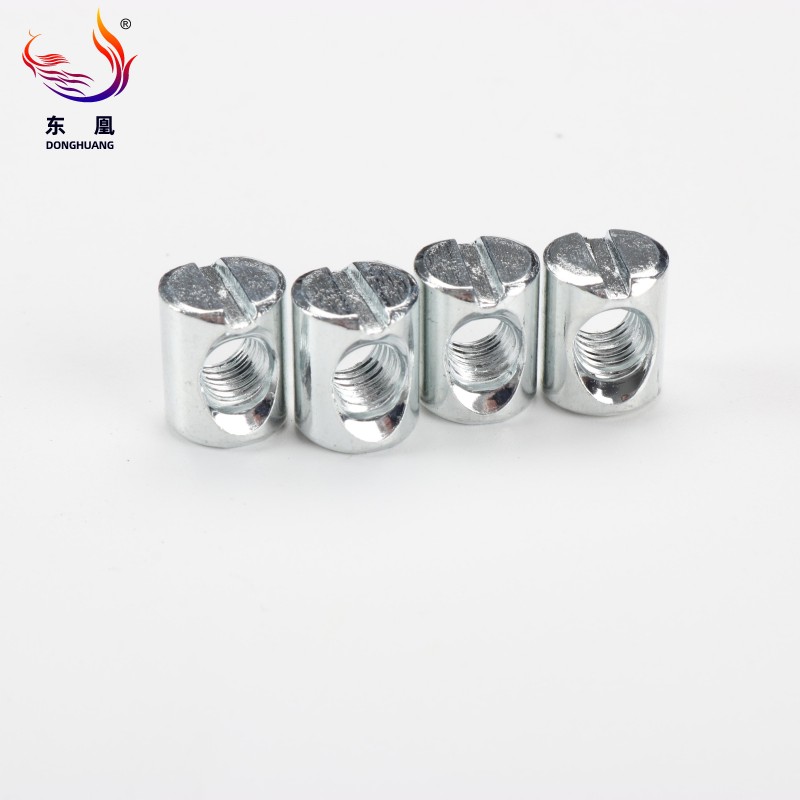
The anatomy of a Barrel Nut solves clearance and alignment problems through internal anchoring. It features a solid cylindrical shape designed for insertion into a pre-drilled transverse hole. The matching bolt intersects the barrel nut exactly at a 90-degree angle.
This perpendicular intersection offers a massive structural advantage. It transfers the clamping force internally, anchoring the connection deep within the component. Instead of crushing the outer layer of the material, the cylindrical body distributes the tensile load across a much larger internal surface area. This anchoring method significantly reduces surface deformation on the exterior and maintains a completely smooth surface profile.
To summarize the mechanical distinctions, review the following comparison chart:
| Feature | Standard Nut | Barrel Nut |
|---|---|---|
| Installation Location | External surface | Internal transverse hole |
| Thread Orientation | Parallel to the bolt | Perpendicular to the bolt |
| Load Distribution | Concentrated at the surface face | Distributed across internal cylinder |
| Tool Clearance | Requires external wrench access | Requires internal alignment access |
Engineers must follow a rigorous evaluation framework before specifying fastener types. Switching from standard hardware to internal cross dowels requires specific application drivers. You must assess space constraints, load profiles, and aesthetic goals to justify the engineering shift.
You should use barrel nuts when external protrusions violate rigid design envelopes. Modern engineering often demands perfectly flush surfaces. For example, drone chassis designs rely on smooth exteriors to minimize drag and improve battery efficiency. Aerospace joints require streamlined profiles to maintain aerodynamic stability. Firearm handguards utilize internal fastening to give operators a smooth, snag-free grip surface. In these scenarios, a raised hex nut becomes an unacceptable design flaw.
You must assess the material fatigue limits of your housing components. Fasteners fail when the applied tensile forces exceed the compressive strength of the surrounding substrate. Barrel nuts excel in high-tension environments because they distribute tensile forces over a larger cylindrical area inside the material.
This internal load distribution prevents the bolt from tearing through composites, plastics, or softwoods. When a standard nut pulls against a soft surface, it often crushes the material. The transverse dowel design mitigates this localized stress, allowing you to apply higher torque values safely.
Beyond structural mechanics, visual design heavily influences hardware selection. Internal fasteners remain ideal for consumer-facing assemblies where hardware must stay hidden. Flat-pack furniture heavily relies on this technology to provide strong joints without exposing ugly threaded rods. Consumer electronics use micro-barrel nuts to secure chassis halves without snagging on clothing or hands.
To successfully integrate this hardware into your assembly, you must verify three specific criteria:
Selecting the correct base material ensures long-term joint stability. The choice typically comes down to steel versus aluminum. You must balance thermal expansion rates, overall weight, and maximum shear strength based on the operating environment.
Steel remains the dominant choice for heavy-duty structural applications. High-carbon and stainless steel variants provide unmatched durability in high-stress environments.
Aluminum provides an excellent alternative when weight reduction drives the engineering requirements. Aerospace-grade aluminum alloys deliver a high strength-to-weight ratio while maintaining natural elemental protections.
Engineers often debate which internal fastener provides the best transverse joint security. While insert nuts and T-nuts offer hidden fastening solutions, their mechanical properties differ wildly significantly from the perpendicular dowel design.
Installers drive insert nuts externally into a pre-drilled pilot hole. Their grip relies entirely on exterior biting threads cutting into the host material. Woodworkers and plastic molders frequently use them for quick assembly.
Verdict: Insert nuts carry a high risk of pull-out under dynamic tension. Because the exterior threads only bite into a few millimeters of material, heavy vibration easily strips the insert out of the hole. You should reserve them strictly for static, low-load applications.
T-Nuts feature a flat flange with metal prongs. Installers hammer them into the back of a material. The bolt threads through the front, pulling the flange tightly against the rear surface. They rely strictly on the material's compressive strength.
Verdict: T-Nuts remain highly prone to unseating if the bolt is pushed rather than pulled. Any reverse force instantly knocks the T-nut out of its seating. They offer zero resistance to sheer forces.
The perpendicular design fundamentally alters the failure mechanics of the joint. By embedding a solid metal cylinder horizontally across the bolt path, you create a physical barrier deep within the substrate.
Verdict: This hardware offers the highest mechanical lock of the three for transverse joints. The perpendicular cross-dowel design makes pull-out physically impossible without catastrophic failure of the surrounding material. The bolt would have to shear the solid metal dowel in half or tear completely through the entire thickness of the housing block.
Even the strongest hardware fails if installed improperly. Internal fastening requires high-precision manufacturing. You must carefully manage alignment, blind installation procedures, and torque limits to ensure success.
The primary failure point in Barrel Nut installation is poor transverse hole alignment. The intersecting holes must meet exactly at 90 degrees. A misalignment of even a fraction of a millimeter creates severe problems. The bolt will strike the internal threads at an angle, which immediately causes cross-threading or bolt shearing. Manufacturers must use precise drill guides, CNC routing, or strict fixturing jigs to maintain these tight tolerances.
Because these nuts sit completely hidden within the material, installers face significant blind installation challenges. You cannot see the internal threads once you drop the nut into the transverse hole.
Best Practice: Installers must use slotted heads or alignment marks machined onto the exposed end of the cylinder. By inserting a flathead screwdriver into the slot, you can perfectly align the internal threads to face the incoming bolt path. Never force a bolt if you feel immediate resistance.
Applying the correct amount of rotational force guarantees joint longevity. Many installers make the critical mistake of treating internal fasteners like external hex nuts.
Common Mistake: Avoid over-torquing the joint. While the internal steel dowel might withstand heavy torque, over-tightening easily crushes the surrounding housing material. If you compress the wood, plastic, or soft aluminum housing, the joint becomes permanently loose.
Best Practice: Always use an accurate torque wrench. Furthermore, use appropriate, application-specific thread-locking compounds. Liquid thread lockers prevent the bolt from backing out in high-vibration scenarios without requiring destructive levels of initial torque.
Selecting the right fastening methodology dictates the ultimate lifespan of your engineered assembly. Defaulting to a standard hex nut remains sufficient for basic, exposed joints where clearance is unlimited. However, when project requirements dictate flush mounting, internal load distribution, or strict aerodynamic limits, the barrel nut stands out as the structurally superior choice.
To implement this hardware successfully, take action on the following next steps. First, review your CAD drawings to verify internal clearance tolerances and transverse hole alignments. Second, evaluate your expected load paths to ensure the housing material can withstand the distributed tensile forces. Finally, request detailed material specification sheets—comparing steel versus aluminum—from your fastener supplier. Validating your maximum torque limits before large-scale procurement prevents costly manufacturing failures.
A: Yes, in most manufacturing and furniture-building contexts, "cross dowel" is simply the colloquial term for a barrel nut used in transverse joints.
A: It depends on the material grade and the surrounding housing. While the barrel nut itself can be machined to handle high torque, the limiting factor is usually the compressive strength of the material it is seated inside.
A: They provide a secure, low-profile method to mate the barrel to the upper receiver while allowing a handguard to slip completely over the joint without interference from protruding fastener heads.

