
Views: 0 Author: Site Editor Publish Time: 2026-07-05 Origin: Site
Securing perpendicular joints presents a tough engineering challenge. You need incredibly strong connections. You must avoid protruding hardware entirely. You cannot compromise host material integrity. Enter the Barrel Nut. Many professionals also call it a cross dowel or steel dowel. It serves as an internally threaded, cylindrical fastener. It works seamlessly alongside a mating machine bolt to anchor perpendicular structures securely.
Choosing the correct fastening hardware requires more than a simple visual check. Evaluating these cylindrical fasteners against alternative options requires deeper engineering analysis. We must understand exact load-bearing requirements first. You must evaluate material compatibility thoroughly. You also need to factor in daily assembly-line realities. We will explore how these robust fasteners solve complex manufacturing problems. You will learn how to select the right specifications to ensure lasting structural integrity for your next critical project.
Engineers constantly battle material failure at connection points. Traditional screws rely entirely on thread bite. This creates significant vulnerabilities in softer substrates. Cylindrical dowels offer a superior mechanical solution.
Standard fasteners concentrate stress into a tiny footprint. This narrow stress point causes massive problems. Soft substrates like medium-density fiberboard (MDF) tear out easily under heavy stress. Cylindrical shapes change this dynamic completely. They distribute clamping force evenly over a much larger internal surface area. The metal body acts as a physical barrier against the wood grain. This prevents material failure during high-stress perpendicular loading. You gain maximum joint rigidity without risking structural blowout.
Exposed hardware creates dangerous snag hazards. It also ruins clean design lines. Modern industrial design demands sleek aesthetics. By keeping hardware entirely flush inside the material, you improve safety immediately. The cylindrical body slides neatly into a pre-drilled bore. It remains completely hidden from the outside face. This concealed approach protects the joint from external tampering. It also prevents environmental debris from compromising the threads over time.
Standard wood screws degrade host threads very quickly. Repeated assembly destroys the joint entirely. Host materials simply cannot survive constant thread friction. Conversely, metal-on-metal connections handle repeated disassembly effortlessly. The bolt threads strictly into the steel cylinder. It never grinds against the surrounding wood or composite. This mechanism preserves the host material completely. It allows unlimited assembly cycles without losing clamping force.
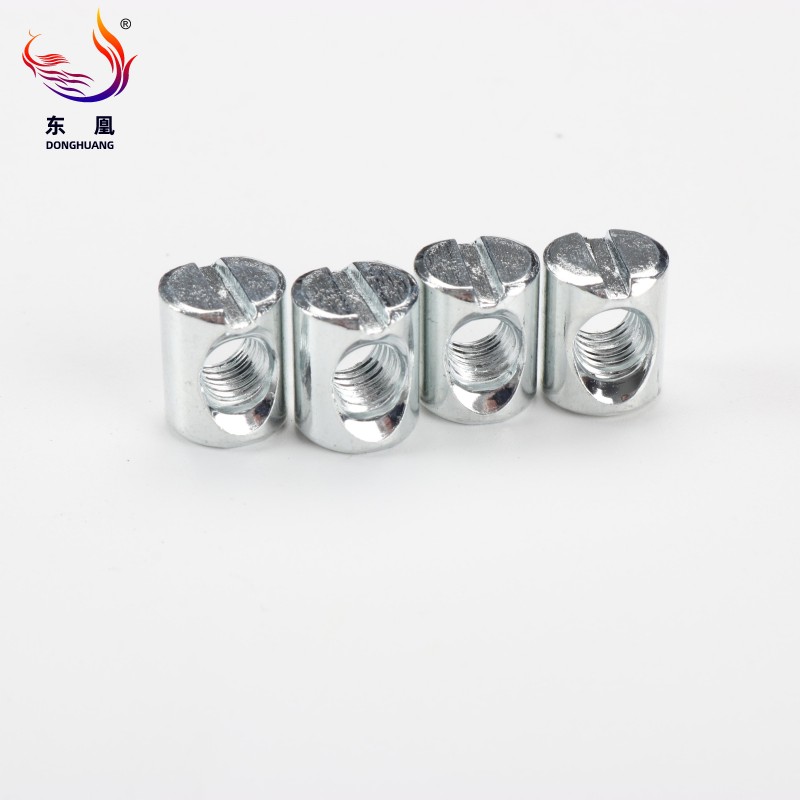
Different industries leverage these versatile fasteners for highly specific reasons. Their unique geometry solves distinct challenges across diverse manufacturing sectors.
The furniture industry relies heavily on cross dowels. You will find them in beds, cribs, cabinets, and modular shelving units. Flat-pack designs require extreme user-friendliness. Consumers must assemble these items quickly at home.
Success criteria in this sector revolve around speed. The hardware must guarantee structural rigidity immediately. It must also resist loosening over time. Beds and chairs endure constant dynamic movement. Standard screws strip out quickly under these conditions. The solid steel cylinder handles dynamic sheer forces flawlessly. This ensures long-term stability for consumer goods.
Aerospace manufacturing demands absolute perfection. Engineers use specialized alloys for aircraft interior assembly. They secure critical mechanical joints where traditional tool access remains physically blocked. Aircraft frameworks feature tight corners and complex geometries.
Success criteria here focus on weight reduction. Extreme tensile strength is also mandatory. Components must adhere strictly to strict compliance standards like ASME and ISO. High-tension machinery utilizes these fasteners to endure massive vibrational loads. The encapsulated design prevents the hardware from vibrating loose during flight operations.
Robotics engineers build dynamic, moving mechanisms constantly. They use these fasteners for securing chassis parts. They also secure framing and movable joints in custom engineering environments. Modular robotics require frequent recalibration.
Success criteria emphasize vibration resistance heavily. Engineers need the ability to frequently swap parts. They must do this without stripping threads. Metal-on-metal fastening provides the necessary durability. Engineers can disassemble a robotic arm hundreds of times. The internal structural integrity remains completely unchanged.
| Industry Sector | Primary Use Case | Critical Success Metric | Typical Material Grade |
|---|---|---|---|
| Woodworking | Modular Shelving, Beds | Assembly Speed, Reusability | Zinc-Plated Steel |
| Aerospace | Interior Panels, Blind Joints | Tensile Strength, Weight | Titanium, Stainless Steel |
| Robotics | Chassis, Moving Joints | Vibration Resistance | Hardened Alloy Steel |
Selecting the correct fastening method requires strict comparative analysis. We must evaluate cylindrical dowels against three common alternatives.
Threaded insert nuts rely on external threads. These threads bite directly into the surrounding material. This creates a high risk of pull-out under heavy tension. If the host material weakens, the insert rips out entirely. It destroys the workpiece in the process.
Cylindrical dowels behave differently. They rely on the physical block of the solid metal cylinder. This solid block cannot pull through the material laterally. This delivers a vastly superior perpendicular load limit. They excel in high-tension applications where inserts routinely fail.
T-nuts offer excellent performance for through-hole compression. They feature a flat flange. This flange distributes pressure well. However, they often protrude slightly above the surface. Furthermore, pushing a bolt backward can easily dislodge the T-nut. It pops right out of its seating.
Cylindrical options remain entirely encapsulated. Once inserted into the bore hole, they cannot pop backward. They stay completely flush. They offer superior security against accidental dislodgment during complex assemblies.
Traditional hex nuts require specific tool access. You need wrench clearance on both sides of the joint. Many complex assemblies feature blind joints. You simply cannot reach the back side to hold a hex nut.
Cylindrical fasteners eliminate this problem. They only require edge access for the mating bolt. You only need face access to drop the cylinder into its hole. This makes them absolute ideal choices for blind joints. They streamline the assembly process significantly.
| Feature | Barrel Nut | Threaded Insert | T-Nut | Hex Nut |
|---|---|---|---|---|
| Pull-Out Resistance | Very High | Moderate | High (One Direction) | Very High |
| Blind Joint Capable | Yes | Yes | No | No |
| Surface Finish | Flush/Hidden | Flush | Slight Protrusion | Protruding |
| Drilling Precision Required | High | Low | Low | Low |
Purchasing the correct hardware demands strict attention to physical specifications. You must align your procurement criteria with your specific engineering environment.
Material grade determines longevity. You must match the alloy to the environmental conditions.
Precision sizing prevents joint failure. You must match the internal thread accurately to the mating machine screw. Mixing metric bolts with imperial threads causes immediate cross-threading. This destroys the fastener instantly.
Consider the thread pitch carefully. Coarse threads assemble faster. They resist cross-threading better in fast-paced environments. Fine threads offer superior tension adjustment. They work better in high-vibration applications. Proper matching prevents galling. Galling occurs when friction welds the bolt and nut together permanently.
Drive types dictate assembly speed. You must evaluate which slot type works best for proper alignment.
Many buyers ignore the cylinder length. If the cylinder is too short, it crushes the wood fibers. If it is too long, it protrudes and catches on moving parts. Always measure your exact material thickness before ordering.
Even the best hardware fails if installed incorrectly. Manufacturing floors must prepare for specific implementation challenges. Understanding these risks prevents costly production delays.
Alignment represents the primary installation risk. Cross-threading occurs easily. It happens due to slight misalignment between the intersecting bolt hole and the cylinder hole. If the bolt enters at a slight angle, it destroys the internal threads immediately. The operator must ensure perfect perpendicular entry. Blind joints make this visual confirmation difficult. The slot on the top of the cylinder becomes your only alignment guide.
Manual drilling rarely achieves necessary accuracy. Precision tooling is entirely non-negotiable. You must utilize specialized drilling jigs. Drill presses ensure the intersecting holes meet at perfect 90-degree angles. If holes deviate by even a fraction of a degree, the bolt will miss the internal threads entirely. Standard hand drills introduce too much human error. Consistent manufacturing requires rigid fixtures to guide the drill bits accurately.
Some environments feature looser manufacturing tolerances. Perfect 90-degree holes remain impossible to guarantee. You must adapt your hardware selection accordingly.
We recommend specifying fasteners with off-center threads. Elongated bodies also provide a safety margin. These design variations accommodate slight misalignments gracefully. They allow the bolt to catch the threads even if the intersecting angle deviates slightly. This reduces assembly line frustration. It also lowers the scrap rate for cross-threaded components significantly.
Barrel nuts serve as the definitive choice for high-strength, reusable joints. They excel in creating secure right-angle connections. They perform flawlessly in materials highly prone to tear-out. By distributing loads safely, they protect soft substrates from catastrophic failure.
Before proceeding, audit your specific load limits carefully. Evaluate your internal drilling precision capabilities realistically. Always request official material specification sheets to verify alloy grades. Doing this prevents hardware failure down the line.
Ready to upgrade your assembly process? Contact a trusted fastening specialist today. Explore specialized catalogs of zinc-plated and stainless steel cylindrical fasteners to secure your next major manufacturing project.
A: Use a flathead screwdriver. Insert it into the slotted end of the cylindrical body. Rotate it slowly until the internal threads visually align perfectly with the perpendicular bolt channel. This ensures the mating bolt engages smoothly without cross-threading.
A: They are highly effective in metalworking. Aerospace and automotive sectors use them extensively. They secure thick metal plates in tight spaces where a standard hex nut cannot physically fit due to tool clearance limitations.
A: There is no functional difference. They are the exact same fastener. Woodworkers commonly use the term "cross dowel." Conversely, engineers in metalworking and aerospace generally prefer the term "barrel nut."
A: You must capture three critical measurements using calipers. First, measure the overall cylinder length. Second, measure the outside cylinder diameter. Finally, identify the thread size and thread pitch of the internal tapped hole.

